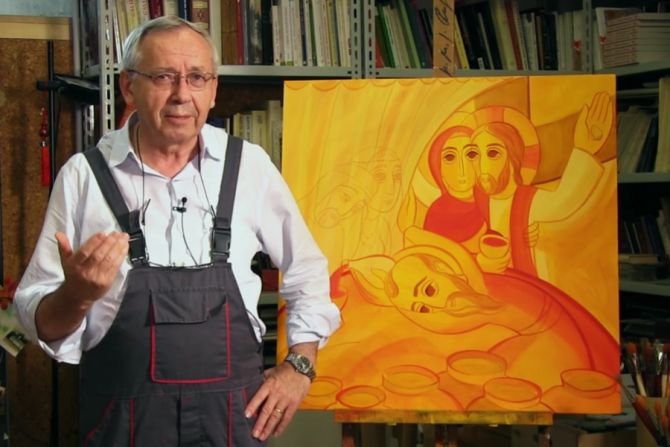
Father Marko Rupnik concelebrated Mass at a basilica in Rome on Sunday despite restrictions prohibiting “any public ministerial and sacramental activity.”
The Jesuit priest and artist who has been accused of sexually and psychologically abusing consecrated women stood at the altar of the Basilica of Santa Prassede, a historic church popular with pilgrims located near the Basilica of St. Mary Major, at the 9 a.m. Sunday Mass on March 5, according to the Italian newspaper Domani.
When asked about the Mass, Rupnik’s superior, Jesuit Father Johan Verscheuren, said that Rupnik is only allowed “to concelebrate Masses in the context of the Aletti Center, which is his inner circle, his community.”
In comments to ACI Prensa, CNA’s Spanish-language sister news agency, Verscheuren said that he had not been able to confirm the Italian media reports and preferred “not to make judgments about things that I am not absolutely sure about.”
Rupnik founded the Aletti Center, a school dedicated to the promotion of religious art in Rome, after his years in the Loyola Community of Slovenia, where he has been accused of abusing consecrated women.
Members of the Aletti Center were present at the Sunday Mass in the Roman basilica this week, which was also open to the public, according to ACI Prensa.
The Jesuit order has received accusations against Rupnik that span from 1985 to 2018 and include claims of spiritual, psychological, and sexual abuse, and abuse of conscience.
According to current restrictions imposed by the Jesuit order, Rupnik is prohibited “from any public ministerial and sacramental activity,” banned from public communication, ordered not to leave Lazio, and “may not engage in any public artistic activity, especially in relation to religious structures (such as churches, institutions, oratories and chapels, exercise or spirituality houses).”
In addition to the Mass on Sunday, Italian media have also reported that Rupnik spoke on Jan. 22 to a visiting group at the Archbasilica of St. John Lateran about his work renovating mosaics in the chapel of the Pontifical Roman Major Seminary.
Verscheuren told ACI Prensa that when the Jesuit order’s restrictions are violated, “a dismissal procedure for reasons of disobedience comes into action.”
“This is a procedure that takes several steps (and time), and the acts of disobedience must occur several times in succession before it can lead to a removal,” he said.