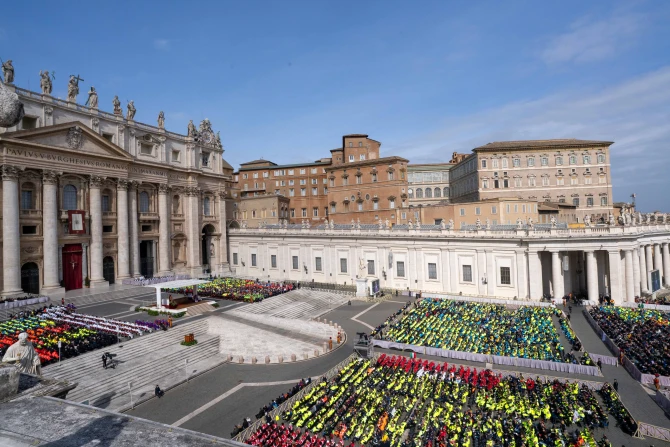
With the aim of improving the experience of pilgrims traveling to Rome to participate in the 2025 Jubilee Year of Hope, the Fabric of St. Peter has led various restoration and innovation projects.
The Fabric of St. Peter is the office that oversees the conservation and maintenance of St. Peter’s Basilica and the surrounding area.
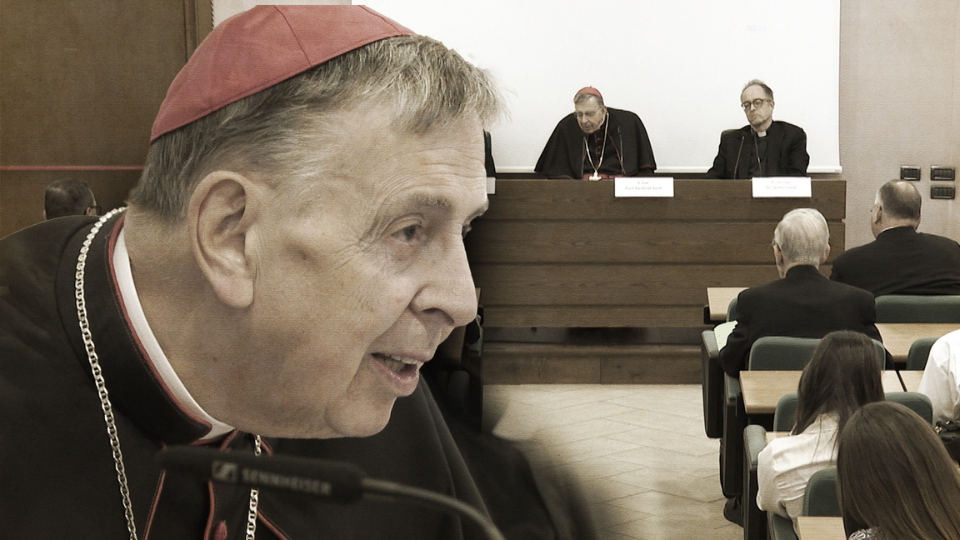
A press conference was held to present the restoration work as well as the technological and security implementation — which includes a new evacuation plan for St. Peter’s Basilica.
Specifically, conservation work has been done on the monuments that house the tombs of popes Paul III and Urban VIII. Rehabilitation work has also been carried out to illuminate the necropolis as well as the archaeological rooms and the Vatican grottoes.
A new evacuation plan has also been established, created thanks to the synergy between the Italian Fire Department and that of the Governorate of Vatican City State.
Cardinal Mauro Gambetti, archpriest of the papal basilica of St. Peter in the Vatican, explained at the briefing that the work seeks to “respect the faith” of the pilgrims and visitors who pass through the doors of the basilica.
St. Peter’s receives 12 million visitors each year. Therefore, according to Gambetti, it needs to “guarantee safety and make everyone feel protected.”
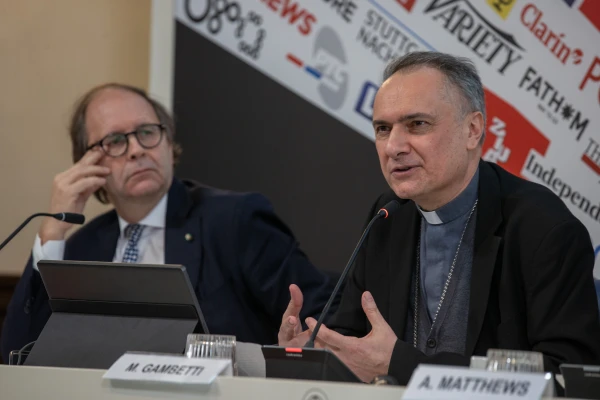
Thus, the new evacuation plan for the church “is a concrete expression of that pastoral concern that cares for the well-being of every member of the faithful and visitor.”
In this context, he specified that “better management and streamlining of the exit flows will guarantee greater convenience and safety.”
“We want to give back what has been given to us and what this place of the Spirit has bequeathed to us over the centuries, especially in this jubilee year,” he emphasized.
The restoration and conservation work, according to the cardinal, “reveals itself as gestures of light and memory that accompany the pilgrim in an experience of contemplation, faith, and beauty.”
To also offer an “immersion in history and a profound experience of the sacred,” renovations have been carried out at the archaeological sites, just as they were seen by the early Christians and the popes of past centuries, “in a splendor of ‘chiaroscuro’ [contrasting light and shadow] evoking the light of the torches that illuminated the birth of the Church and our own journey,” he explained.
The cardinal also expressed his gratitude for the collaboration of the benefactors: the Knights of Columbus, who participated in the restoration of the necropolis, and the Safavi Philanthropic Institute, which contributed to the enhancement of the Vatican grottoes.
Reducing risks in critical situations
Stefano Marsella, central director of Technological Innovation and Logistics Resources for the Italian Fire Department, also participated in the press conference.
Marsella emphasized that this new emergency plan is designed to “reduce risks in critical situations, both during the jubilee religious events and on days of high and constant flow of pilgrims and tourists.”
He also specified that training activities will be carried out thanks to an “exhaustive study of the evacuation routes within the basilica.”
The work began with the use of high-precision laser scanner systems by National Fire Department personnel to create a three-dimensional design with millimeter accuracy of almost the entire basilica.
This allowed them to accurately reproduce the site and verify some key details for the simulation without the need for constant on-site inspections.
Specialized software was then used to simulate in detail the behavior of people and the characteristics of the environment, “which made it possible to analyze the fluidity of movement toward the exits and identify critical points that could slow down evacuation in the event of an emergency,” as well as identify areas where dangerous bottlenecks occur, he explained.
Transforming a historic space into a safer place
Among the key aspects that emerged from the study, “the elimination of physical and other barriers stands out, which led to the replacement of steep steps with ramps, in order to reduce risks and make the basilica more accessible to all, including people with disabilities or reduced mobility,” the central director added.
The proposed modifications also significantly reduce the time required to evacuate the basilica, significantly improving previous procedures.
“The goal has been to transform a historic, yet complex, space into an even safer place for the millions of faithful and visitors each year, using innovative technology and meticulously designed plans,” he said.
This story was first published by ACI Prensa, CNA’s Spanish-language news partner. It has been translated and adapted by CNA.