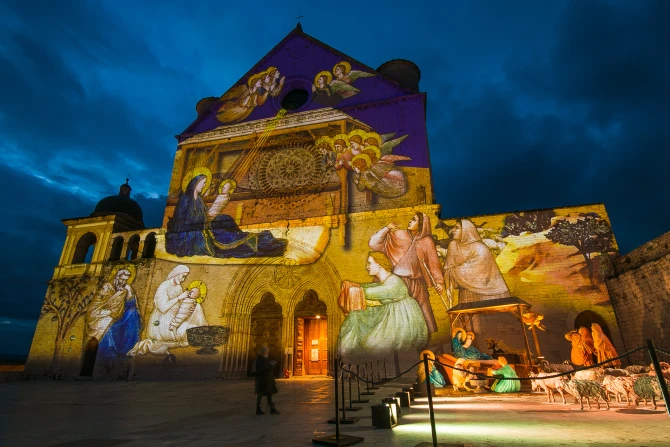
It’s a well-known origin story: how the young and wealthy Francis of Assisi freely abandoned his noble patrimony to serve Christ’s Church as a poor, itinerant preacher.
One of the world’s most beloved saints, the founder of the Franciscan order cared deeply for God’s creation. He also loved Christmas, the solemnity of the Nativity of the Lord.
St. Francis’ meditations on the life of Christ led him to create the first-ever Nativity scene in Greccio, Italy, in 1223.
From the Holy Land to Italy
It is believed Francis’ inspiration to do a live representation of the birth of Jesus came from his time in the Holy Land in the years 1219 and 1220.
Seeing the holy sites of Christ’s birth, life, death, and resurrection made them feel all the more real — and he wanted to recreate that experience.
In November 1223, three years before his death, St. Francis was in Rome to await the pope’s approval of the final rule of his friars.
The friar and deacon was already very familiar with the hill town of Greccio, about 50 miles north of Rome. He had first arrived there over a decade prior and would frequently return to preach to the people of the surrounding countryside.
Eventually, a hermitage was built for St. Francis a short distance outside the town.
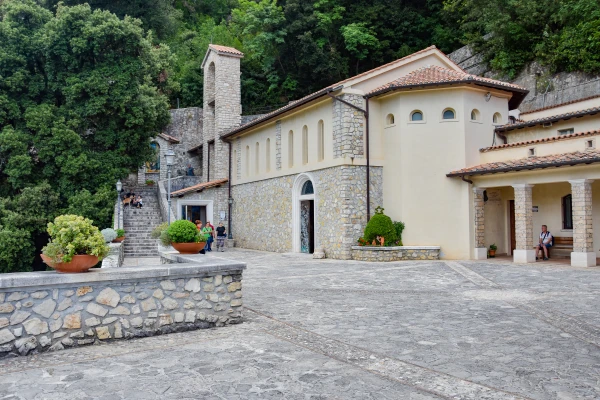
Ahead of his return to the hermitage, two weeks before Christmas, Francis asked his friend, Lord of Greccio Giovanni Velita, to prepare a cave with live animals and a hay-filled manger.
The friar had, during his audience with the pope, already received permission to stage the scene of Jesus’ birth in Bethlehem.
According to the first biographer of St. Francis, Brother Thomas of Celano, the friar desired to “re-present the birth of that Child in Bethlehem in such a way that with our bodily eyes we may see what he suffered for lack of the necessities of a newborn babe and how he lay in a manger between the ox and ass.”
That was how, in December 1223, in the rocky crags a short distance outside Greccio, people flocked to see the simple scene during Christmas Mass.
St. Francis, who was a deacon, proclaimed the Gospel and preached the homily.
According to accounts of the moment, fires lit the dark scene while crowds arrived at the spot carrying candles and torches.
An eyewitness says a miracle happened at Mass that night.
Giovanni Veleti asserted that he saw a real infant appear in the empty manger and that St. Francis took the beautiful child into his arms, holding him to his chest in an embrace.
In the period that followed, other miracles were reported, brought about by touching the straw of the manger where the Child Jesus had appeared.
Miraculous healings took place after pieces of hay were placed on sick animals or laboring women in difficulty.
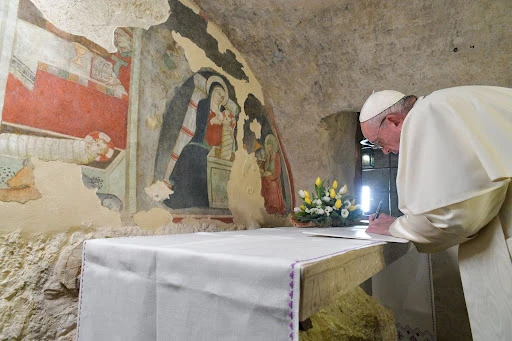
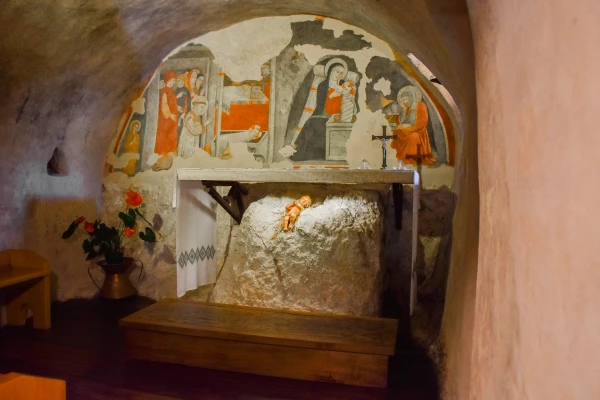
Greccio today
The place where the first Nativity was staged can still be seen today in the Franciscan hermitage and sanctuary outside the main town. The rock is topped by an altar for celebrating Mass and adorned with frescoes depicting Jesus’ birth.
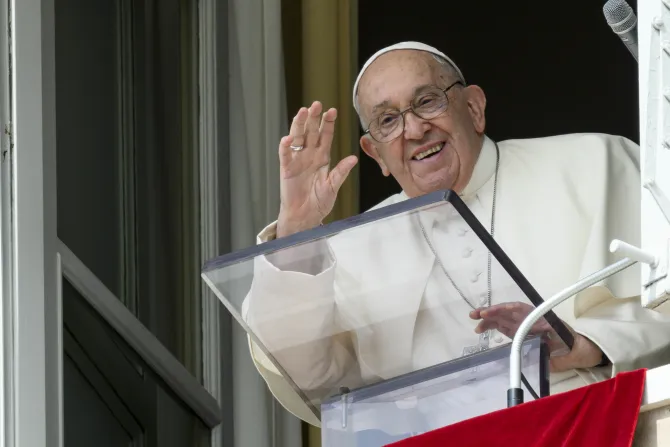
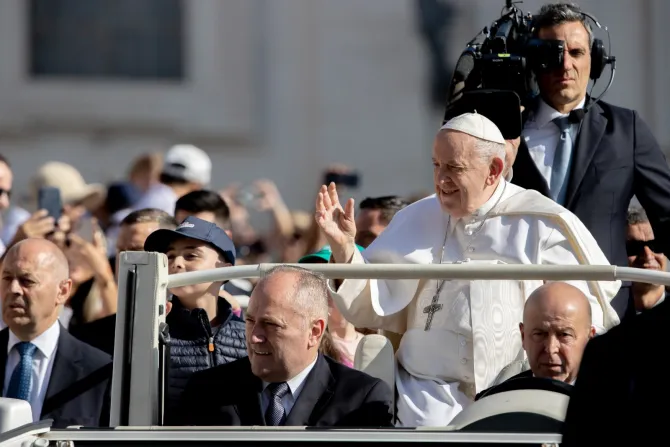
Pope Francis visited the spot two times: once in 2016 and again on Dec. 1, 2019, when he signed an apostolic letter on the meaning and importance of Nativity scenes.
“All those present” at St. Francis’ Christmas Mass, Pope Francis wrote in Admirabile Signum, “experienced a new and indescribable joy in the presence of the Christmas scene. The priest then solemnly celebrated the Eucharist over the manger, showing the bond between the incarnation of the Son of God and the Eucharist. At Greccio there were no statues; the Nativity scene was enacted and experienced by all who were present.”
Every year at Christmas, the people of Greccio stage a live, historical reenactment of St. Francis and the first Nativity scene. The performance is now in its 50th year.
This story was first published on Dec. 23, 2022, and has been updated by CNA.