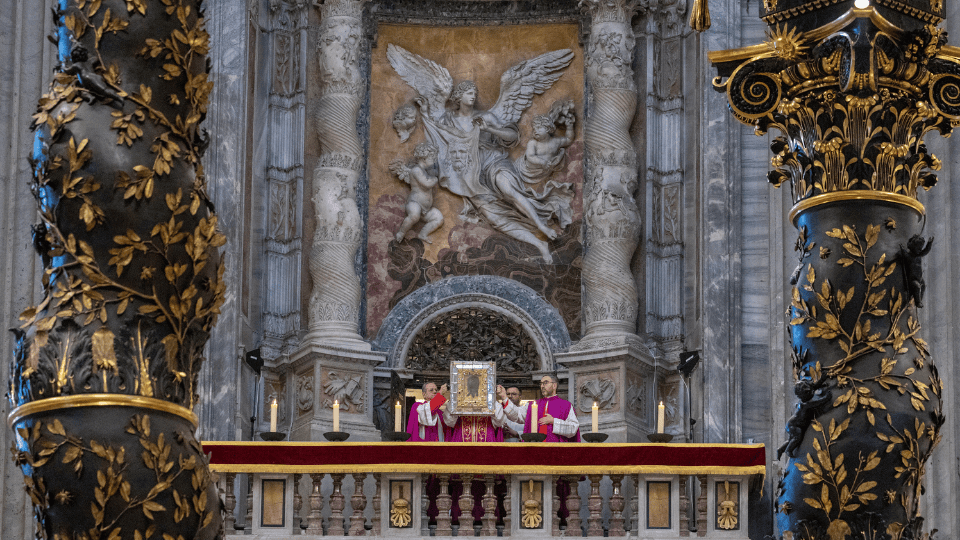
On Sunday, April 6, the fifth Sunday of Lent, St. Peter’s Basilica displayed the revered “Veronica’s Veil,” a cloth that, according to tradition, was used to wipe the face of Jesus on his way to Calvary, renewing a very ancient tradition of the Catholic Church.
At 6 p.m. local time, while the litanies are intoned, the faithful processed through the naves of the basilica, entering through the Holy Door. From the Veronica loggia, the relic, also known as the Holy Face, is then displayed in an extraordinary liturgy.
Afterward, the archpriest of St. Peter’s Basilica, Cardinal Mauro Gambetti, celebrated a Mass with the canons and concelebrant priests participating.
But what exactly is this relic, and why has it attracted more and more people for centuries?
The relic is referenced in the sixth station of the Way of the Cross, where a woman named Veronica wipes the face of Jesus with a cloth as he carries the cross to Calvary.
According to tradition, this cloth bears the true image of Christ’s face.
The woman who wiped Jesus’ face is commonly known as Veronica, derived from the Latin “vera icona,” meaning “true icon.” It is believed that Christ’s image was imprinted on the veil on his way to the cross. The cloth itself is also named Veronica.
Along with a relic of the cross and the relic of the lance of St. Longinus, the Veil of Veronica occupies a place of great importance within St. Peter’s Basilica. According to tradition, Longinus was the soldier who pierced Christ’s side.
The cloth, linen, or veil of Veronica (or simply Veronica) is normally kept in a chapel that lies behind a balcony above a colossal statue of the saint by Francesco Mochi situated in an alcove that is part of one of the piers supporting the dome.
Although the account of Veronica does not appear in the Gospels, she was later associated with the woman with a hemorrhage who was cured by Jesus. The apocryphal book of the Acts of Pilate (sixth century) also speaks of a woman, known as Veronica, who wiped Christ’s face with a veil as he made his way to Calvary.
This story was first published by ACI Prensa, CNA’s Spanish-language news partner. It has been translated and adapted by CNA.