Because it falls exactly six months before the solemnity of the Nativity of Our Lord, John the Baptist’s birthday is sometimes known as “Summer Christmas.”
St. John the Baptist, the forerunner of Christ, is one of only three people in history — after Jesus and Mary — whose birthday is celebrated in the Church’s liturgy.
In fact, the Nativity of St. John the Baptist on June 24 is a solemnity, meaning it is the highest form of Catholic feast day. And because it falls exactly six months before the solemnity of the Nativity of Our Lord, it is sometimes known as “Summer Christmas.”
“The Church observes the birth of John as in some way sacred; and you will not find any other of the great men of old whose birth we celebrate officially. We celebrate John’s, as we celebrate Christ’s,” St. Augustine of Hippo said in his sermon 293.
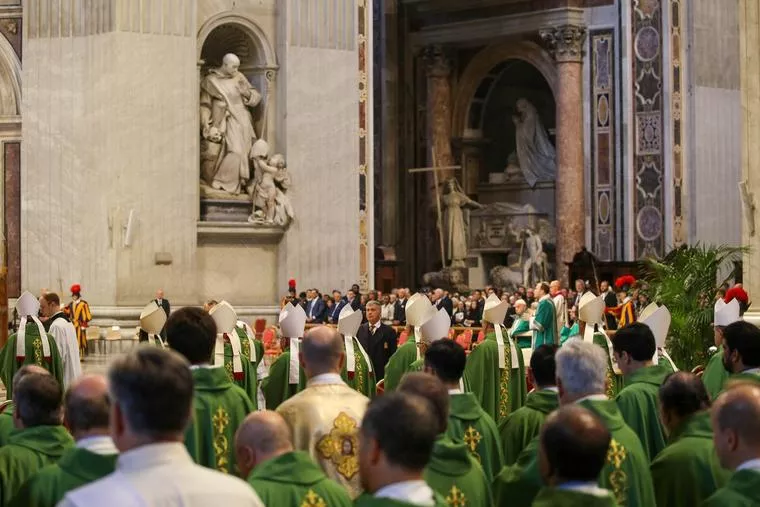
In the Mass for the solemnity, the priest prays to God in the preface that in Christ’s precursor, “St. John the Baptist, we praise your great glory, for you consecrated him for a singular honor among those born of women.”
“His birth brought great rejoicing; even in the womb he leapt for joy at the coming of human salvation. He alone of all the prophets pointed out the Lamb of redemption,” the prayer continues. “And to make holy the flowing waters, he baptized the very author of baptism and was privileged to bear him supreme witness by the shedding of his blood.”
St. Augustine explained that “John, it seems, has been inserted as a kind of boundary between the two Testaments, the Old and the New. That he is somehow or other a boundary is something that the Lord himself indicates when he says, ‘The Law and the prophets were until John.’ So he represents the old and heralds the new. Because he represents the old, he is born of an elderly couple; because he represents the new, he is revealed as a prophet in his mother’s womb.”
John’s connection to Christ
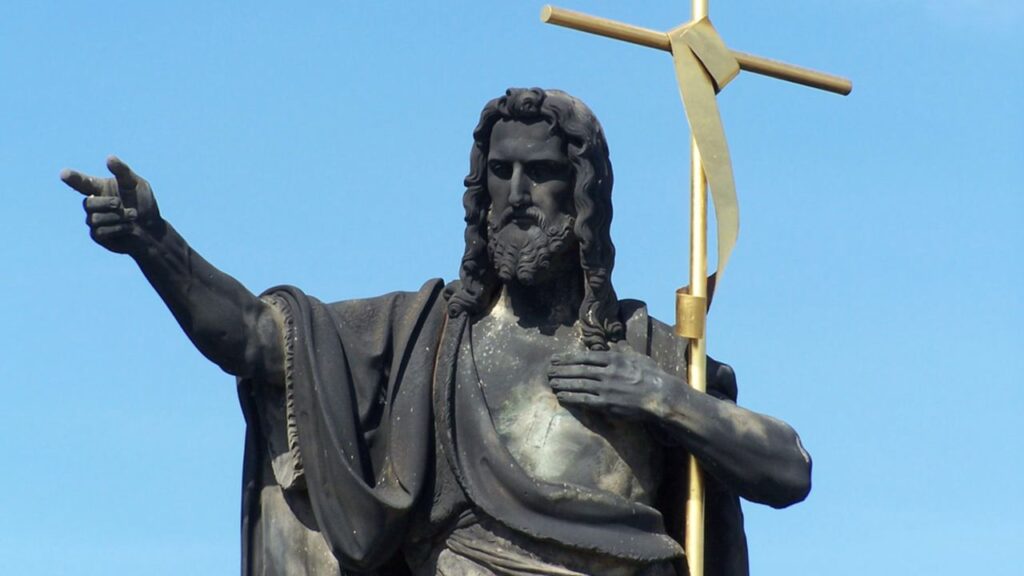
Father Mauro Gagliardi, a theologian and liturgist who teaches in Rome, wrote in a 2009 article on Zenit that it is important to emphasize John the Baptist’s role as “indicator.” John is “a prophet who refers back to Christ.”
The liturgy, Gagliardi said, does the same thing, and thus the June 24 solemnity “reminds us of this: The Christian liturgy is a powerful indicator of Christ to the peoples, like [John] the Baptist.”
John the Baptist’s feast day also has cosmic connections, the theologian pointed out. The fact that June 24 is close to the summer solstice demonstrates the fulfillment of the prophecy in John 3:30 that “he must increase; I must decrease,” since after John’s birthday the days get shorter, or “decrease,” while after Jesus’ birthday on Dec. 25, the days get longer, or “increase.”
“This interweaving between a figure from the history of salvation — John — and the cosmic rhythms (both guided by the same God) has found a fruitful development in the devotion and liturgy of the Church,” Gagliardi said.
Popular customs of ‘summer Christmas’
The Church’s liturgical commemoration of St. John the Baptist dates back to the fourth century.
Acknowledgement of the saint’s importance can also be noted in his shared patronage, together with St. John the Apostle, of Rome’s Archbasilica of St. John Lateran, which is also the seat of the bishop of Rome — that is, the pope.
The night of June 23 is known in some countries, including Italy, as “St. John’s Eve.” Due to the solemnity’s timing, shortly after the summer solstice, some of the practices connected to the feast have a pagan character, including that some refer to it as “the Night of the Witches.”
Modern-day secular festivities may include concerts and theatrical performances, while Catholics usually celebrate Mass and hold religious processions.
One of the most typical customs related to St. John’s Eve, both secular and religious, is the bonfire, called in some countries “St. John’s Fires,” which are lit in honor of the saint who “was not the light, but came to testify to the light (Jn 1:8).” Fireworks or candle-lit processions can also take the place of bonfires.
In an Angelus message on June 25, 2006, Pope Benedict XVI said the feast of St. John the Baptist “reminds us that our life is entirely and always ‘relative’ to Christ and is fulfilled by accepting him, the Word, the Light, and the Bridegroom, whose voices, lamps, and friends we are.”
“‘He must increase, but I must decrease’ (Jn 3:30): The Baptist’s words are a program for every Christian,” Benedict said.
This story was first published on June 24, 2024, and has been updated.
This article was originally published by EWTN News English.