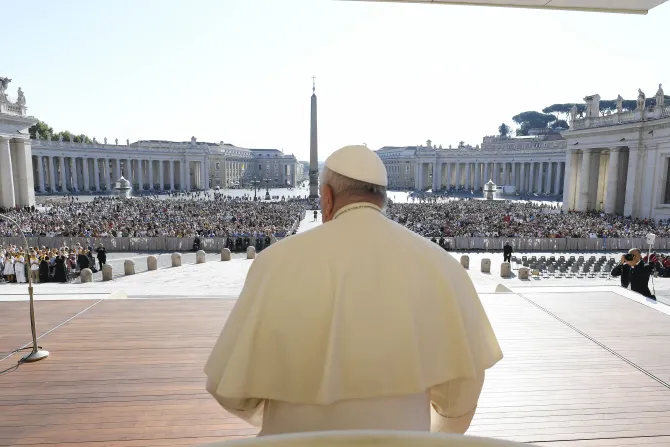
The Synod on Synodality is set to launch the first of two assemblies on Oct. 4.
The global meetings in Rome are the culmination of two years of preparation, and during that time, much has been said about synodality, including by the pope.
In some of his more recent comments on synodality, Pope Francis said, “speaking of a ‘Synod on Synodality’ may seem something abstruse, self-referential, excessively technical, of little interest to the general public,” but it is “something truly important for the Church.”
“Precisely at this time, when there is much talk and little listening, and when the sense of the common good is in danger of weakening, the Church as a whole has embarked on a journey to rediscover the word together,” he said to media representatives on Aug. 26.
“Walk together. Question together. Take responsibility together for community discernment, which for us is prayer, as the first Apostles did: This is synodality, which we would like to make a daily habit in all its expressions,” he added.
Here are some of the other things Pope Francis has said about synodality during his papacy:
Oct. 17, 2015: Address marking the 50th anniversary of the founding of the Synod of Bishops
“The world in which we live, and which we are called to love and serve, even with its contradictions, demands that the Church strengthen cooperation in all areas of her mission. It is precisely this path of synodality which God expects of the Church of the third millennium.
“Synodality, as a constitutive element of the Church, offers us the most appropriate interpretive framework for understanding the hierarchical ministry itself. If we understand, as St. John Chrysostom says, that ‘Church and Synod are synonymous,’ inasmuch as the Church is nothing other than the ‘journeying together’ of God’s flock along the paths of history towards the encounter with Christ the Lord, then we understand too that, within the Church, no one can be ‘raised up’ higher than others. On the contrary, in the Church, it is necessary that each person ‘lower’ himself or herself, so as to serve our brothers and sisters along the way.
“In a synodal Church, the Synod of Bishops is only the most evident manifestation of a dynamism of communion which inspires all ecclesial decisions.”
Nov. 29, 2019: Address to the International Theological Commission
“In the last five years you have produced two relevant texts. The first offers a theological clarification on synodality in the life and mission of the Church.
“You have shown how the practice of synodality, traditional but always to be renewed, is the implementation, in the history of the People of God on their journey, of the Church as a mystery of communion, in the image of Trinitarian communion. As you know, this theme is very close to my heart …
“And for this I thank you for your document, because today one thinks that synodality is taking each other by the hand and setting out on a journey, celebrating with the young, or carrying out an opinion poll: ‘What do you think about the priesthood for women?’ That is mostly what is done, isn’t it? Synodality is an ecclesial journey that has a soul, which is the Holy Spirit. Without the Holy Spirit there is no synodality.”
Sept. 18, 2021: Address to the faithful of the Diocese of Rome
“Synodality is not a chapter in an ecclesiology textbook, much less a fad or a slogan to be bandied about in our meetings. Synodality is an expression of the Church’s nature, her form, style, and mission. We can talk about the Church as being ‘synodal,’ without reducing that word to yet another description or definition of the Church. I say this not as a theological opinion or even my own thinking, but based on what can be considered the first and most important ‘manual’ of ecclesiology: the Acts of the Apostles.”
Oct. 9, 2021: Address for the opening of the Synod on Synodality
“The synod, while offering a great opportunity for a pastoral conversion in terms of mission and ecumenism, is not exempt from certain risks. I will mention three of these.
“The first is formalism. The Synod could be reduced to an extraordinary event, but only externally; that would be like admiring the magnificent facade of a church without ever actually stepping inside. If we want to speak of a synodal Church, we cannot remain satisfied with appearances alone; we need content, means, and structures that can facilitate dialogue and interaction within the People of God, especially between priests and laity.
“A second risk is intellectualism. Reality turns into abstraction and we, with our reflections, end up going in the opposite direction. This would turn the synod into a kind of study group, offering learned but abstract approaches to the problems of the Church and the evils in our world. The usual people saying the usual things, without great depth or spiritual insight, and ending up along familiar and unfruitful ideological and partisan divides, far removed from the reality of the holy People of God and the concrete life of communities around the world.
“Finally, the temptation of complacency, the attitude that says: ‘We have always done it this way’ (Evangelii Gaudium, 33) and it is better not to change. That expression — ‘We have always done it that way’ — is poison for the life of the Church. Those who think this way, perhaps without even realizing it, make the mistake of not taking seriously the times in which we are living. The danger, in the end, is to apply old solutions to new problems.”
Sept. 4, 2023: Aboard the papal plane returning to Rome from Mongolia
“There is no place for ideology in the synod. It’s another dynamic. The synod is dialogue between baptized people in the name of the Church, on the life of the Church, on dialogue with the world, on the problems that affect humanity today. But when you think along an ideological path, the synod ends.
“There is one thing we must safeguard: the synodal climate. This is not a TV program where everything is talked about. There is a religious moment, there is a moment of religious exchange. Consider that in the synod sessions they speak for 3-4 minutes each, three [people], and then there are 3-4 minutes of silence for prayer … Without this spirit of prayer there is no synodality, there is politics, there is parliamentarianism. “In the synod, religiosity must be safeguarded and the integrity of the people who speak must be safeguarded.”
This article was originally published on Catholic News Agency.