The final report also proposes a greater role for women religious in selecting bishops who oversee consecrated life and clearer agreements between dioceses and religious institutes.
The General Secretariat of the Synod on Tuesday, Sept. 8, published the final report of Study Group 6, which presents concrete proposals for renewing relations among bishops, consecrated life, and ecclesial associations, including specific mechanisms to promote greater equality between men and women in Church workplaces.
The document, originally written in Italian and also available in an English translation and a Spanish summary, states: “A clear mechanism for implementing gender equality in the workplace must be developed.”
It also proposes publishing new criteria for approving the establishment of institutes of consecrated life and appointing a delegate for consecrated life in every diocese.
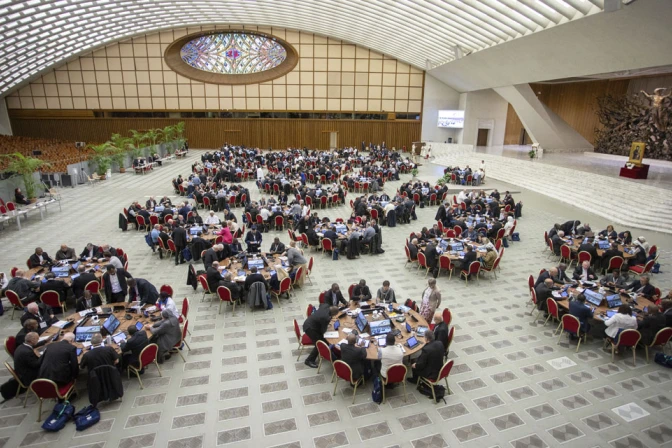
The nonbinding report, which will now be reviewed by Pope Leo XIV, is part of the work undertaken by the 10 study groups created by Pope Francis in 2024 in connection with the Synod on Synodality. The groups are dissolved once their respective final reports have been published.
The working group was coordinated by Cardinal Joseph William Tobin, the archbishop of Newark, New Jersey. Its members included Cardinal Kevin Farrell, prefect of the Dicastery for the Laity, the Family, and Life; Cardinal Luis Antonio Tagle, pro-prefect of the Section for the First Evangelization and New Particular Churches of the Dicastery for Evangelization; and Cardinal João Braz de Aviz, prefect emeritus of the Dicastery for Institutes of Consecrated Life and Societies of Apostolic Life. Sister Simona Brambilla, prefect of that dicastery, also participated.
One of the report’s main conclusions is that the Church should move toward broader participation by consecrated men and women in discernment and decision-making processes.
It therefore calls on Church leaders to “strengthen the relationship between the conferences of major superiors and the episcopal conferences to include consecrated persons in decision-making processes.”
The experts consider the distinctive charisms of religious life an indispensable contribution to the Church’s evangelizing mission and argue that consecrated people should have a greater presence in bodies where pastoral decisions are made.
The document adds that such participation should not be limited to national bodies but should also extend to the diocesan level.
Clear protocols between dioceses and religious congregations
Another issue addressed in the report is the need for clearer procedures governing institutional relations between dioceses and religious congregations.
“There is a need to develop a standard memorandum of understanding model and accompanying guidelines, taking into account current challenges,” the report states.
According to the experts, these agreements should help prevent disputes and guarantee transparent cooperation between both parties.
The group recommends that such protocols clearly define issues including pastoral responsibilities, the administration of assets, the use of property, and financial matters.
“Issues related to property and remuneration should also be clearly and fairly agreed upon in the memoranda of understanding,” the document states, with the aim of avoiding disputes and adequately protecting the rights of everyone involved.
It also says: “The timely resolution of issues, while respecting privacy and confidentiality, should be prioritized and subject to specific deadlines.”
The study group argues that every Church institution should have mandatory dispute-resolution procedures. It therefore recommends that “the establishment of procedures for resolving conflicts should be made mandatory, through the creation of conciliation committees, particularly for matters relating to property.”
These committees should include representatives of both bishops and consecrated men and women, ensuring the participation of both sides in seeking solutions.
Oversight and accountability
The report also addresses the need to establish effective oversight and accountability systems.
“Relevant statutory measures, with specific deadlines, are necessary to ensure oversight and accountability in relations between bishops and consecrated men and women,” the experts state.
They also emphasize the importance of ensuring that future priests are better acquainted with the realities of consecrated life. The report therefore calls on episcopal conferences to “ensure that the formation of the clergy includes knowledge of consecrated life, both in centers of study and in joint missions involving clergy, consecrated persons, and laity.”
Among the report’s most notable proposals is the possibility of expanding the participation of women religious in certain Church selection processes.
The document proposes allowing “women religious to participate in the process of electing bishops responsible for consecrated life at the national and diocesan levels, and in the election of chaplains for the works of communities of consecrated life.”
Although the report does not specify the mechanisms through which this participation would be implemented, the proposal is one of the most significant initiatives to emerge from Study Group 6, pointing toward a greater presence of women religious in areas traditionally reserved to the clergy.
Seven of the Synod’s 10 original study groups have now published their final reports. Reports are still pending from Study Group 1, on relations between the Eastern Catholic Churches and the Latin Church; Study Group 8, on the role of papal representatives; and Study Group 10, on ecumenism.
Final reports are also pending from two additional groups: one on “the liturgy in a synodal perspective” and another on “the status of episcopal conferences, ecclesial assemblies, and particular councils.” Both were created at the initiative of Leo XIV.
The study groups are also accompanied by three commissions: the Canonical Commission, the Eastern Canonical Commission, and the Symposium of Episcopal Conferences of Africa and Madagascar Commission on Polygamy, which published its final report in March. The reports of the other two commissions remain pending.
This story was first published by ACI Prensa, the Spanish-language sister service of EWTN News. It has been translated and adapted by EWTN News English.