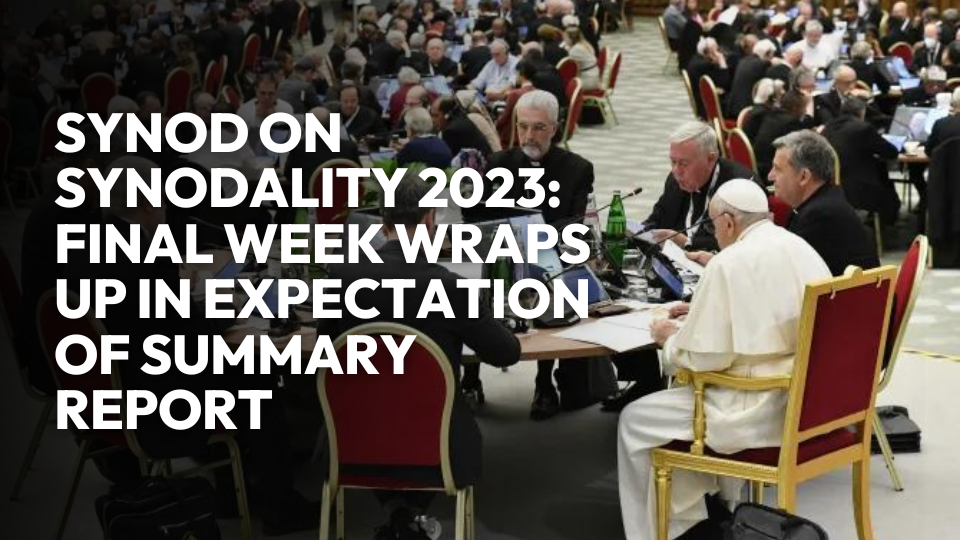
As the final week of this year’s gathering unfolds amid increasingly contentious discussions, anticipation is rising for the publication of the Synod on Synodality’s summary report.
Paolo Ruffini, prefect of the Vatican Dicastery for Communication, captured this spirit of anticipation, speaking about the prospect of a “concise and discursive document” to summarize the first leg of this synodal journey. The Vatican spokesman has previously explained that the synthesis report would be written by “the experts” attending the Synod.
Synthesis report: A vision for the Church?
While subject to many potential changes, the document is expected to be about 40 pages long — and to focus on what makes a synodal church, on the equal dignity of all the baptized, and on how the synodal method is intended to renew Catholic communities.
While undergoing a rigorous voting process, as the Vatican has repeatedly confirmed, it also will draw on the previous documents that paved the way for the synodal process, such as the continental stage of the Synod.
Given that the document is subject to amendments, delving into its content in detail may be premature.
However, Synod delegates highlighted that the final report should underscore that the Word of the Lord comes first, and that the Church is called to spread the Gospel; what is more, that local Church communities should be inspired to live the Word of God in their lives.
Ecclesiastical oversight and synodality
Discussions during the Synod, especially in the small circles, were often focused on the centrality of Jesus Christ and the importance of episcopal collegiality.
Amid concerns about “vagueness,” one synod participant expressed a desire for a more concrete manifestation of the Church. This perspective, while only one of several, reflects a common sentiment distinct from the Synod’s narrative.
The overall trajectory of this gathering also hints at a notable shift in ecclesiastical oversight, proposing a more localized accountability for papal nuncios, a change that could affect the independence of these “ambassadors” who currently report directly to the pope.
Further, the gathering will likely make more room for discussing the pope’s role within a synodal Church, recalling St. John Paul II’s contemplation in his 1995 encyclical on Christian Unity, “Ut Unum Sint” on revisiting the traditional exercise of Petrine primacy.
This could also usher in a more active involvement of cardinals, aligning with the pope’s recent convening of three consistories for broader ecclesiastical discussions, the last one in 2022 aimed at Curia reform.
An emerging proposition is the establishment of a “Council of the Synod,” envisioned as a global consultative body to aid the pope in Church management.
The concluding week of the Synod saw a flurry of activity, with schedule tweaks and robust discussions. Small groups elected an additional secretary to document proposed amendments and validate procedures, reflecting the adaptive nature of the Synod process.
Testimonies also took center stage, especially from conflict-ridden regions like the Middle East, Ukraine, and the Amazon.
A stark emphasis was laid on the crucial communion with Peter’s successor, underlining the ecclesiastical rifts that could ensue in its absence.
A Letter to the People of God, approved by the participants this week, garnered 336 affirmative votes against 12. Addressing all members of the Catholic Church, it invites them to take an active role in “the discernment and decision-making” of the Church.
Cardinal Kurt Koch, president of the Vatican’s Pontifical Council for Promoting Christian Unity, reiterated the importance of the ecumenical dimension this week, saying it was “very visible at the beginning of the synod process when there was the prayer vigil, an ecumenical vigil, for me it was impressive. It is a powerful vision. Synodality also has a liturgical dimension. There must be reciprocity between ecumenism and synodality”.
Archbishop Stanisław Gądecki of Poznan in Poland stated that the method of this Synod made it possible to “avoid discord” because it allows one to “express one’s ideas, address those of others and rediscover silence. This was a discovery for us, speaking with the help of the Holy Spirit. The synodality used by us shows us that there is a method with which we can progress not only on synodality but also with wars and world conflicts.”
This article was originally published on Catholic News Agency.