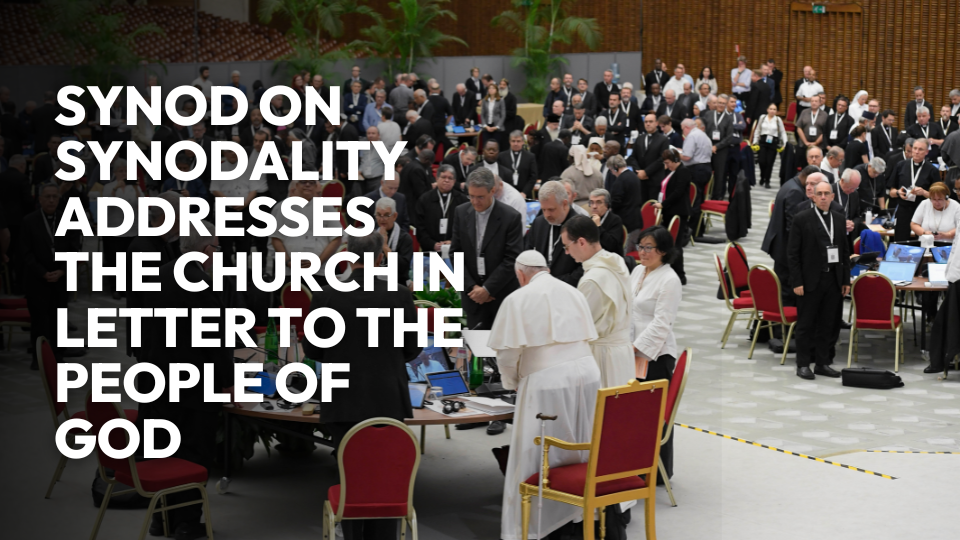
The Synod on Synodality has addressed the members of the Catholic Church in a letter published during the final days of the October gathering in Rome, inviting them to take an active role in “the discernment and decision-making” of the Church.
“This is not about ideology but about an experience rooted in the apostolic tradition,” the letter says. Quoting from Pope Francis’ 2021 speech to open the synodal process, it says that “communion and mission can risk remaining somewhat abstract, unless we cultivate an ecclesial praxis that expresses the concreteness of synodality … encouraging real involvement on the part of each and all.”
“We lived this blessed time in profound communion with all of you. We were supported by your prayers, bearing with you your expectations, your questions, as well as your fears,” the letter says, calling the meeting “an unprecedented experience” for including laypeople in voting.
“Using the conversation in the Spirit method, we have humbly shared the wealth and poverty of our communities from every continent, seeking to discern what the Holy Spirit wants to say to the Church today.”
A draft of the letter was read to applause from synod delegates during a presentation Oct. 23, according to Paolo Ruffini, president of the synod’s information commission. Some changes were then incorporated into the letter before it was voted on and released to the public on Wednesday, four days before the conclusion of the Oct. 4–29 assembly. Of the 348 delegates present for the vote, 336 voted in favor of the letter and 12 voted against.
Past assemblies of the Synod of Bishops have also published messages or letters to the people of God from the bishops, also called synod fathers. This letter is the first to have been approved by a synod membership with the highest participation yet of non-bishops with the right to vote — approximately 21%.
“Firmly united in the hope brought by his Resurrection, we entrusted to him our common home where the cries of the earth and the poor are becoming increasingly urgent: ‘Laudate Deum!’ (‘Praise God’), as Pope Francis reminded us at the beginning of our work,” the note says.
The letter acknowledges that the Vatican assembly took place amid “a world in crisis, whose wounds and scandalous inequalities resonated painfully in our hearts.”
The work of the synod had “a particular gravity,” it says, given that some participants are from countries experiencing war.
The general assembly of the Synod on Synodality is taking place in two sessions, in October 2023 and October 2024.
“And now? We hope that the months leading to the second session in October 2024 will allow everyone to concretely participate in the dynamism of missionary communion indicated by the word ‘synod,’” the letter states.
The letter says many challenges and “numerous” questions remain at the end of the synodal gathering, and a synthesis report to be published Oct. 28 “will specify the points of agreement we have reached, highlight the open questions, and indicate how our work will proceed.”
“To progress in its discernment, the Church absolutely needs to listen to everyone, starting with the poorest,” the letter argues. It specifically lists those “denied the right to speak in society,” those who feel excluded by the Church, and victims of racism, including “Indigenous peoples whose cultures have been scorned.”
“Above all,” it adds, “the Church of our time has the duty to listen, in a spirit of conversion, to those who have been victims of abuse committed by members of the ecclesial body and to commit herself concretely and structurally to ensuring that this does not happen again.”
The Church “needs to welcome the voice of those who want to be involved in lay ministries and to participate in discernment and decision-making structures” and “needs to be attentive to all those who do not share her faith but are seeking the truth.”
The letter points out that during the synod, people living in poverty were asked by Pope Francis what they wanted from the Church, to which they answered: “Love.”
The note also draws attention to Pope Francis’ publication of an apostolic exhortation on St. Thérèse of the Child Jesus amid the synod’s meetings on Oct. 15.
“This love must always remain the ardent heart of the Church, a Trinitarian and Eucharistic love, as the pope recalled,” the letter says.
“It is ‘trust,’” the note continues, “that gives us the audacity and inner freedom that we experienced, not hesitating to freely and humbly express our convergences, differences, desires, and questions.”
These article was originally published on Catholic News Agency.