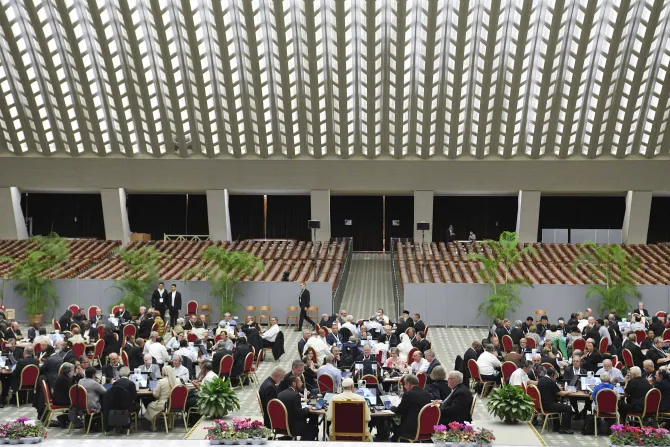
As the Synod on Synodality in Rome launches into its final week with a changed calendar, all eyes are on the anticipated Letter to the People of God, expected on Saturday evening.
The tradition of the Synod writing such a letter — or producing a similar document or message to the faithful — is far from new. However, the document this year aims for a fresh twist, at least in how it is brought about: Unlike the summary document slated for approval at the end of the Synod, this missive serves as a compass, pointing the way for the synodal journey.
As Paolo Ruffini, prefect of the Dicastery of Communication, puts it, if the summary is “transitional,” the letter should illustrate the desired synodal trajectory, encompassing major topics like peace, migration, and alignment with the pope and papal magisterium, discussed vehemently in the last week of discussions.
Jesuit Cardinal Jean-Claude Hollerich, the Synod’s general relator, already outlined a “road map” for the Synod’s next phase in his opening speech. Various proposals are to be gathered, though it’s unclear if new continental or other local stages will follow.
The will of the General Secretariat of the Synod seems to be to have a solid and pervasive presence in the processes. Therefore, everything will depend on what the Secretariat requests from the regional and continental bodies.
This week’s agenda
Discussions will commence in the smaller circles on Oct. 23, after Mass and theological reflection. After a review and vote on the letter, a reflective break follows until Oct. 24, with the summary report commission meeting in the afternoon. On Oct. 25, the General Congregation meets to review the summary report outline delivered by the general rapporteur, followed by open discourse in the afternoon and a rosary in the Vatican Gardens.
Amendments to the synthesis report are deliberated on Oct. 26 in smaller circles, and the next synodal process phase is discussed in the General Congregation in the afternoon. Following a break on Oct. 27, the document is reviewed in the hall on Oct. 28, morning and afternoon, prior to approval, concluding with the Te Deum.
Theological deliberations
As the Synod nears conclusion, the pope’s call for confidentiality keeps debates largely internal, yet lacking practical solutions to vital issues like dwindling vocations or faltering faith, even in traditionally Catholic nations. The Synod, on Oct. 20, hosted the second of two events at St. Peter’s Basilica, titled “Without Prejudice to the Primacy of the Chair of Peter: The Exercise of the Petrine Ministry in a Synodal Church,” exploring the balance between papal primacy and Church reform in a synodal context.
Moderated by Father Dario Vitali and featuring discussions by theologians including Father Leonardo Pelonara and Father Luca Massari, the event dissected the relationship between primacy, collegiality and potential dissent towards papal decisions. The discourse also touched on Pope Francis’ endeavor to bolster episcopal conferences and claimed that a papal documents’ reception isn’t merely passive but a call for the laity to engage and discern, with bishops overseeing the process to avoid division.
Rosalba Manes, a New Testament professor, delved into the Gospel of John’s Last Supper narrative, emphasizing the servitude and leadership lessons it holds for modern-day apostles, urging them to emulate Jesus and Peter’s examples of selflessness and protection towards others.
Setting the stage for the week — and the coming year
The theme of papal primacy will undoubtedly be a Synod discussion staple, and will influence the final document. The debate oscillates between those who would like to change the structures of the Church — applying a variety of ideas — and those advocating for the pope’s central role.
Regardless of where the compass needle points, this Synod session will undoubtedly set the stage for 2024’s gathering.
These article was originally published on Catholic News Agency.