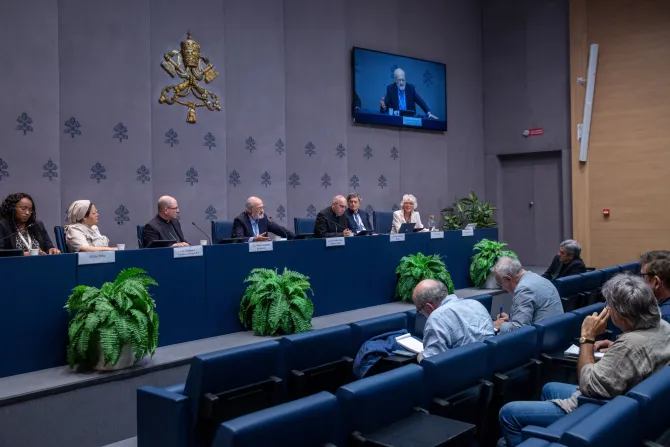
Closing the first week of meetings, Synod on Synodality participants from different continents put a spotlight on the plight of the world’s poor and vulnerable at a press briefing held in the Vatican on the Oct. 4 feast day of St. Francis of Assisi.
Bishop Anthony Randazzo of Broken Bay, Australia, told journalists on Friday that people often forgotten by the wider Church are the poor and vulnerable, including those who are economically disadvantaged, migrants, displaced communities, and women who are excluded or “pushed to the margins into places of poverty and violence.”
In Oceania, Randazzo said several communities living in Pacific Ocean countries that are rich in natural resources are some of “the most vulnerable on the planet” because of exploitation by wealthy companies and nations.
He stated that churches and communities in wealthier countries overly concerned with “niche Church issues” can feel very comfortable and forget vulnerable or oppressed people fighting for survival in other parts of the world.
“Others cannot live, or exist simply, because of people of might and power and authority and wealth decide that those niche issues are the most important ones,” Randazzo said during the Friday press briefing. “Please do not forget the most vulnerable.”
“Women, who in many parts of the Church and in the world are treated as second-class citizens and are totally ignored. This is scandalous!” he added.
According to the 2024 World Migration Report, several Sub-Saharan migrants who moved to North Africa to flee poverty or hunger due to severe droughts are often exposed to violence, abuse, or exploitation after leaving their homelands.
During the press conference, Cardinal Archbishop Cristóbal López Romero of Rabat, Morocco, stated that though his diocese of 25,000 faithful is comparatively small, they are from different countries. He said an increasing number of Sub-Saharan migrants who belong to Rabat’s diocesan communities participated in regional synodal gatherings since 2021.
“We are a Church for the kingdom of God. It was something. It was really a way of putting synodality into practice in a simple but effective way. I think this should be repeated in some way in all dioceses, by organizing things depending on the local situation and the possibility of getting together,” López Romero told journalists.
Sister Xiskya Paguaga from Nicaragua, a journalist and communications expert who works in the area of “digital evangelization,” highlighted that many of the world’s poor and vulnerable can also be found in virtual spaces.
In line with the theme “Mission in the Digital Environment” of the Instrumentum Laboris, Paguaga noted that the Church should also place special attention on vulnerable people who seek consolation and support through online communities and social media platforms.
“We must reach out to these people. People wounded through their journey in life and who express themselves through digital tools,” Paguaga told journalists. “That is where we should focus our discernment.”
The Synod on Synodality will start its second week of discussions on Monday, Oct. 7, the day Pope Francis has called for a day of prayer and fasting for peace in the world to mark the one-year anniversary of the Hamas attack on Israel as violence continues to escalate throughout the region.
This article was originally published on Catholic News Agency.