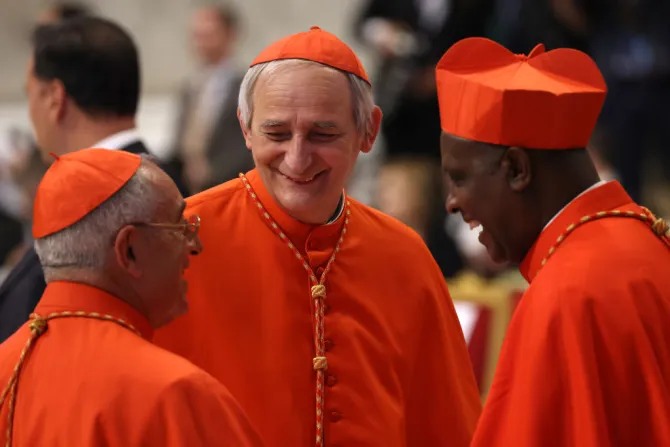
The head of the Italian bishops’ conference, Cardinal Matteo Zuppi, presided over Vespers on Friday for an annual Traditional Latin Mass (TLM) pilgrimage to Rome.
The pilgrimage is named after Pope Benedict XVI’s 2007 apostolic letter Summorum Pontificum, which acknowledged the right of all priests to offer Mass according to the 1962 Roman Missal, which is in Latin.
The Traditional Latin Mass pilgrimage, organized by the People of Summorum Pontificum, is in its 11th year.
In other words, it predates the recent restrictions and changes decreed by Pope Francis, and Zuppi made it clear: There are no special “signs” to be interpreted by his attendance.
Zuppi, 67, said he had received an invitation to participate before he was appointed president of the Italian Bishops’ Conference. He agreed to it, “not thinking there was anything wrong.”
Nonetheless, Zuppi’s participation in the pilgrimage, which brings to Rome thousands of pilgrims who favor the Traditional Latin Mass, had a particular, if not surprising, impact.
The pilgrimage over the years has seen several cardinals and archbishops celebrate for the numerous pilgrims.
Cardinal Antonio Cañizares Llovera celebrated with the pilgrims in 2012 in St. Peter’s Basilica when he was prefect of the Congregation for Divine Worship.
Yet, Cañizares — who recently retired as archbishop of Valencia, Spain — was among those who practically applied Pope Francis’ motu proprio Traditionis Custodes to the letter, suspending the celebration of the TLM in his archdiocese.
Traditionis custodes is the July 16, 2021, motu proprio in which Pope Francis placed sweeping restrictions on the celebration of Mass using the 1962 Roman Missal, known variously as the extraordinary form of the Roman Rite, the Tridentine Mass, and the Traditional Latin Mass. (You can read a further explanation of the document here.)
While some bishops, such as Cañizares, applied the restrictions to the letter, Zuppi, in his archdiocese of Bologna, found a pragmatic solution.
The cleric, who has a reputation as the “bicycling cardinal,” also took into account the particular sensitivity of the faithful of the diocese.
In a decree, Zuppi noted that a traditional community had immediately started in Bologna after Summorum Pontificum and that this celebration had already met the requirements of Traditionis Custodes.
So the cardinal decided to keep everything as it was — except to find another non-parish church — allowing the faithful to attend the Traditional Latin Mass.
Indeed, Zuppi emphasized that “the liturgical tradition has given an unmistakable mark to our local Church. It is a garden to be cultivated with renewed love and passion without ever resigning ourselves to weariness and laziness, which — even when they do not degenerate into abuses — end up weakening the formidable strength of the liturgy from which the Church is born and always is built.”
Zuppi’s decision should not come as a surprise, considering that as a bishop, he also accepted invitations to celebrate the TLM.
His participation in this year’s Summorum Pontificum pilgrimage was to be expected.
Recently, Zuppi also visited the Institute of Christ the King Sovereign Priest (ICKSP) in Gricigliano, near Florence.
The ICKSP also celebrates the Traditional Latin Mass, and Zuppi was reportedly impressed by the many seminarians.
While an experienced pastor and much-respected bishop, Zuppi is not considered a “traditionalist” or “conservative” and is known for his active support of the Community of Sant’Egidio.
His tendency to act as a builder of bridges is also noticeable in a fragmented College of Cardinals.
Pope Francis appointed Zuppi as a member of the Dicastery of the Eastern Churches. He is already a member of the Dicastery for Promoting Integral Human Development. The archbishop of Bologna, therefore, increases his duties in the Curia, becoming a member of a very important dicastery.
Do all these moves make Zuppi a candidate for the succession of Pope Francis? That is idle speculation. How the cardinal-electors might decide in a possible conclave remains to be seen.
The only tangible fact is that Zuppi does not want to be divisive. Instead, he is building bridges — which might yet prove to be an essential role in a Church marred by tensions and divisions.
This article was originally published by EWTN News English.