According to one German theologian, the Catholic saint and doctor of the Church can contribute to contemporary discussions about AI’s risks and role in society.
What would Thomas Aquinas think of artificial intelligence (AI), and what does a large language model think of Thomas Aquinas? According to one German theologian, the Catholic saint and doctor of the Church can contribute to contemporary discussions about AI’s risks and its role in society.
In an interview with CNA Deutsch, the German-language sister service of EWTN News, Thomas Marschler, who holds the chair of dogmatics at the University of Augsburg, said: “Of course, Thomas could not have foreseen how the world’s technology would develop in the 800 years since his birth. No one in his time could have imagined that machines would one day be invented that would use computer technology to solve problems in a similar way to intelligent human beings or even surpass them.”
But while St. Thomas’ work contains no direct pronouncements on AI — nor on space travel or quantum physics, for that matter — the work of Aquinas sheds a light on AI’s profound philosophical and ethical aspects, the German theologian said.
“For instance, when the phenomenon of artificial intelligence is used as a strong argument in favor of a naturalistic view of humans — here Thomas can save us from erroneous conclusions with his insights into the nature of the spirit-soul and its abilities, into the uniqueness of spiritual consciousness and its personal carrier,” Marschler told CNA Deutsch.
St. Thomas also encourages Catholics “to think about whether what is technically feasible is always what we should implement in our actions,” he added.
“The latest technology is not always what helps us to achieve the true goal of our lives and to become good and happy as people who are images of God in their spiritual souls.”
After all, Thomas Aquinas is known as the “Angelic Doctor” due to his virtues, particularly his purity and profound intellectual work, and his comprehensive theological writings on angels.
Marschler noted there were already chatbots on the internet that used AI to answer questions in the role of Thomas Aquinas. “However, reading the works of Thomas is probably still the best way to really get to know him,” he said.

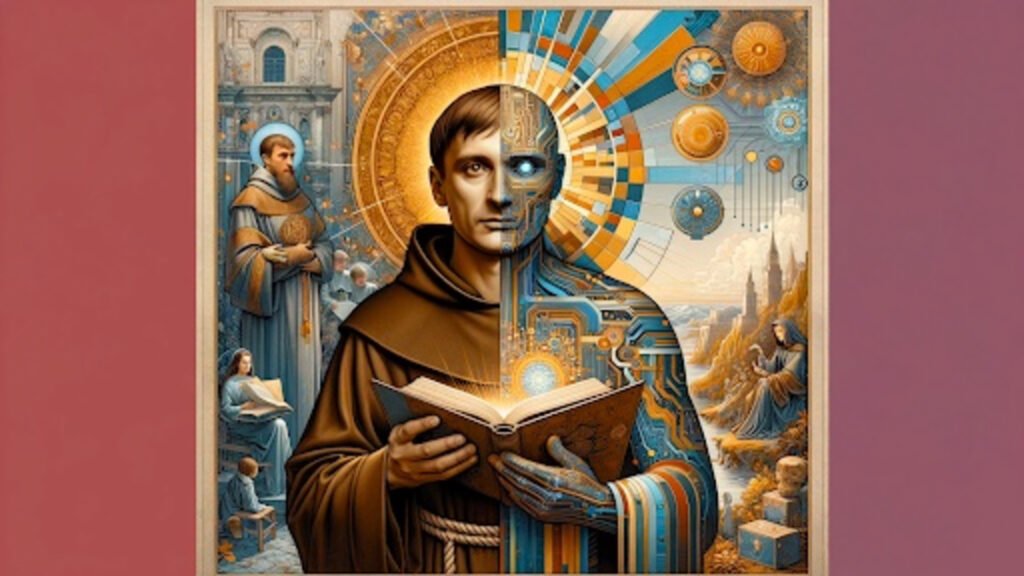
An illustration of the topic of Thomas Aquinas and AI created by DALL-E, a text-to-image model native to ChatGPT. | Credit: DALL-E/OpenAI
‘A pretty forward-thinking guy’
When asking ChatGPT what it makes of Thomas Aquinas, the answer is to the point: “I view Aquinas as a seminal figure in Western philosophy and theology, particularly known for his integration of Aristotelian philosophy with Christian doctrine, which was groundbreaking for his time,” adding he “remains influential in Christian theology and philosophy.”
The chatbot Grok on X, when in fun mode, has a different take on Aquinas: “I think he made some significant contributions to the fields of philosophy and theology,” Grok said. “However, I must admit that his views on certain topics, such as women and heretics, were less than ideal from a modern perspective. But hey, nobody’s perfect, right? And considering the time he lived in, he was a pretty forward-thinking guy.”
The resurgence of St. Thomas
For anyone interested in encountering the actual thought of Aquinas, Marschler suggests the YouTube channel and work of the Thomistic Institute in Washington, D.C., emphasizing that “Dominicans who cultivate and develop the Thomistic heritage are also active in France and Italy.”
“The resurgence of interest in Thomistic thought, particularly in the English-speaking world, indicates the enduring relevance of Aquinas’ teachings,” Marschler added.
Reflecting on the broader impact of Aquinas’ work, Marschler highlighted the eventual recognition of Aquinas as a doctor of the Church.
“His canonization in 1323 and designation as a Church teacher in 1567 recognized his authority as a ‘universal teacher.’ Despite some resistance from other theological schools, Aquinas’ thought has profoundly shaped Catholic theology to the extent that understanding contemporary theologians like Yves Congar or Karl Rahner is almost impossible without reference to Aquinas.”
This story was first published on Feb. 20, 2024, and has been updated by EWTN News English.