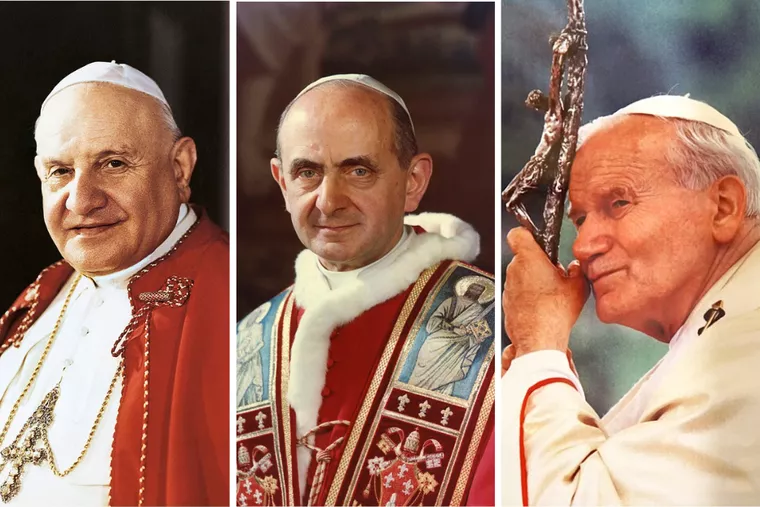
COMMENTARY: ‘Ad Gentes,’ ‘Evangelli Nuntiandi’ and ‘Redemptoris Missio’ offer a potent reminder that the faithful are a key component of the Church’s mission to evangelize the world.
Advent, the beginning of the Catholic Church’s year, is not just a time for personal resolutions, but also ecclesial ones. It’s an opportunity for the pilgrim Church on earth, having finished another nourishing journey through the liturgical year, to examine herself, focus anew on the essentials, and recommit herself to the mission Christ has entrusted to her.
She does this within the threefold dynamism of Advent, as she ponders the Incarnation and birth of God-with-us (Emmanuel) and God saves (Jesus) in Bethlehem; the continual coming of the Lord in prayer, the sacraments and the moral life; and the definitive coming of the Lord at the end of time.
Advent’s focus on the past, present and future helps to deepen the Church’s self-examination and to frame her approach to living more fruitfully her purpose.
That’s one of the reasons why it’s not surprising that this Advent the Church is celebrating the anniversaries of three of its most important documents ever on the Church’s mission in the world: The 60th anniversary of Ad Gentes, the Second Vatican Council’s decree on the mission activity of the Church (Dec. 7, 1965); the 50th anniversary of Evangelii Nuntiandi, Pope St. Paul VI’s apostolic exhortation on proclaiming the Gospel to the people of today (Dec. 8, 1975); and the 35th anniversary of Redemptoris Missio, Pope St. John Paul II’s encyclical on the permanent validity of the Church’s missionary mandate (Dec. 7, 1990).
All three drive home the fundamental points that the Church does not have a mission but is a mission — the completion of Jesus’ saving mission — and that every one of the faithful, by baptism, is called by God to be a key part of that mission. The insights given in the documents are, therefore, not just helpful for the Church’s Advent recalibration, but for every disciple’s new year’s resolutions.
The first and fundamental document is Ad Gentes, published on the second-to-last day of the Second Vatican Council. Pope St. John XXIII, in his opening address to the Council, was clear about its purpose: “that the sacred deposit of Christian doctrine should be guarded and taught more efficaciously. … The substance of the ancient doctrine of the deposit of faith is one thing, and the way in which it is presented is another. And it is the latter that must be taken into great consideration.”
It wasn’t about changing Church teaching but helping the Church communicate the deposit of faith with greater lucidity, love and evangelical fire. The ultimate purpose of that mission, as the Council affirmed the previous year in Lumen Gentium, its dogmatic constitution on the Church, was to call and assist people to become holy, as God is holy.
There was great hope at the Council’s conclusion that the Church now had a speedboat with which to go out to lower the nets for a catch. That began to happen in many parts of Africa, Asia and Oceania; but in Europe and the American hemisphere, the Church began to hemorrhage faithful, priests, religious and missionaries.
St. John XXIII had opened wide the windows of the Church to the world, but a decade later, St. Paul VI wondered whether the “smoke of Satan” had entered through those windows.
So, 10 years after Ad Gentes, Paul VI published Evangelii Nuntiandi, in which he wondered aloud, “What happened to the hidden energy of the Good News?” which Vatican II had intended to ignite. He focused on the missionary work of Jesus and how, in calling and training the apostles, he intended to form the Church to be a vocational-technical school of evangelized evangelizers.
“The Church,” he insisted, “exists in order to evangelize,” not merely to accompany, educate, or carry out charitable and humanitarian works.
In language both fatherly and firm, he warned that many who acted in the so-called “spirit of Vatican II” were drifting from the Council’s actual intentions. Renewal had been confused with rupture; supposed relevance had overshadowed sure Revelation.
After illustrating what the mission of the Church is, he beautifully illustrated its contents, pathways, means, beneficiaries, agents, challenges and spirituality. Pope Francis called Evangelii Nuntiandi “the greatest pastoral document that has ever been written to this day” and urged us to read it repeatedly.
Fifteen years later, on the 25th anniversary of Ad Gentes, St. John Paul II, himself a young bishop at Vatican II, sought in his encyclical Redemptoris Missio to reemphasize the Church’s missionary mandate and respond to the way the proclamation of the Gospel was being reduced to humanitarian or social work detached from explicit proclamation of Christ or to politicized Marxism through various forms of liberation theology.
He did not diminish the importance of justice, charity or solidarity, but insisted on their proper foundation: the Person of Jesus Christ and his saving mission. The Church’s humanitarian work, he underlined, does not replace evangelization but flows from it. Our first act of love for our neighbor is to announce the Redeemer.
Toward the end of the encyclical, he sketched the elements of authentic missionary spirituality, which is one of the document’s most enduring contributions.
The first element is cooperation with the Holy Spirit, who came upon the Church at Pentecost as tongues of fire and a strong driving wind to show that the faith is meant to be proclaimed with ardor wherever the Holy Spirit blows us.
The second element is a total configuration to Christ, who himself came to proclaim the Gospel to the poor.
The third is a sincere charity for others, conscious that the greatest poverty is a life without God, and aware that one of the most powerful reasons for the credibility of the Church’s message is the way she loves those whom the rest of the world neglects.
The fourth is a hunger for holiness, so that we can effectively proclaim the Gospel first to others’ eyes through our body language before we seek to announce it to their ears with words.
Fifth is the Marian quality of discipleship and apostolate, learning from the Mother of God how to go with haste to take Christ to others, as she did at the Visitation.
He noted, with characteristic candor and courage, “The mission of Christ the Redeemer, which is entrusted to the Church, is still very far from completion.” He urged all of us to take up our role.
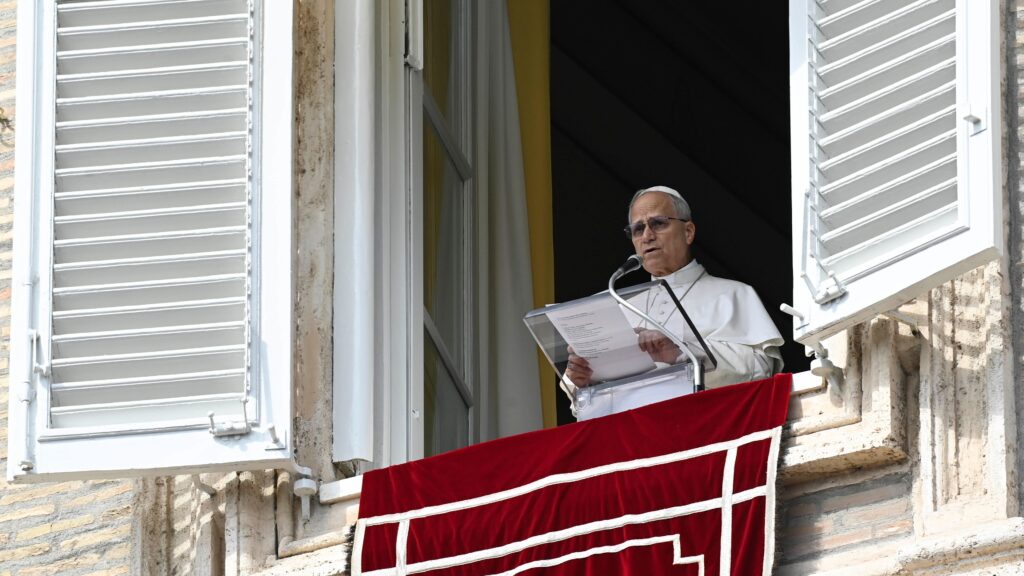
Thirty-five years later, the Church now has, in Pope Leo XIV, the first pope since St. Peter himself to have served as a missionary. The night of his election, our new Holy Father said that we must “proclaim the Gospel without fear, to be missionaries,” adding that we “must look for ways to be a missionary Church.”
In continuity with John XXIII, Paul VI, John Paul II, Benedict XVI and Francis, he is calling the Church yet again back to her roots, to the Great Commission, to the Upper Room, to Christ’s saving work.
As we mark these significant anniversaries of the Church’s greatest missionary documents at the beginning of the Church’s new year, we are being invited to recommit ourselves to announcing to others the “good news of great joy to all the people” that we will hear anew on Christmas.
We are also reminded, as Pope Francis wrote in his 2013 exhortation Evangelii Gaudium, that “my mission of being in the heart of the people is not just a part of my life or a badge I can take off; it is not an ‘extra’ or just another moment in life. Instead, it is something I cannot uproot from my being without destroying my very self. I am a mission on this earth; that is the reason why I am here in this world.”
This article was originally published by NCRegister.