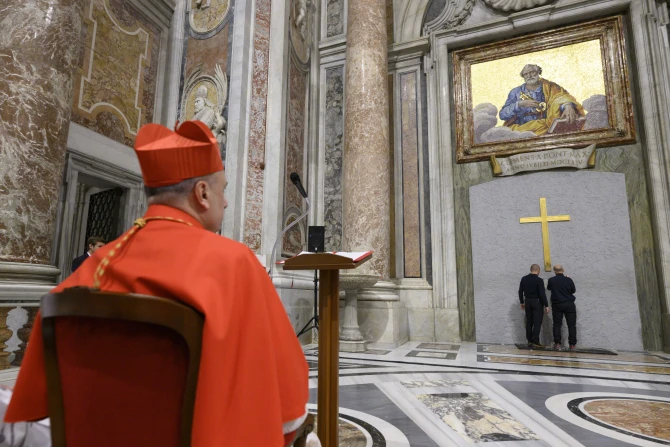
On the evening Dec. 2, the rite of “recognitio” (Latin for “verification”) took place in St. Peter’s Basilica. This is a traditional ceremony to verify and ascertain that the Holy Door, closed during the last holy year, is intact, sealed, and ready to be reopened at the beginning of the new Jubilee 2025.
The pilgrimage to the Holy Doors is a central act of the jubilee. Passing through them during the holy year symbolizes entry into a new life in Christ and the beginning of a journey of conversion.
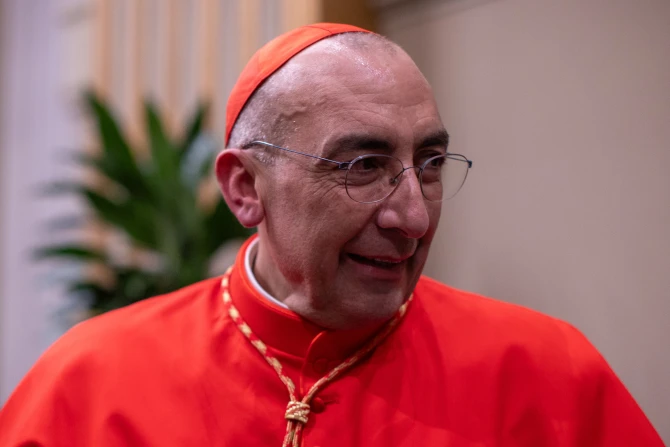
The ceremony began with a prayer led by the archpriest of the basilica, Cardinal Mauro Gambetti. Then the “sampietrini,” employees of the Fabric of St. Peter’s who are responsible for the oversight and maintenance of the Vatican basilica, tore down the wall that seals the Holy Door inside the church.
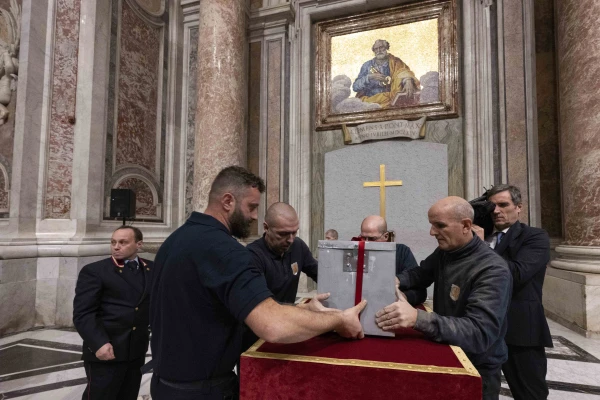
Once the wall protecting the Holy Door was demolished, the workers removed a metal box that had been kept inside it since the closing of the Jubilee of Mercy on Nov. 20, 2016.
The box contains the key with which the Holy Father will open the Holy Door on the evening of Dec. 24. It also contains the handles, the parchment of the act certifying its closure, four golden bricks, and some medals, including those of the pontificates of Francis, Benedict XVI, and St. John Paul II.
Gambetti was in charge of leading a procession, with the singing of the litanies of the saints, from the Holy Door to the Altar of Confession, where he paused for a moment in prayer.
The participants in the rite then proceeded to the Chapter House, where the metal box removed from the Holy Door was opened. Present were Archbishop Rino Fisichella, pro-prefect of the Dicastery for Evangelization, and Archbishop Diego Ravelli, master of pontifical liturgical celebrations, who received the documents and objects of the recognitio, which will be given to Pope Francis.
On Tuesday afternoon, the same ceremony took place for the Holy Door of St. John Lateran basilica. On Dec. 5 the rite of recognitio will take place in St. Paul Outside the Walls basilica and on Dec. 6 in St. Mary Major Basilica.
A ceremony full of meaning
The jubilee year, one of the most anticipated and important events of the Catholic Church, is marked by different solemn ceremonies with centuries of tradition.
In 1499, Pope Alexander VI wanted to define the ceremonial norms of the jubilee. He entrusted this task to the then-master of ceremonies, Johannes Bruckard, who established different rites that continue to be celebrated today, although with some variations.
From the Jubilee of 1500 until the Jubilee of 1975, it was the pope who began the construction of the wall that enclosed the Holy Door. With a hammer, made of gold and later of silver, he would symbolically strike the wall three times. Later, the masons would take charge of demolishing it completely.
The wall was usually covered in turn by a simple wooden door, which was removed and replaced at the beginning and end of each holy year. However, on Dec. 24, 1949, it was replaced by a bronze door blessed by Pope Pius XII.
In 1975, the rite of closing the Holy Door was modified, as the trowel and bricks were no longer used, and the panels of the bronze door were simply closed, giving greater prominence to the door than to the wall.
That same year, the tradition of including a metal chest inside the wall began, since previously symbolic elements such as golden bricks were inserted with the mortar with which the wall was rebuilt.
For the Jubilee of 1983, John Paul II did not use the hammer during the opening of the Holy Door.
During the jubilees of the 20th century, each of the steps that make up the rite of recognitio were consolidated. These include the demolition of the wall, the recovery of the symbolic objects, and the solemn procession with liturgical chants.
This story was first published by ACI Prensa, CNA’s Spanish-language news partner. It has been translated and adapted by CNA.