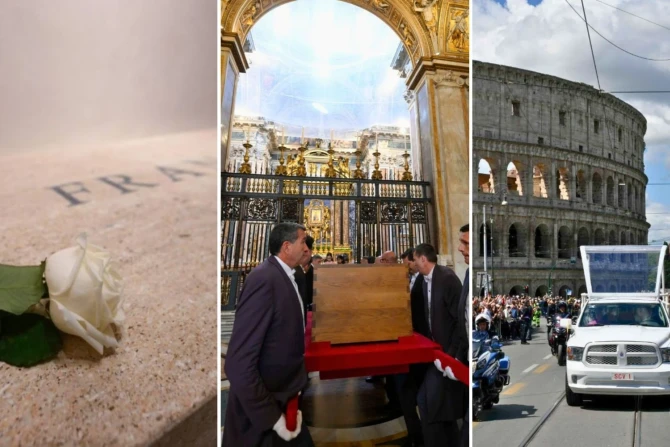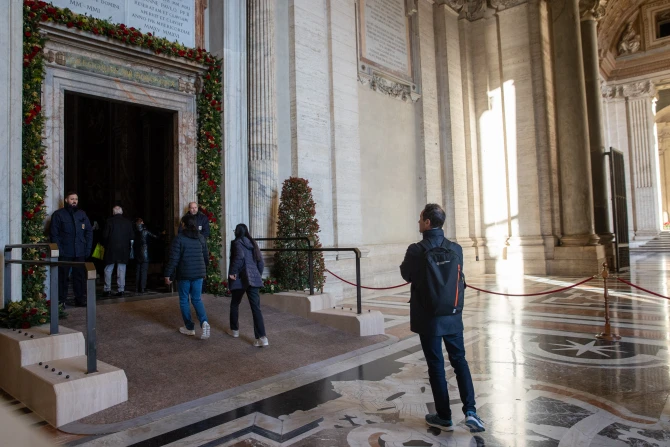
Members of the Ukrainian Greek Catholic Church gathered in St. Peter’s Basilica from Nov. 12–13 to celebrate the end of the jubilee year marking the 400th anniversary of the martyrdom of St. Josaphat Kuncewycz.
St. Josaphat was born around 1580 in the village of Volodymyr (now part of Ukraine) in the Volhynia region of the Polish-Lithuanian Commonwealth during a time of tension between Catholics and the Orthodox Churches.
In 1595 some bishops in the Commonwealth signed the Union of Brest, placing themselves under the jurisdiction of the Holy See — and establishing the Ukrainian Greek Catholic Church.
Ordained a Catholic priest in 1609, Josaphat devoted his ministry to service and efforts to bring the local population back into communion with Rome.
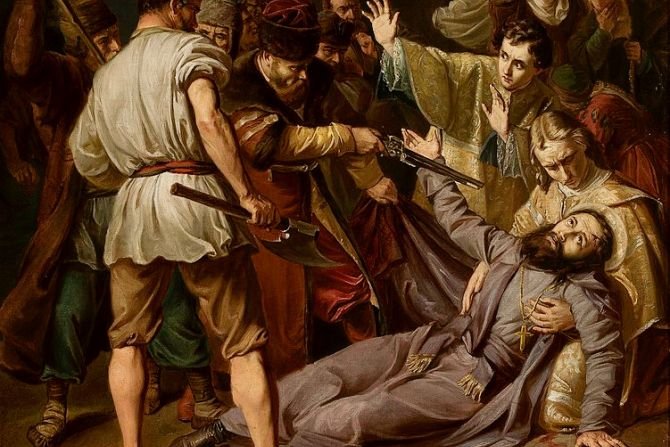
The Union of Brest, however, continued to be a contentious topic in the region and ignited intense political and religious struggle. Josaphat was killed on Nov. 12, 1623, by a mob of people during a visit to Vitebsk, a city in modern Belarus. He was hacked to death and his body was dumped in a river, to only be recovered later.
He was declared blessed in 1643 and canonized in 1867 by Pius XI. On the 300th anniversary of the martyrdom, Pope Pius XI declared St. Josaphat the patron of reunion between the Catholic and Orthodox churches.
Reflecting his broader desire for greater union between East and West, Pope John XXIII ordered the incorrupt body of the saint to be moved to St. Peter’s Basilica, which was done on Nov. 22, 1963, under Pope Paul VI.
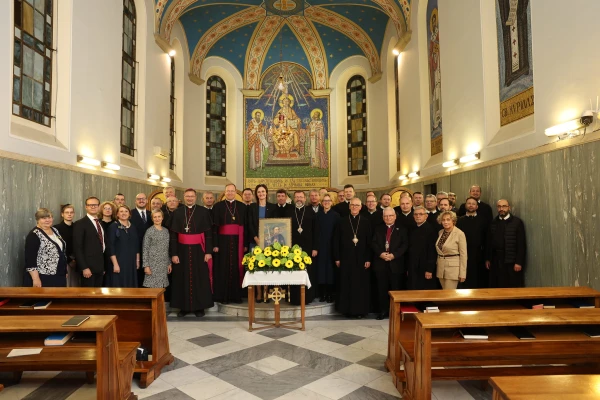
The Nov. 12–13 event included the celebration of vespers at the tomb of the saint, located beneath the altar in St. Basil Chapel, on Saturday and culminated with the celebration of the Hierarchical Divine Liturgy on Sunday.
Major Archbishop Sviatoslav Shevchuk, the leader of the Ukrainian Greek Catholic Church (UGCC), presided over vespers on Saturday and concelebrated the divine liturgy with the Latin-rite Archbishop Gintaras Grušas of Vilnius, president of the Council of Bishops’ Conferences of Europe.
During the Saturday evening vespers, Father Robert Lyseyko, protoarchimandrite of the Basilian Order of St. Josaphat, reflected on the saint’s role in forging unity between East and West.
“We call him the ‘Apostle of Unity’ for a reason. He is an apostle of unity from the moment he begins to seek unity with God in a life marked by deep prayer and renunciation, seeking not his own but what is God’s,” Lyseyko said.
Lyseyko also spoke about the importance of the saint’s life especially against the backdrop of the unabated war in Ukraine.
“The example of St. Josaphat is particularly relevant in our time, amidst the evils and violence surrounding us, with our people enduring the hardships of war. It encourages us to care for one another, prioritize salvation, and foster a spirit of conversion,” he said.
On Sunday, Shevchuk thanked those present for commemorating the saint, calling it an opportunity to heal “the contemporary wounds of Europe and Ukraine.”
During his homily, Grušas highlighted the saint’s life as a model for Christian unity.
“His life touched many peoples and nations, seeking to bring all into unity in Christ. During the present difficulties we face in today‘s world, in Ukraine and elsewhere, of war, migrations, and many other crises, Josaphat‘s life gives us hope that the Lord can use each of us as instruments to establish his kingdom here on earth, starting from our own hearts and taking action in the world around us,” the archbishop said.
“St. Josaphat was a man who took up this invitation from God to be a collaborator in the establishment of this unity and peace. He chose his episcopal motto and mission ‘Ut unum sint,’ ‘that all may be one,’ taken from the Lord‘s prayer for his disciples during the Last Supper. He took it also as his mission in his ministry,” he continued.
In 2013, in an address to Ukrainian Greek Catholics on the 50th anniversary of the transfer of St. Josaphat’s body, Pope Francis said: “The best way to celebrate St. Josaphat is to love one another, and to love and serve the unity of the Church.”
This story was originally posted on CNA.