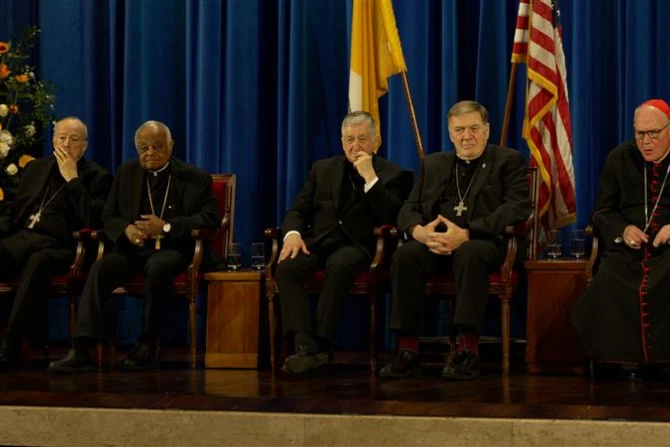
The United States cardinals who were part of the conclave that on Thursday elected Pope Leo XIV, the first U.S.-born pontiff, called him “a citizen of the world,” in continuity with Pope Francis but with his own manner of doing things.
At a May 9 press conference at the Pontifical North American College in Rome following Leo’s election, seven cardinals fielded questions about participating in the conclave, the qualities of Pope Leo, and the impact of having an American pope.
While Cardinal Robert McElroy, the new archbishop of Washington, D.C., expressed surprise at the election of a U.S.-born pope, something he said he never expected to see in his lifetime, others, including Cardinal Daniel DiNardo, archbishop emeritus of Galveston-Houston, underlined that where Leo is from was of little importance to the cardinals’ decisions compared with the new pontiff’s quiet manner and missionary experience.
Leo XIV “is a citizen of the world,” Cardinal Timothy Dolan of New York underlined, and “where he came from is secondary” to what he represents now as pope and leader of the universal Church.
Cardinal Blase Cupich of Chicago, Leo’s hometown, emphasized the unity and common purpose of the cardinal electors, who, he said, treated one another with respect and “jelled” inside the conclave, allowing at least 89 men from many different countries and backgrounds to agree and make a decision in just 24 hours.
McElroy described an atmosphere of contemplation, from walking into the conclave to the chanting of the Litany of Saints, to coming face-to-face with Michelangelo’s “Last Judgment” on the wall of the Sistine Chapel.
“All sense of divisions within the world fell away and we were looking into the souls of each other,” reflecting on which soul had the capacity to be Christ’s vicar on earth, he said.
Like Pope Francis, Pope Leo will promote a missionary discipleship, McElroy said. Leo is “at his core a missionary. In every way a missionary giving his life for the Church.”
Cardinal Christophe Pierre, of French origin but the apostolic nuncio to the U.S., was also present in the press conference and seconded the reflection that the conclave took place in a spiritual atmosphere rather than a political one.
The archbishop emeritus of Washington, D.C., Cardinal Wilton Gregory, got emotional as he recounted pledging his respect, fidelity, and love to the new pontiff after his election. He said the former Cardinal Robert Prevost made the biggest impression on the other cardinals during small, side conversations during lunch or coffee breaks, rather than in one big speech before the whole assembly.
McElroy added that the new pope did speak during the general congregations before the conclave, but it was less about what he said and more about how he said it.
Cardinal Joseph Tobin of the Archdiocese of Newark, New Jersey, shared the most evocative image from inside the Sistine Chapel.
He recalled walking up to cast one of his votes, and immediately afterward, turning and looking over toward the then-Cardinal Prevost, who had his head in his hands.
“And I was praying for him, because I can’t imagine what happens to a human being when he faces something like [becoming pope],” Tobin said. “And then when he accepted it, [it was like] he was made for it. All of whatever anguish [he had] was resolved by the feeling, I think, that this wasn’t simply his saying yes to a proposal, but God made something clear and he agreed to it.”
Tobin, who has known Pope Leo XIV for about 30 years and worked with him when they were both superiors of their respective religious congregations, said: “I don’t think he’s one to pick fights with people, but he’s not one to back down if the cause is just.”
Tobin, DiNardo, Gregory, Cupich, and Dolan all encouraged journalists to let Leo grow into the office of pope, watching what he does and says in this new role before casting judgment.
“You can’t capture tomorrow by looking at yesterday,” Gregory said.
McElroy added that while the cardinals were looking for someone “following the same pathway as Francis,” they were not interested in choosing “a photocopy.”
This article was originally published on Catholic News Agency.