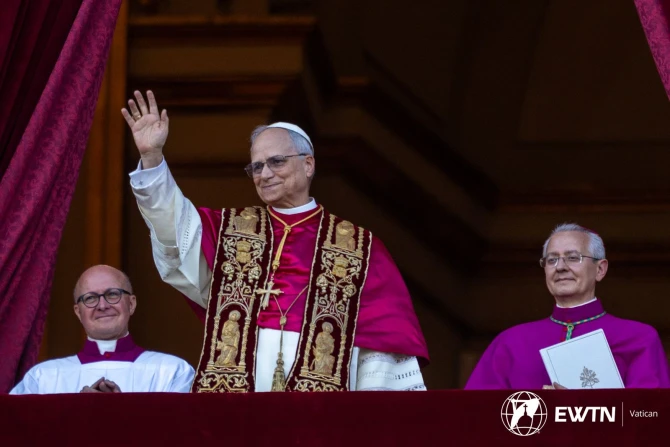
The Vatican announced Wednesday that Pope Leo XIV appointed Father Ignatius Wu Jianlin as auxiliary bishop of Shanghai on Aug. 11, with his episcopal ordination taking place today under the framework of the Provisional Agreement between the Holy See and the People’s Republic of China.
Father Wu Jianlin’s consecration at St. Ignatius Cathedral marks a further development in the complex relationship between Beijing and the Vatican.
Chinese authorities had previously announced Wu’s “election” by an assembly of priests and laypeople on April 28, during the sede vacante period following the death of Pope Francis.
The Vatican Bollettino, published Wednesday, revealed that the Holy Father approved Wu’s candidacy on Aug. 11.
While his appointment was not previously made public, the announcement suggests the move was made in accordance with the Vatican-China agreement.
At the time of Wu’s election, observers expressed concern that Beijing was exploiting the papal interregnum to assert control over episcopal appointments.
Wednesday’s Vatican statement confirms the new appointment was approved by Pope Leo XIV.
Bishop Wu, 55, was born on Jan. 27, 1970, and studied philosophy and theology at Sheshan Seminary in Shanghai from 1991 to 1996. He was ordained a priest in 1997, and served in a number of roles as cleric.
Between 2013 and 2023, he helped administer the diocese during Shanghai’s prolonged sede vacante, and later served as vicar general.
Agreement as ‘seed of hope’?
The Provisional Agreement, first signed in 2018 and renewed in 2024 for four more years, establishes a system in which Chinese authorities apparently propose candidates for episcopal office, who must then receive pontifical approval before being appointed.
The exact terms of the controversial agreement remain unpublished, however, and the way the process is applied has repeatedly come under scrutiny.
Cardinal Pietro Parolin, the Vatican secretary of state, has long defended the agreement as an instrument of dialogue in an imperfect situation.
In an Oct. 11 address commemorating the 1924 Council of Shanghai, Parolin described the agreement as a “seed of hope” which, despite setbacks, could bear fruit in the long term “in the proclamation of the Gospel, in communion with the universal Church and the Bishop of Rome, and in authentic Christian life.”
At the same conference, Cardinal Luis Antonio Tagle, pro-prefect of the Dicastery for Evangelization, affirmed “the real life and ordinary daily routine of Catholic communities in China,” even if “attention is usually focused on issues of episcopal appointments, local incidents, relations between the Chinese political authorities and the Holy See, or problems related to the state’s religious policy.”
This article was originally published by CNA.