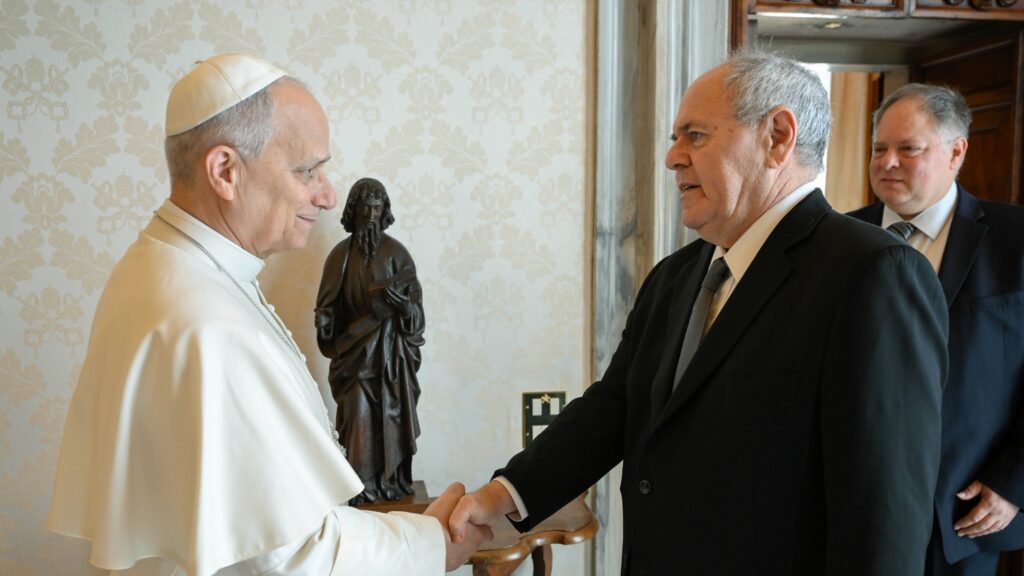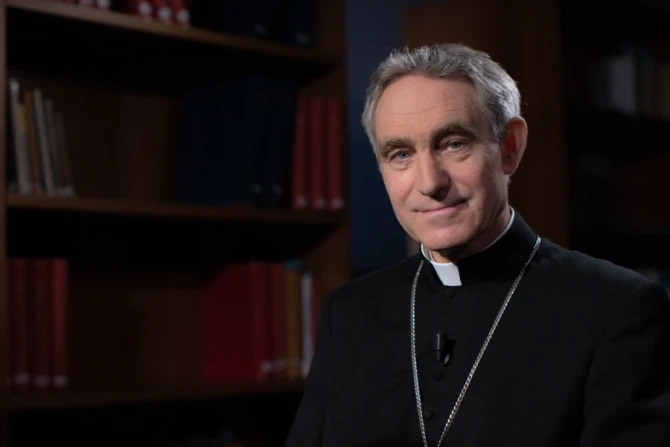
Archbishop Georg Gänswein, the Vatican’s nuncio to the Baltic states since 2024, said the region has been disappointed with the current U.S. administration’s approach to the conflict in Ukraine.
FIND THE POPE’S BIOGRAPHY HERE
Speaking about the Russia-Ukraine war, Pope Benedict XVI’s former secretary said: “The major powers play a major role here, and the Baltic states are somewhat disappointed with the attitude of the current U.S. administration. They expected something different.”
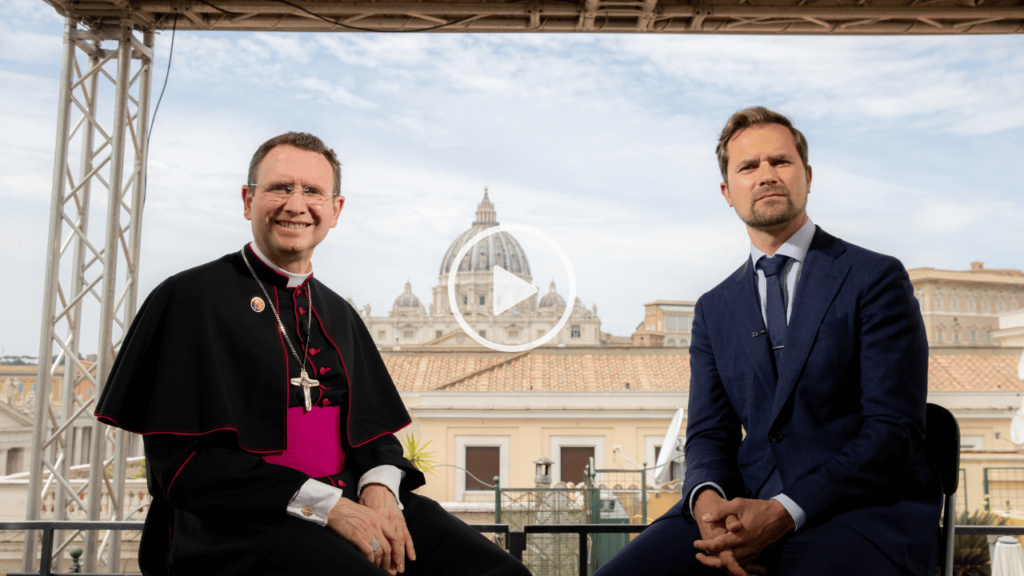
Gänswein spoke about his role as a nuncio and the Holy See’s peace efforts in a June 13 interview with Rudolf Gehrig of EWTN News and CNA Deutsch, CNA’s German-language news partner. The archbishop took up his post in the nunciature in Vilnius, Lithuania, last year after 17 years as the personal secretary of Pope Benedict XVI and 11 years as prefect of the Papal Household.
In the interview, he said Russia’s invasion of Ukraine is strongly felt in the capital of Lithuania, which is just over 370 miles from Kyiv, the capital city of Ukraine. He said a nuncio — the pope’s representative to a country — “can’t do anything specifically. … It always goes through the Holy See, rightly so.”
“The Holy See is,” he continued, “a bridge builder — this was one of the new pope’s first words: peace. ‘Peace be with you!’”
Playing off of Pope Leo XIV’s love of tennis, Gänswein called the pope’s first words after his election “a first serve of his pontificate.”
“A lot is being done,” he noted, but “it’s impossible to say now how successful it is. A constant drip wears away the stone.”
Overall, a “mistrust of the Russians, especially [President Vladimir] Putin,” can be felt among the population, the archbishop said. This goes back to the influence of the communist dictatorship at the time of the Iron Curtain.
“There is an atmospheric presence of war,” said Gänswein, who added: “It is important to see reality, to accept it, but also to take it seriously. We must continue to live life normally. And as Christians, we have the great gift of having clear hope and a clear mission in our faith.”
Ecumenism in times of ‘fratricidal war’
Russia’s war of aggression against Ukraine has also made ecumenism with the Orthodox churches more difficult, Gänswein explained. The Orthodox Church in the Baltic countries, which was initially under the Patriarchate of Moscow, turned away from the Russian Orthodox Patriarch Cyril I, who even tried to legitimize the war in religious terms.
“How can the patriarch support the war — it is actually a fratricidal war, i.e. Orthodox fighting Orthodox; how can he support it,” Gänswein said. “This is a new bone of contention, so it’s important not to cut the strings — these are no longer bridges — but to hold them.”
While Lithuania is 80% Catholic, the balance of power between Catholics and Orthodox Christians in Latvia is almost evenly distributed at 20% each. In Estonia, on the other hand, as much as a fifth of the population is of Russian origin, a noticeable influence, the nuncio said.
Shortly after the start of the Russian invasion, Cyril I and Pope Francis met for a video call on March 16, 2022, at the patriarch’s request. The Swiss Cardinal Kurt Koch, who was present at the meeting, later reported in an interview with EWTN News that “the pope spoke very clearly when he said to the patriarch: ‘We are not state clerics, we are shepherds of the people. And therefore it must be our task to end this war.’”
Meanwhile, Gänswein emphasized that the Vatican is still needed in its role as mediator.
Rift with Pope Francis?
In the interview, the archbishop also responded to media claims that there had been a major rift between him and Pope Francis.
“It wasn’t always easy,” he said, but “not everything was as the press reported, that it was a big ‘falling out.’ So that’s not true.”
“There were certain difficulties, certain tensions, but they were resolved in January 2024” when he had an audience with Pope Francis, he explained, calling that the beginning of the easing of tension between them: “The fact that I was subsequently appointed nuncio in the Baltic countries is certainly one of the fruits of this.”
Gänswein was suspended from his post as prefect of the Papal Household at the beginning of 2020. After Pope Benedict XVI’s death on Dec. 31, 2022, Pope Francis sent the archbishop back to his home diocese in Freiburg, Germany. Just under a year later, in June 2024, Pope Francis appointed him apostolic nuncio of Lithuania, Latvia, and Estonia.
“It wasn’t the case that we parted on bad terms,” Gänswein affirmed.
Looking back, he said the meetings with Pope Francis in early January 2024, the appointment as nuncio in June 2024, and another audience as nuncio in November 2024 “gave him inner peace again.”
A recent visit to Francis’ tomb to pray for the deceased pope “completed the reconciliation,” the archbishop said.
SIGN UP FOR OUR NEWSLETTER HERE
Hannah Brockhaus contributed to this CNA Story.