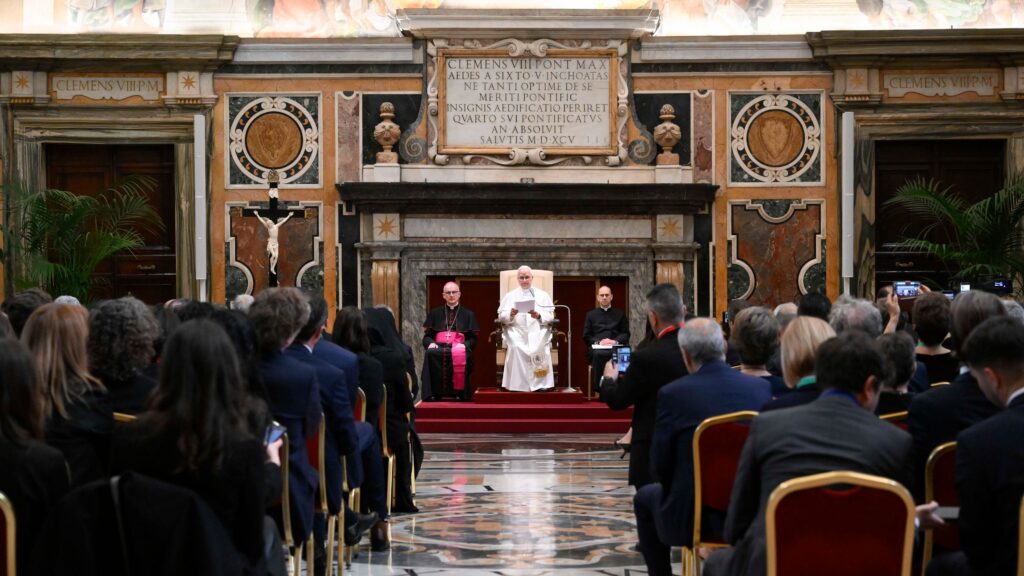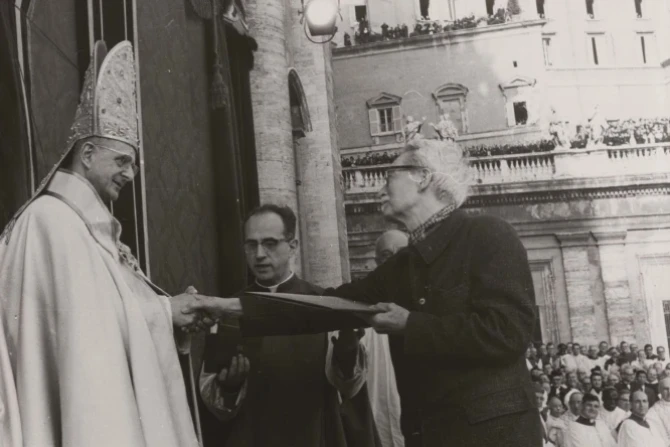
The Vatican Museums inaugurated June 12 the exhibition “Paul VI and Jacques Maritain: The Renewal of Sacred Art Between France and Italy (1945–1973),” a tribute to the friendship between the celebrated French philosopher and the pope who succeeded John XXIII and concluded the Second Vatican Council (1962–1965).
FIND THE POPE’S BIOGRAPHY HERE
The project focuses on Maritain (1882–1973), a neo-Thomist thinker and key figure in the dialogue between faith, culture, and art in the 20th century.
Appointed ambassador to the Holy See by French President Charles de Gaulle after the Second World War, Maritain lived in Rome from 1945 to 1948. During that time, his friendship with Giovanni Battista Montini (the future Pope Paul VI), whom he had met in Paris in 1924, was strengthened.
Maritain’s thinking influenced the fundamental concepts underlying the Second Vatican Council, particularly his idea of an “integral humanism” in which Christian faith, human dignity, and artistic expression converge.
Along with his wife, Raïssa Oumansoff, with whom he converted to Catholicism in 1906, Maritain was at the center of an international intellectual elite that included poets, philosophers, artists, and mystics such as Charles Péguy, Léon Bloy, Paul Claudel, Jean Cocteau, and Georges Rouault, the latter considered by Maritain to be one of his closest artistic interpreters.
The exhibition, which is part of the 2025 Jubilee and will be open throughout the summer, commemorates several significant events: the 80th anniversary of Jacques Maritain’s appointment as French ambassador to the Holy See in 1945 and the almost simultaneous founding of the French Institute-St. Louis Center in Rome by Maritain; the 60th anniversary of the closing of the Second Vatican Council in December 1965; and the inauguration of the Modern Religious Art Collection, promoted by Paul VI in June 1973.
For the director of the Vatican Museums, Barbara Jatta, these anniversaries “make clear the wealth of historical inspiration that this project offers to the public from the papal museums.”
The exhibition — through photographs, documents, and paintings that create a dialogue between spirituality, Christian thought, and avant-garde art — traces the spiritual and intellectual bond between the French philosopher and then-Monsignor Giovanni Battista Montini.
“The relationship with the pontiff lasted well beyond the diplomatic experience and was quite intense during the Second Vatican Council, to whose development Maritain’s neo-Thomist thought contributed,” Jatta noted.
The museum director also noted that Maritain and his wife, Raïssa, of Russian origin, formed a highly influential international cultural circle throughout the 20th century, bringing together artists, thinkers, and religious figures. In fact, the couple also gathered together a significant collection of works of art, many of which became part of the initial holdings of the Vatican Museums’ Collection of Modern Religious Art.
“They spent significant time together in the early days of the Vatican Collection, because in addition to reaffirming the uninterrupted and mutual esteem between Montini and Maritain, it underscores how the latter immediately understood the scope of Paul VI’s project, of which the philosopher himself was one of the theoretical driving forces,” Jatta explained.
This project took on a public and official form with the famous address to artists delivered by Paul VI in the Sistine Chapel on May 7, 1964, in which he called for healing the “divorce between the Church and contemporary art.”
Indeed, this request culminated with the opening of the collection on June 23, 1973, “in the historic heart of the Vatican Museums, between the Borgia Apartments with its various rooms leading to the Sistine Chapel.”
The exhibition brings together paintings, drawings, prints, photographs, period volumes, and material objects that document an intense network of friendship and collaboration between thinkers and artists committed to the spiritual renewal of art.
Prominent artists include Maurice Denis, Émile Bernard, Gino Severini (with works for Swiss churches promoted by Cardinal Charles Journet), Georges Rouault (perhaps the artist closest to Maritain), and Marc Chagall, a close friend of Raïssa, whose visual narratives reveal a unique sensibility inspired by Jewish folklore.
The exhibit also includes works by Henri Matisse, with his famous Vence Chapel, and the American William Congdon, an artist of strong mystical inspiration, known to Maritain in the years leading up to the council.
Also featured is the Dominican priest Marie-Alain Couturier, another great innovator of sacred art in France. His perspective, more progressive and different from Maritain’s, is integrated into the exhibition as a sign of Paul VI’s openness to multiple currents within contemporary Catholic thought.
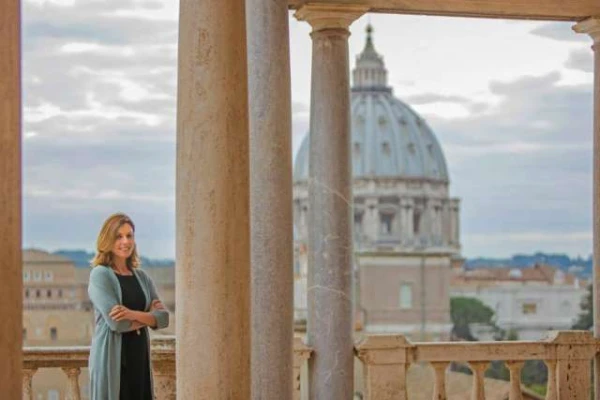
Curated by Micol Forti, head of the Vatican Museums’ modern and contemporary art collection, the display is located at the heart of the exhibition dedicated to present-day art, between the Raphael Rooms and the Sistine Chapel.
The exhibition is the result of a collaboration between the Vatican Museums and various cultural institutions, including the French Embassy to the Holy See, the French Institute-St. Louis Center, and the Strasbourg National and University Library.
SIGN UP FOR OUR NEWSLETTER HERE
This story was first published by ACI Prensa, CNA’s Spanish-language news partner. It has been translated and adapted by CNA.