COMMENTARY: As the SSPX moves toward unauthorized episcopal ordinations, Vatican II’s path to ‘Dignitatis Humanae’ sheds light on the Church’s teaching on religious freedom.
With the Society of St. Pius X’s recent announcement of its intention to proceed to unauthorized episcopal ordinations, the Catholic Church once more faces the sad possibility of further rupture.
Such an event, while it involves a relatively small group of persons, should nonetheless be a matter of concern for all Catholics, since unity is an essential part of the identity Christ willed for his Church.
The motive for this new step toward further division is not new: “the fundamental orientations adopted since the Second Vatican Council,” as the superior general of the society has recently stated. Such a direction, the society’s leaders contend, “has proven to be a rupture with the Tradition of the Church.”
A key part of the SSPX’s critique of the Council has been the declaration Dignitatis Humanae, which would allegedly involve a contradiction with previous Church teaching.
For Catholics, the pope remains the authentic authority for interpreting the Church’s tradition. Recent Roman pontiffs have guided the Church firmly along the path of the Council’s teaching. At the same time, the clarity provided by such instruction does not take away from the importance of seeking to understand Vatican II in its own historical and theological context.
How exactly did the Council bring together its desire to remain faithful to the deposit of faith with its concern to express this same body of teaching in a more adequate way to the modern world? The long and complex history behind Dignitatis Humanaeprovides keen insights into the way the Council carried out this difficult task.
On Nov. 19, 1963, Belgian Bishop Emiel Jozef De Smedt presented an initial draft of a Vatican II text on religious liberty to the Council Fathers. His eloquent explanation of the importance of the topic and the doctrinal development behind it aroused fervent applause. The Council would not have time to discuss the draft, then situated as the final chapter of a text on ecumenism, during that year’s Council sessions.
Over the following months, 380 observations were sent by the Council Fathers to the Secretariat for Christian Unity, which included criticisms of various aspects of the text. The secretariat composed a new version that sought to respond to the Council Fathers’ concerns. In reworking the document, the secretariat once again counted greatly on the help of theologian and Jesuit Father John Courtney Murray, who, despite a heart attack in January 1964, continued to work on the text.
In April 1964, the commission entrusted with coordinating the Council’s work decided that the text would be an independent declaration, no longer forming part of the Council’s text on ecumenism, although it was sent to the Council Fathers as an annex to the ecumenism document.
The revised text on religious liberty was presented once more by Bishop De Smedt to the Council Fathers on Sept. 23, 1964. This new version of the text provided a clearer definition of religious freedom as a “right to religious freedom in society, by virtue of which men can privately and publicly practice their religion and cannot be prevented from practicing it by any coercion.”
With this definition, the Secretariat for Christian Unity wanted to reiterate that it was not trying to deal with the freedom of man in his relation to God, nor with the nature of freedom itself. Rather, the document was interested in the specifically legal issue of the right to religious freedom, a right founded in the God-given dignity of the human person.
In keeping with this vision, among various other changes, the new version of the text sought to avoid the danger of subjectivism or religious indifferentism by more explicitly affirming man’s duty to order himself to God as part of the “eternal, objective, absolute and universal” divine law.
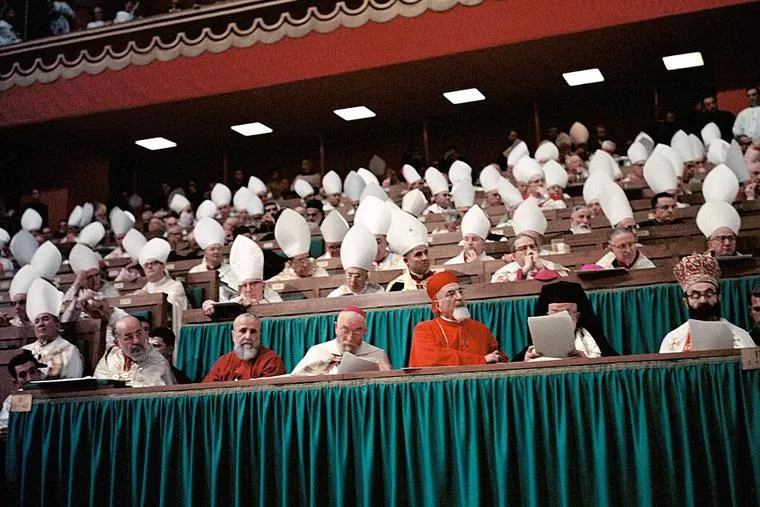
After Bishop De Smedt’s introduction and explanation of the new text, the moment finally arrived for the Council Fathers to discuss the proposed draft. Many recognized its value for the Church’s mission in modern society, while also pointing out areas for improvement. Archbishop Karol Wojtyła, now known to the world as Pope St. John Paul II, expressed his desire for an improved text and called on the Council to proclaim in it the “full and solid truth about man,” which is perfected in religion, in the face of atheism and materialism.
Vietnamese Bishop Simon Hoà Nguyễn Văn Hiền, the first head of the Diocese of Ðà Lạt, while pointing out various areas in which he desired greater clarity, nonetheless stated that the proposed declaration was of the “greatest importance,” not only for dialogue among Christians, but also for those regions in which Christians constitute only a tiny minority.
Archbishop Jean Zoa of Cameroon, speaking in the name of many bishops from Africa and several other regions, forcefully echoed Bishop Nguyễn’s sentiment about the importance of the declaration for the Church’s mission. If “we do not declare the absolute reverence due to the human person in religious matters,” he stated, the Council would not be able to reach the people of the time. The Church would then be comparable to a totalitarian state, instead of following the model of charity and patience found in Christ.
Cardinal Richard Cushing, speaking in the name of almost all the bishops of the United States, voiced praise and approval of the text, saying that by this declaration, the Catholic Church “must present itself to the entire contemporary world as a protagonist of human and civil freedom, especially in religious matters.”
However, as in the case of the earlier draft, several Council Fathers continued to be critical of the Council’s proposed teaching.
Irish Cardinal Michael Browne stated that the text in its current form, in his opinion, could not be accepted. The cardinal took issue in particular with the draft’s attempt to give erroneous conscience the same juridical rights as a correctly formed one, and saw such a view as breaking with the teaching of recent popes.
Later that same morning, Sept. 24, 1964, French Archbishop Marcel Lefebvre — who would later break from communion with the Catholic Church and found the SSPX — issued a harsh critique of the draft. While he recognized that the declaration seemed “truly opportune,” he desired to echo the criticisms that had already been made. The French archbishop felt that the text needed to be shorter and to avoid disputed questions as well as “dangerous consequences.”
Archbishop Lefebvre asserted that freedom is a “relative” quality, not an absolute one, and against the draft’s declaration against coercion, he defended the authority of Christian parents toward their children, of teachers in Christian schools, of Church authority against “apostates, heretics and schismatics,” and of Christian rulers toward “false religions.” He claimed that the text contained the philosophical errors of relativism and idealism, and concluded by warning of the great damage to souls that would be caused by the approval of the existing draft.
These criticisms and others brought up issues the Council would still need to grapple with. In particular, how could the Church better articulate an authentic notion of religious freedom, in keeping with the Christian faith, while not condoning the errors associated with exaggerated conceptions of liberty?
The Council debate in the early fall of 1964 revealed that there was still much distance to travel before agreement could be reached. Much work needed to be done to elaborate a teaching that could respond to the eager expectations of so many and, at the same time, adequately satisfy the emphatic critiques.
This article was originally published by NCRegister.