Watch Colm Flynn in this special EWTN News in Depth extra as he takes us to the heart of Vatican City, where a story of courage and humanity unfolds – the story of Monsignor Hugh O’Flaherty, an Irish priest who became a beacon of hope during one of history’s darkest times.
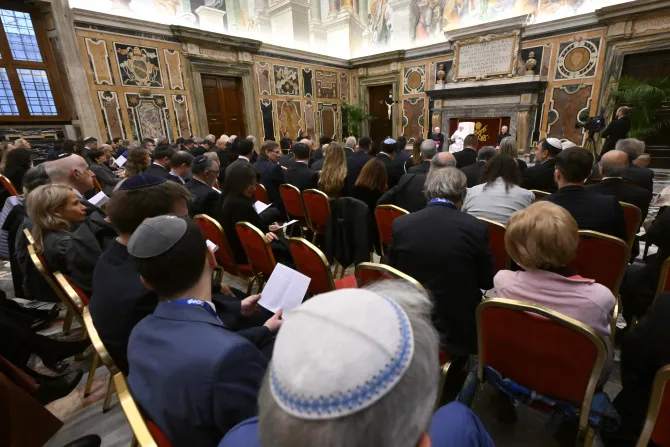
A special mass was celebrated by former Archbishop of Dublin, Duirmid Martin, and attended by members of the Irish community. It marked the 60th anniversary of O’Flaherty’s death, commemorating his life and legacy.
The Irish Ambassador to the Holy See, Frances Collins, recalls Pope Francis’s words, “There are those who defeat evil with good, and Mons. O’Flaherty is certainly one of those people.” She says, “In telling his story, we tell the story of others.”
The Vatican, a place steeped in history, was the setting for O’Flaherty’s remarkable acts of bravery. Working in one of the Vatican’s most influential departments during the 1930s and 40s, he was well-placed to impact World War II significantly.
As the Nazi regime tightened its grip on Rome in September 1943, the danger for the city’s Jewish population and prisoners of war escalated. Father Enda, head of the office for the Dicastery for Divine Worship and Discipline of the Sacraments, says, “It’s important to remember what Rome was like at the time. In all this, O’Flaherty was at work in a city in terror. The people besieged, locked in their homes. He must have had the courage to live under that sort of pressure and to do what he did.” O’Flaherty, understanding the gravity of the situation, orchestrated ‘The Organisation’ – a secret network providing safe havens for thousands of Jews and POWs in Rome and even within the Vatican.
Despite the ever-present threat from the Nazis, who were aware of his activities, O’Flaherty was protected by the Vatican’s neutral status. He orchestrated his daring rescue operations right from his residence in Campo Santo, a building inside Vatican City. In that way, the Nazis couldn’t touch him. Father Enda relates, “Mons. O’Flaherty used to meet people standing on the steps of Saint Peter’s Basilica.”
With exclusive access, rarely granted, inside Vatican City, EWTN News in Depth speaks with German historian Father Stefan Heid inside Campo Santo, ironically the German residence within the walls of Vatican City. Father Heid has extensively researched O’Flaherty’s life, revealing that Pope Pius XII, the then Pope, played a subtle role in these events. While publicly silent about Hitler’s regime, he allowed clandestine support for the Jewish community, evidenced by O’Flaherty’s operation under the Vatican’s aegis. Providentially, with Ireland’s neutrality in the Second World War, O’Flaherty was able to remain safely within the Vatican. Thousands of priests and religious leaders could operate quietly with the political neutrality of the Vatican and Pope Pius XII.
The courage of Monsignor O’Flaherty saved over 6,500 lives. “No one could see his coming or going,” Father Heid tells us. His nightly missions outside the Vatican’s neutral territory were fraught with danger, yet he persisted, often disguising fleeing Jews as priests and nuns to evade Nazi detection. They hid in the nearly 200 safehouses established throughout the city of Rome.
Even the highly secret Vatican Archives fail to recount the work of O’Flaherty. Father Heid tells us, however, “The Pope certainly knew everything.”
It’s important to point out that his story is not just his own but also represents the efforts of others, like the Irish Dominicans at the Church of San Clemente in Rome, who similarly responded to the call to protect those in peril. The Irish Dominicans arrived in Rome in 1677 as refugees during the Cromwellian persecution. Father Paul Lawler, OP, prior of San Clemente, reflects on this point and says, “It’s amazing to think then that during the Second World War, we were able to give hospitality to refugees who were escaping from the persecution of Fascism.”
San Clemente housed five Jews in the student quarters of the Basilica. Father Lawler tells us, “They lived in the corridor during the day and went out to the garden at night.” The work during the war of so many Irish religious is a source of pride for the Irish community in Rome.
Not only in Rome but also in Ireland, O’Flaherty’s legacy continues to inspire. At his alma mater, The Presentation Monastery Primary School, and through monuments and memorials, his heroic deeds are remembered and honored.
“So few people know about him in Ireland,” Jerry O’Grady of the Mons. Hugh O’Flaherty Memorial Society says, “But yet in Rome, he is still well remembered.” When asked what is the most essential thing that should be remembered about O’Flaherty, O’Grady says, “His motto says it all, ‘God has no country,’ if you require assistance, then you should get it. In today’s world, that’s more apt than ever.”
O’Flaherty’s story took a remarkable turn post-war with his befriending and eventual baptism of Herbert Kappler, the very Gestapo Colonel who had sought his capture. This act of forgiveness and reconciliation underscores O’Flaherty’s extraordinary character.
O’Flaherty, who passed away at 65, lies buried in Cahersiveen, Ireland, but his legacy of bravery, compassion, and humanity continues to resonate within the walls of Vatican City and beyond.
(Adapted by Jacob Stein)