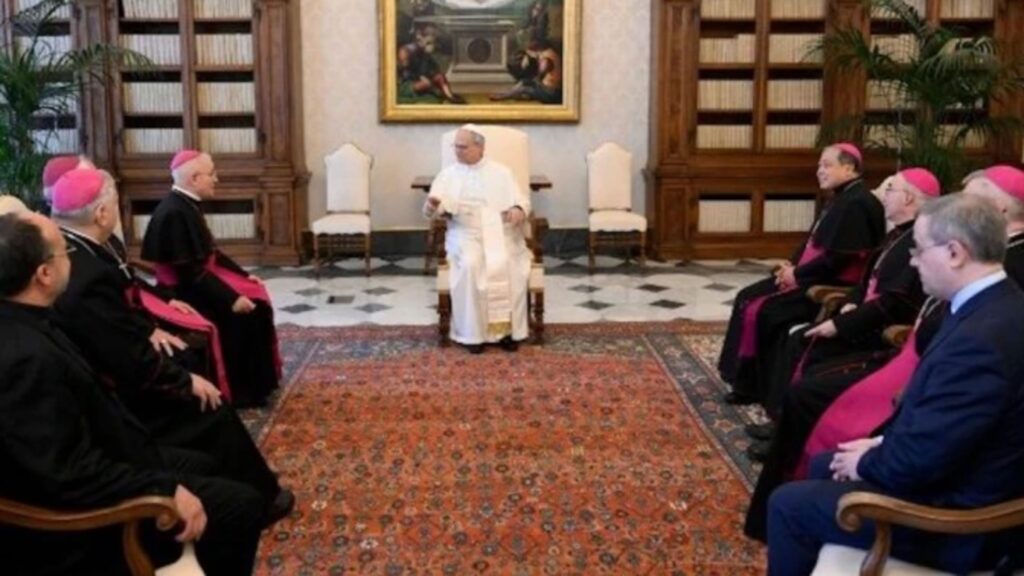
The Vatican’s doctrine office issued a response on Thursday to “clarify the reception of Fiducia Supplicans” amid widespread international backlash to the Vatican’s recent declaration on same-sex blessings.
Cardinal Victor Manuel Fernández, prefect of the Vatican’s Dicastery for the Doctrine of the Faith (DDF), published a five-page press release on Jan. 4 that refers to Fiducia Supplicans as “perennial doctrine” and underlines that pastoral blessings of couples in irregular situations should not be “an endorsement of the life led by those who request them.”
Fernández said that the responses he has received from bishops’ conferences around the world to the declaration highlight “the need for a more extended period of pastoral reflection” and that what is expressed in these bishops’ statements “cannot be interpreted as doctrinal opposition because the document is clear and definitive about marriage and sexuality.”
“There is no room to distance ourselves doctrinally from this declaration or to consider it heretical, contrary to the Tradition of the Church, or blasphemous,” the cardinal said, pointing to a few paragraphs in the text of the original declaration that affirms the Church’s doctrine on marriage. You can read the full text of the press release at the bottom of this story.
The clarification was published two and a half weeks after the Dec. 18 publication of Fiducia Supplicans, which prompted strong backlash from bishops in several African and Eastern European countries as well as confusion and division from other parts of the world.
Some bishops have welcomed the declaration, some are approaching it with caution, and others are refusing to implement it.
In the press release, published in six languages, Fernández provides one “concrete example” of what the spontaneous “pastoral blessings” might look like in practice, explaining that they should only last “about 10 or 15 seconds.”
“Since some have raised the question of what these blessings might look like, let us look at a concrete example: Let us imagine that among a large number making a pilgrimage a couple of divorced people, now in a new union, say to the priest: ‘Please give us a blessing, we cannot find work, he is very ill, we do not have a home and life is becoming very difficult: May God help us!” he said.
“In this case, the priest can recite a simple prayer like this: ‘Lord, look at these children of yours, grant them health, work, peace, and mutual help. Free them from everything that contradicts your Gospel and allow them to live according to your will. Amen.’ Then it concludes with the sign of the cross on each of the two persons.”
Fernández said that priests giving these types of blessings should “not impose conditions” or “enquire about the intimate lives of these people.”
He added that “this non-ritualized form of blessing, with the simplicity and brevity of its form, does not intend to justify anything that is not morally acceptable.”
“It remains clear, therefore, that the blessing must not take place in a prominent place within a sacred building, or in front of an altar, as this also would create confusion,” Fernández added in the clarification.
The press release did not mention anything about cases in which priests have already violated the terms stipulated in the Fiducia Supplicans declaration, which requires that blessings be spontaneous and cannot be a “blessing similar to a liturgical rite that can create confusion.”
The cardinal emphasized that the “real novelty of this declaration” is “the invitation to distinguish between two different forms of blessings: ‘liturgical or ritualized’ and ‘spontaneous or pastoral.’”
“The central theme … is to have a broader understanding of blessings and of the proposal that these pastoral blessings, which do not require the same conditions as blessings in a liturgical or ritual context, flourish. Consequently, leaving polemics aside, the text requires an effort to reflect serenely, with the heart of shepherds, free from all ideology,” he said.
The DDF’s press release says that the same-sex blessing declaration may require more time for its application “depending on local contexts and the discernment of each diocesan bishop with his diocese.”
“In some places, no difficulties arise for their immediate application, while in others it will be necessary not to introduce them, while taking the time necessary for reading and interpretation,” Fernández said.
The cardinal added that it is fine that some bishops have, for example, established that priests perform these blessings only in private, so long as this is “expressed with due respect for a text signed and approved by the Supreme Pontiff himself, while attempting in some way to accommodate the reflection contained in it.”
The clarification also notes that in countries where there are “laws that condemn the mere act of declaring oneself as a homosexual with prison and in some cases with torture and even death, it goes without saying that a blessing would be imprudent.”
The press release was signed by Fernández and Monsignor Armando Matteo, the secretary for the doctrinal section of the dicastery.
“We will all have to become accustomed to accepting the fact that, if a priest gives this type of simple blessings, he is not a heretic, he is not ratifying anything nor is he denying Catholic doctrine,” it said.
“We can help God’s people to discover that these kinds of blessings are just simple pastoral channels that help people give expression to their faith, even if they are great sinners. For this reason, in giving a blessing to two people who come together to ask for it spontaneously, we are not consecrating them nor are we congratulating them nor indeed are we approving that type of union.”
This article was originally published on Catholic News Agency.