The Vatican’s liturgy czar has intervened against the implementation of resolutions of the German Synodal Way that demand laypeople should be able to regularly baptize and preach the homily at Mass in churches across Germany.
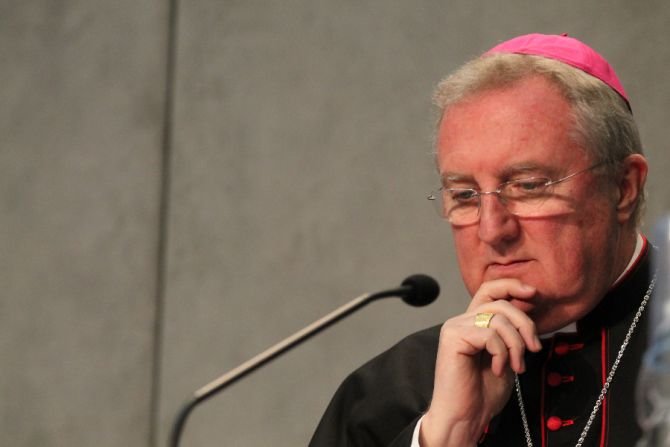
In a letter to the German Bishops’ Conference president dated March 29, Cardinal Arthur Roche said neither was possible — despite at least one German diocese already announcing both practices.
The written intervention by the Vatican’s prefect of the Dicastery for Divine Worship and the Discipline of the Sacraments was addressed to Bishop Georg Bätzing of Limburg, reported CNA Deutsch, CNA’s German-language news partner, which has obtained a copy of the document.
Apart from covering the question of homilies and baptisms by laypeople, the seven-page letter also reminded the German bishops that liturgical translations must be confirmed and approved by the Vatican.
On the issue of homilies, Roche wrote that the reason why laypeople cannot regularly preach at Mass is not due to their need for “better theological preparation or better communication skills.” Nor is the intent to create “inequalities among the baptized.”
Instead, the cardinal pointed to “distinctions made by the Spirit, who produces different charisms that are distinct and complementary.”
Roche wrote that well-formed laypeople should contribute, for instance, as catechists or by conducting conversations about sacred Scripture.
However, he added that laypeople could not give the homily at Mass since only someone ordained “sacramentally represents Christ by virtue of the sacra potestas [sacred power] conferred on him at ordination.”
Explaining that the issue of preaching at Mass was, in other words, a sacramental rather than an educational matter, Roche warned of “misunderstandings” about the figure and identity of the priest, who is the only one who can act ‘in persona Christi capitis’ [in the person of Christ, the head of the Church] by virtue of the sacrament.”
The cardinal also rejected the introduction of laypeople regularly administering baptisms, something already in practice in some German dioceses. He wrote that justifying this with a lack of priests, for example, was not possible under canon law.
Laypeople could only validly perform baptisms in exceptional circumstances, such as in danger of death or “in painful situations of persecution, but also in mission areas and in other cases of special need,” the cardinal explained.
Papal appeal to unity
Roche reminded the German bishops of Pope Francis’ 2019 letter regarding the direction of the Synodal Way process. “The universal Church lives in and from the particular Churches, just as the particular Churches live and flourish in and from the universal Church; if they were separated from the universal Church, they would weaken, decay, and die,” the pope wrote at the time.
Responding to Roche’s communication, a spokesperson for the German Bishops’ Conference on Thursday said the bishops would continue to seek dialogue with Rome on these issues.
Earlier this month, several German bishops announced plans to implement several resolutions passed by the Synodal Way.
Bishop Franz-Josef Bode of Osnabrück — then vice president of the German Bishops’ Conference — said laypeople could baptize babies and “regularly” preach at homilies in his diocese.
About one week later, on March 25, the Holy See announced that Pope Francis had accepted Bode’s request to resign.