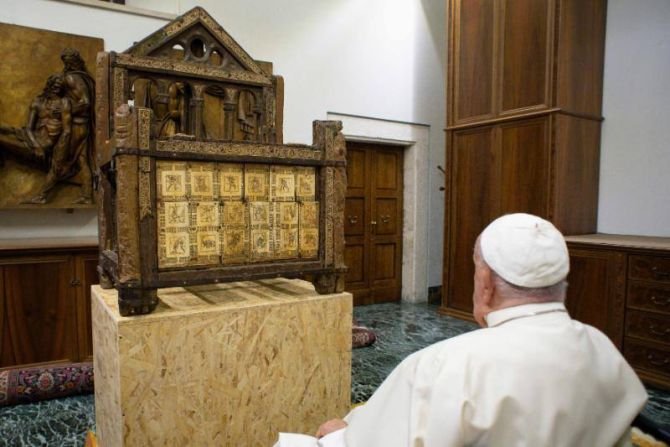
On Wednesday, Oct. 2, the Holy Father had the opportunity to view the historic relic of St. Peter’s chair in the Ottoboni sacristy of St. Peter’s Basilica after celebrating Mass in St. Peter’s Square ahead of the second session of the Synod on Synodality. The photo of him sitting before the chair went viral.
Francis is the first pope since 1974 to have viewed the relic believed to have belonged to St. Peter the Apostle.
Ordinarily, the historic wooden chair is encased inside the large chair monument crafted by the 17th-century sculptor Gian Lorenzo Bernini, which is installed directly above the altar in the apse of the Vatican basilica.
However, the Fabric of Saint Peter, a Vatican institution entrusted with the restoration and maintenance of the basilica, recently removed the chair from the monument amid restoration work on Bernini’s Baldacchino, the canopy that hangs over the Altar of the Cathedra, according to Vatican News.
What’s the story behind the ‘chair relic?’
Ancient tradition maintains that St. Peter himself sat on the chair during sermons to the early Christians in Rome.
However, according to Papal Artifacts, archeologists determined that only the acacia wood skeleton of the chair in its current form dates back to this time period. The rest of the chair is composed of oak, bound to the original skeleton by strips of iron, and is believed to be a reconstruction made during the Byzantine period. The ivory plaques featured in the bottom portion of the throne are also attributed to this time. They depict sketches of Hercules and various constellations.
Pope Alexander VII commissioned Bernini to construct the monument where the chair is ordinarily encased during his pontificate in the 17th century. Bernini completed the monument between 1647 and 1653, but it was not installed above the altar in St. Peter’s Basilica until 1666.
The bronze-gilded throne is set against a backdrop of golden clouds, directly above the main altar — which is composed of black and white marble from Aquitaine and red jasper from Sicily.
Above the chair, there is a pair of angels holding the tiara and keys symbolizing papal authority, while four large statues of St. Ambrose, St. Augustine, St. Athanasius, and St. John Chrysostom surround the monument. On the chair itself, there are three gold bas-reliefs representing the Gospel episodes of the consignment of the keys (Matthew 16:19), “feed my sheep” (John 21:17), and the washing of the feet (John 13:1-17).
What does the Chair of St. Peter symbolize?
Every year on Feb. 22, the Church celebrates the feast of the Chair of St. Peter, which is also a symbolic title for the papacy itself.
In 2006, during a speech delivered during his general audience on the feast of the Chair of St. Peter, Pope Benedict XVI described the spiritual significance of this symbol as “a privileged sign of the love of God, the eternal Good Shepherd, who wanted to gather his whole Church and lead her on the path of salvation.”
The Holy Father’s veneration of the chair — a symbol of the Church’s unity under the instruction of Christ — takes place amid the commencement of the second session of the Synod on Synodality.
This article was originally published on Catholic News Agency.