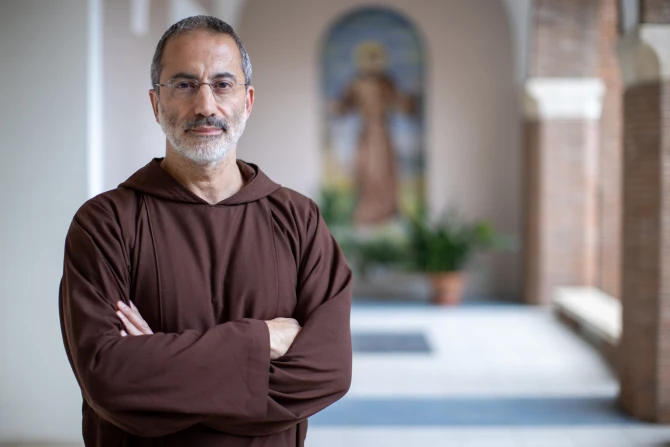
A Scripture expert who is now the official preacher of Pope Francis has explained what makes the Bible “modern” and why knowledge of the word of God is important for evangelization.
“The revelation of God is offered within a great variety of stories, tales, situations that correspond closely to life,” Father Roberto Pasolini, OFM Cap, told CNA in an interview last month.
People today are always thinking in terms of stories, whether that is Instagram “stories” or films or TV, he continued. “Because stories are places where we recognize ourselves immediately,” while it is sometimes harder to see ourselves in “more abstract, theoretical, and dogmatic formulations.”
“And so in this way, I think, the Bible is very modern as a resource for proclaiming the mystery of God,” he said.
On Jan. 26, the Catholic Church commemorates the Sunday of the Word of God, established by Pope Francis in 2019.
Francis, for the occasion, presided over a Mass in St. Peter’s Basilica in which he conferred the ministry of lector on 40 Catholics from four continents, including one layperson from Iceland.
The Mass was the concluding event of the three-day Jubilee of the World of Communications, part of the Catholic Church’s Jubilee of Hope in 2025.
Pasolini, who was appointed preacher of the papal household in November 2024, succeeding Cardinal Raniero Cantalamessa after 44 years, has a doctorate in sacred Scripture.
He said he considers himself very fortunate to have spent so many years in deep scriptural study, including several years in Rome and in Jerusalem.
According to the Franciscan Capuchin friar, “the Church has been experiencing since fairly recently — certainly since the Second Vatican Council onward — a theological renewal due to the rediscovery of the word of God contained in the Scriptures as the place to draw on in order to build an adequate theology.”
“The advantage that a person who knows the Scriptures has is to be able to place himself at a level where the understanding of God’s revelation is still very narrative, and therefore also very open and inclusive,” he said.
As a priest who also leads retreats and speaks publicly, Pasolini’s advice for preaching well is “first of all, to learn, especially in the years of theological, spiritual, or priestly formation, to do meditation on God’s word in a free way. That is, not to get used to doing things only when we have to do them for others.”
He explained how for years before his own preaching ministry began, he nurtured a habit of meditating on the word of God every day “for me, first of all, for my heart, for my life.”
“This habit of doing ‘lectio divina,’ as we would say today, accustomed me to stand before God every day as one who listens to him, receives a [message], and tries to respond to this [message],” he explained. “So, when I became a priest and started giving homilies and catechesis, I would just tell others what God and I had already said to each other during prayer.”
Pasolini added that he would organize what came to him in that dialogue with God, as the technical aspects of communication also should not be ignored, and he would not share everything that was said in prayer: “But I mean that the best preparation to give a homily, to give a catechesis, is to let God’s word touch your heart personally. Then, if we have allowed ourselves to be touched, we will surely be able to touch the hearts of others.”
This article was originally published on Catholic News Agency.