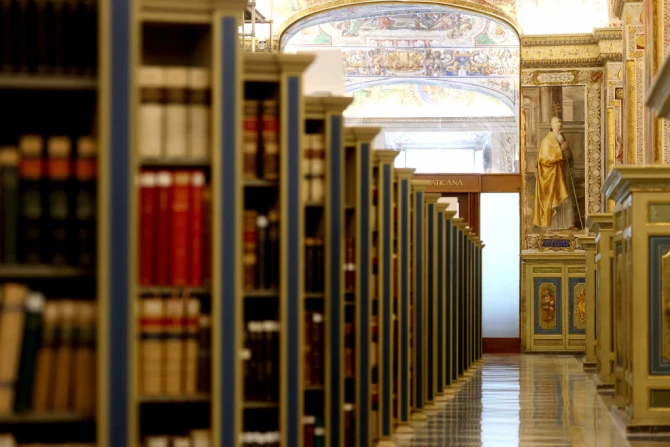
The Vatican Library is the custodian of a major part of humanity’s literary heritage. That includes more than 80,000 ancient manuscripts and 2 million printed books (8,600 of which are “incunabula,” that is, printed before 1501); a graphic collection (drawings, maps, engravings, photographs); 150,000 documents; a large collection of coins and medals (300,000 pieces); and a collection of archives (100,000).
The library is currently in the process of digitizing and publishing online all the manuscripts it houses, a project that first started in 2012. When necessary, manuscripts receive conservation treatments or are restored before digitization. So far, some 30,000 manuscripts have been digitized and published online. This work is made possible due to the support of many benefactors, including the Sanctuary of Culture Foundation, which generously supports the digitization and restoration of manuscripts as well as other projects.
Recently, a new collaboration was launched between the Vatican Library and the Colnaghi Foundation, a prestigious art gallery founded in 1760. The two institutions are working together specifically on the library’s archives section.
The five-year agreement provides for the restoration and reorganization of the archives’ storage facilities, which will improve the future preservation of documents spanning the 10th to the 20th century. The archival collections include documents of exceptional historical value.
The project, which involves a complete reorganization of the department, including new shelving systems and renovations, will be led by the renowned British architectural firm David Chipperfield Architects.
The Colnaghi Foundation has promoted the creation of an association, the Patrons of the Vatican Library, to assist in the project and to study and carry out other projects related to the conservation treatments of many of the archival manuscripts.
The association has provided a new system for scanning the surface of documents, called Selene, developed by the Factum Foundation. Among other benefits, this device makes it possible to bring to light parts of objects that are hidden from view.
To celebrate this collaboration between the art world, represented by the Colnaghi Foundation and the Vatican Library, the “Codex” exhibition opened on May 26.
The exhibit features 14 works from private collections that are not normally exhibited. The library has also selected 15 documents from its collections (manuscripts and archival documents) related to the people portrayed in the exhibited works, the curators of those works, or the artists who created them.
On June 3, the works will return to private collections, and the Vatican manuscripts will be returned to their original collections.
The works on display offer a visual and historical journey through sacred art and portraits from the Renaissance and Baroque periods, highlighting pieces by some of history’s greatest masters.
The exhibition opens with “Saint Peter Penitent” by Flemish artist Anthony van Dyck, which depicts the weeping apostle with a deeply human expression of repentance and features baroque chiaroscuro (strong light and dark contrasts).
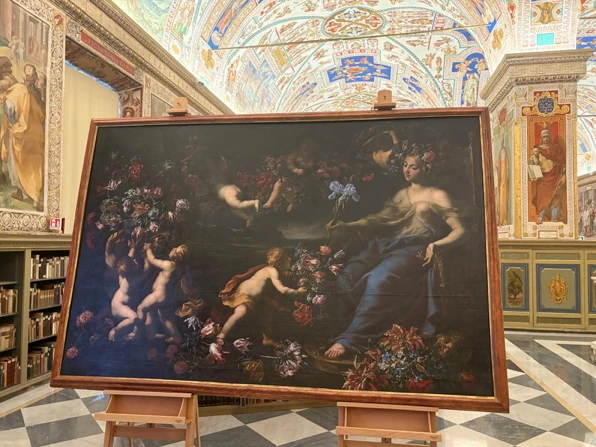
The exhibition continues with “The Triumph of Flora,” a mythological allegory by Mario Nuzzi, exuberant in color and symbolism, which celebrates the fertility of nature with a festive and decorative spirit that contrasts with the gravity of other pieces.
Another work on display is Michelangelo Buonarroti’s preparatory sketch for “The Adoration of the Brazen Serpent,” a powerful scene from the Old Testament. The drawing demonstrates the artist’s anatomical and expressive intensity, which manages to condense drama and redemption into a single figure.
The exhibition also includes works by other influential artists of the 16th and 17th centuries, such as Titian’s “Portrait of Pope Paul III,” painted during his trip to Rome between October 1545 and May 1546. This painting, in which the pope appears with a shrewd expression and the traditional camauro (red cap with white trim), a symbol of his authority, belongs to a private collection and is kept in Lisbon, Portugal.
SIGN UP FOR OUR NEWSLETTER HERE
This article was originally published by CNA.