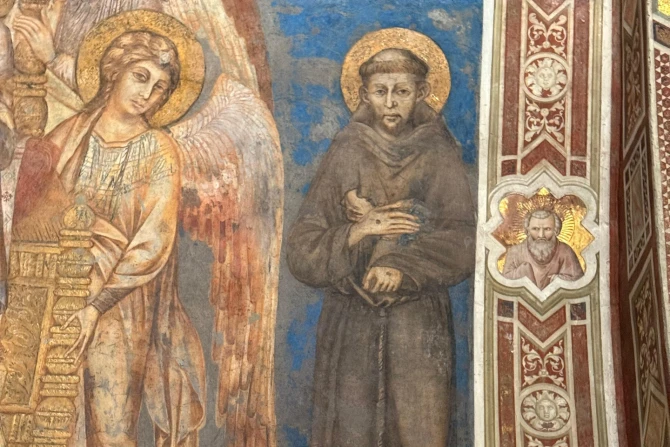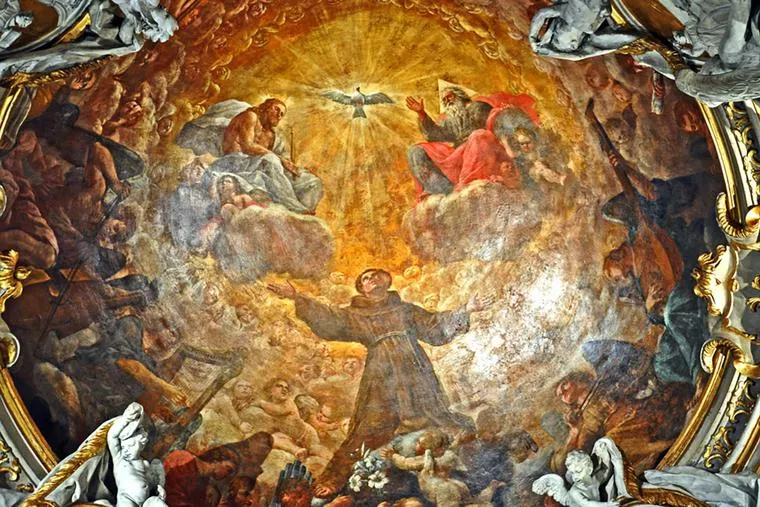
SAINTS & ART: St. Anthony reached out to everyone and preached Christ and moral renewal.
SIGN UP FOR OUR NEWSLETTER HERE
St. Anthony came into the world as “Fernando” in 1195 in Lisbon, Portugal of probably noble parents. He was a contemporary of St. Francis of Assisi and one of the first generation of Franciscans.
He entered the Monastery of the Augustinian Canons at age 15 and was transferred to their community in Coimbra, about 125 miles north of Lisbon where, given his roots and familial ties, life was more distracting. During nine years in Coimbra, he studied theology and during this period was probably ordained.
In 1220, the bodies of five of the first Franciscan martyrs were brought back from Morocco, where they had been beheaded for their preaching by the Muslims. The return of their bodies inflamed the young man’s missionary zeal, who wanted to become a Franciscan and preach in Morocco. He received the habit from Franciscans at the nearby monastery in Olivares, taking the name “Anthony.”
God’s ways are not always man’s and while he reached Morocco, illness forced him to return to Portugal. The ship bringing him home ran into headwinds that blew it off course, landing him in Sicily. He was cared for by the Franciscans in the monastery at Messina and eventually took part in a Franciscan chapter in Assisi.
Not recognized there, he sought out a local provincial who sent him to a hermitage at Montepaolo in northeast Italy, near Forli, to be the priestly chaplain to the brothers. Not having revealed his previous education, in 1222 he was asked to deliver a sermon at an ordination supper. The detail had been overlooked and the Franciscans and Dominicans in attendance were unprepared. In order to “check the box,” Anthony was asked to deliver some remarks as the Spirit led him. The degree and profundity of his preaching astounded those who heard it, and St. Francis himself designated him to teach theology to other Franciscans. Anthony taught in Bologna in Italy and Montpellier and Toulouse in France.
Anthony excelled, however, in public preaching, especially against the various heresies then rampant in northern Italy and especially southern France, particularly Albigensianism and Catharism. He probably made about 400 missionary trips in that area. His preaching earned him the name “hammer of heretics” (malleus hereticorum). Both heresies were not far removed from ways of thinking today, because they denigrated the body and sexuality, a dualistic view of the world. Anthony preached particularly about moral renewal, one of the key efforts of the then-newly formed Franciscans and especially Dominicans.
He eventually was also a provincial in northern Italy, while his famous Lenten preaching and hearing confessions in Padua in 1231 attracted perhaps 30,000 people — a huge number for that day. Imagine a priest today attracting 30,000 listeners by his preaching!
Anthony knew death was near him and, on June 13 in Arcela, near Padua, he died, aged 36.
Many miracles were associated with his life. “St. Anthony’s Bread” is associated with a mother who, in 1263 (35 years after Anthony’s death) begged the saint to restore the life of her son who had drowned near a basilica named after him. She promised that if her son was restored, she would donate grain the equivalent of her son’s weight to feed the poor. Her boy was returned to her.
The tradition of St. Anthony as a finder of lost things goes back to an event in his own life, where his Book of Psalms with his annotations was missing. Besides the sacredness of the book and the value of his notes to him, this was an era 300 years before printing. Books were hand-copied and extremely costly and valuable. A novice who had stolen the book returned it.
St. Anthony is often depicted with two attributes: lilies and the Christ Child. Lilies are an obvious allusion to his purity. The account of the Christ Child alludes to a visit Anthony made to a hermitage, where late at night a light was seen in his room. The owner came and observed Anthony playing with and holding the Christ Child, who was laughing to him. The owner felt to his knees at the threshold, but Anthony instructed him not to reveal what he saw until after his death.
Anthony reached out to everyone and preached Christ and moral renewal. He was already popular in his own day, and devotion to him has only increased over the centuries. Let me acknowledge a family debt. My maternal grandmother prayed to St. Anthony for a peaceful death. One Saturday night, she felt tired; early the next morning, she called for my mother’s help. As my mother held her, she died peacefully, aged 90. Thank you, Saint Anthony.
Our saint is illustrated in an 18th century from Ravenna, Italy, the “Glory of St. Anthony.” Anthony is depicted on his way to heaven, the Trinity ready to receive him. Many saints and angels witness his entry to glory while puti — winged, Cupid-like spirits — bear him to God. The golden heavenly realms are filled with people — a “cloud of witnesses” (Hebrews 12:1) — reminds us of two truths: we all want to be in the position St. Anthony is depicted in here, and heaven is a place of profound joy, human and angelic. It reminds me of a wise aphorism of St. Josemaría Escrivá: “Does your soul not burn with desire to make your Father God happy when He has to judge you?” And proud?
This article was originally published on National Catholic Register.