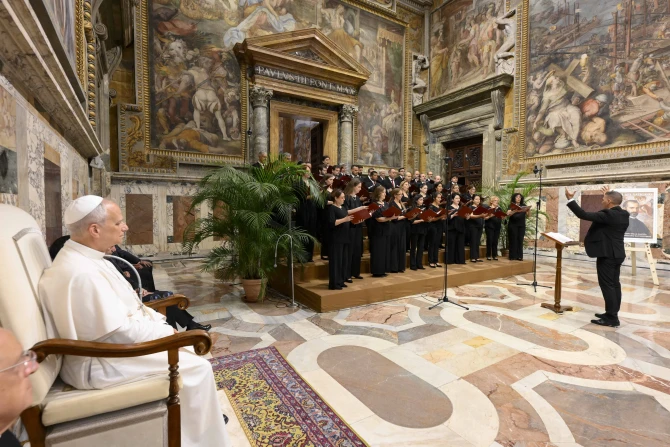
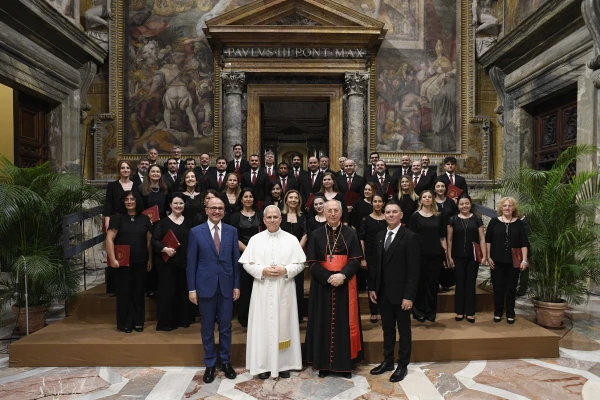
At an event sponsored by the Domenico Bartolucci Foundation on Wednesday, Pope Leo XIV said that polyphony is a musical form “full of meaning” for prayer and Christian life, and cited the works of the famous Italian composer Giovanni Pierluigi da Palestrina as an example.
FIND THE POPE’S BIOGRAPHY HERE
The Holy Father offered his praise to polyphonic music while welcoming participants at the June 18 event commemorating the 500th anniversary of the birth of Palestrina, a great composer of sacred music of the 16th century who directed institutions such as the Sistine Chapel, the Lateran Chapel, and the Liberian Chapel.
“Giovanni Pierluigi da Palestrina was, in the history of the Church, one of the composers who most contributed to the promotion of sacred music, for ‘the glory of God and the sanctification and edification of the faithful’ in the difficult yet passionate context of the Counter-Reformation,” Leo XIV said.
Among Giovanni Pierluigi da Palestrina’s best-known works are “Tu es Petrus,” “Missa Papae Marcelli,” and “Missa brevis” (“You are Peter,” “Mass of Pope Marcellus,” and “Brief Mass”).
“His solemn and austere compositions, inspired by Gregorian chant, closely unite music and liturgy, ‘both by giving prayer a sweeter expression and fostering unanimity, and by enriching the sacred rites with greater solemnity,’” the pontiff added.
In this regard, Leo XIV said that polyphony “is a musical form full of meaning, both for prayer and for Christian life,” since “it is inspired by the sacred text, which it seeks to clothe with an appropriate melody so that the faithful may better understand the text.”
The pope explained that polyphonic music “achieves this goal by entrusting the words to several voices, each of which repeats the words in its own unique way, with varied and complementary melodic and harmonic movements.”
“Finally, everything harmonizes thanks to the skill with which the composer develops and interweaves the melodies, respecting the rules of counterpoint, echoing them, sometimes even creating dissonances that later find resolution in new chords,” he noted.
Leo XIV said that “the effect of this dynamic unity in diversity — a metaphor for our common journey of faith under the guidance of the Holy Spirit — is to help the listener enter ever more deeply into the mystery expressed by the words, responding, if appropriate, with responsories or in alternations.”
The pontiff noted that “thanks to this richness of form and content, the Roman polyphonic tradition, in addition to having bequeathed us an immense artistic and spiritual heritage, remains even today, in the musical field, a reference to which we can turn, albeit with the necessary adaptations, in sacred and liturgical composition.”
In this way, through song, the faithful will be able to participate “fully, consciously, and actively in the liturgy, profoundly involving voice, mind, and heart.”
Pope Leo XIV held up the “Mass of Pope Marcellus” as an example of excellence “as well as the precious repertoire of compositions bequeathed to us by the unforgettable Cardinal Domenico Bartolucci, the illustrious composer and, for almost 50 years, director of the Sistine Chapel Choir.”
The Holy Father recalled the words of St. Augustine, who, “speaking of singing the Easter Alleluia, said: ‘Let us sing it now, my brothers … As wayfarers sing, but walk … Go forward, go forward in good … Sing and walk! Do not stray from the path, do not turn back, do not stop!’”
“Let us make his invitation our own, especially in this sacred time of joy. My blessing to all,” he concluded.
SIGN UP FOR OUR NEWSLETTER HERE
This story was first published by ACI Prensa, CNA’s Spanish-language news partner. It has been translated and adapted by CNA.