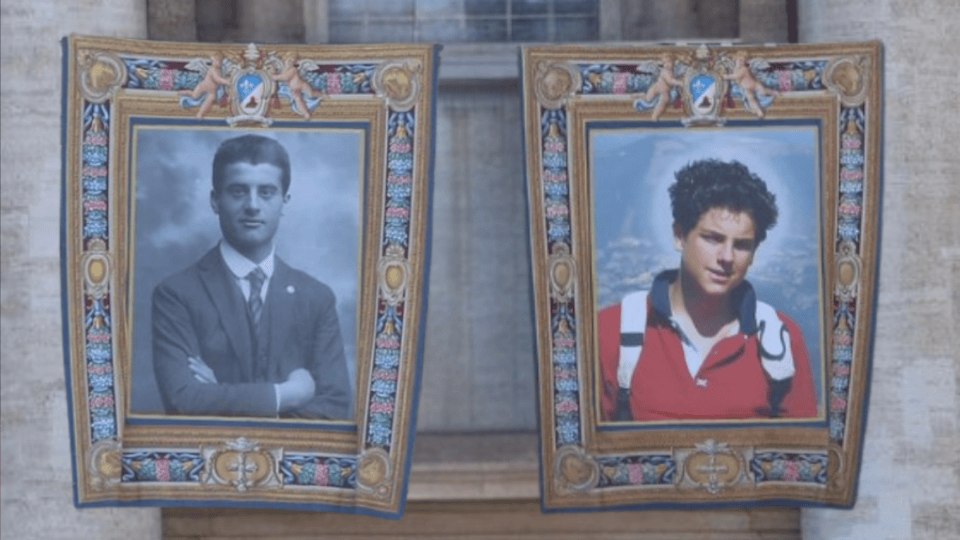
In this exclusive interview, Andreas Thonhauser, Vice President and Chief Global Officer of EWTN sits down with Cardinal Marcello Semeraro, Prefect of the Dicastery for the Causes of Saints, in his office overlooking Saint Peter’s Basilica. Together, they explore the lives and spiritual lessons of two remarkable young saints: Carlo Acutis and Pier Giorgio Frassati. Carlo Acutis, known as the “saint of the internet,” used his technological skills to document Eucharistic miracles, inspiring teenagers and Catholics of all ages to live with devotion, generosity, and a deep love for the Eucharist.
The conversation then turns to Pier Giorgio Frassati, a young Italian layman whose commitment to faith, charity, and social engagement left a profound legacy. Cardinal Semeraro highlights Frassati’s joy, his dedication to helping the needy, and the enduring lessons his life offers to young people navigating the challenges of today’s world. This dialogue provides a unique glimpse into how modern saints continue to guide and inspire us.
SIGN UP FOR OUR NEWSLETTER HERE
Your Eminence, thank you so much for inviting us into your office, here, right next to Saint Peter’s Basilica. This is the place where saints are created. Can you tell us what can teenagers learn from Carlo Acutis?
There are things to be learned here that apply to the age. But then there are also universal values that apply to everyone. Not only the teenagers, but all of us can learn from Carlo Acutis. On a spiritual level, we need to learn how to detach oneself from realities, to dedicate oneself to others. To live for others. Of course, the commandment says, “Love your neighbor as yourself,” and so it is important to know how to love yourself, so it is important to have a linear life, a correct life. The relationship with oneself is very important for the relationship with others, but Carlo Acutis knew how to live not only for oneself, not only to take care of oneself, but also to open oneself to the relationship, to the encounter with others, to give a witness, the witness of the Christian faith.
And if you allow me a more personal question. For your faith – what is inspiring to you when you think of Carlo Acutis?
I must tell you that yes, there is a personal angle. There’s the fact that the beatification of Carlo Acutis happened when the Holy Father had just decided and communicated to me to call me to this office. Given my old friendship with him, I had asked him to have time to think about it for a few days, a few weeks, and Carlo Acutis was beatified just the Sunday before. Two days later my nomination was made public. So the Bishop of Assisi invited me to go to Assisi to celebrate Mass on Sunday evening and also to close the tomb that they had kept open during that week. And so I went willingly, and Carlo Acutis, I saw him at that moment as an icon, an image that the Pope later spread. It was the image of a young man, a young monk, carrying on his shoulders an old man, an elderly monk, and I somehow felt that Sunday a little bit like the elderly monk being carried by a young man. And in my prayer, in that first gesture, we would say, as the new Prefect of this dicastery, I think it was to ask Carlo Acutis to carry me on his shoulders as a young man, even though I was old, and to help me walk with his strong legs.
In this Jubilee year we will see another canonization of a saintly hero of the youth: Pier Giorgio Frassati.
Frassati is a young man who is at least 24 years old. This is an adult person, who has made life choices, a person who is not at the beginning of his studies. He was about to graduate in mining engineering. He held so many relationships that even on the day of his death he was surprised by the presence of so many people he had helped during his life. A great Italian writer, a great man of letters, a writer, a poet, Giovanni Papini, said in one of his introductions to a biography of Frassati: “Pier Giorgio kept his good works hidden, as we so often keep our sins hidden. He hid the good works, the works of charity that he was doing“. And all this came out of the blue, leaving his father and his mother astonished. His Mother wondered, “But why are these people coming? Why are they coming to our house after my son has died? And no one understood why.
We have to understand that people had different lifestyles then. So Pier Giorgio’s mother was nervous when he came home late at night. She wondered what he had been up to. But Pier Giorgio would come from Eucharistic Adoration, which was done in the parish until late at night. When we think of Frassati we should not only talk about a commitment to the life of faith, to the spiritual life, or charity.With Frassati we also talk about a political commitment. He was very close to the popular movements, for example, in Italy at that time, it was Sturzo’s Popular Party. He was very close. There are also figures in socialism at that time, like Filippo Turati, etc., who talk about Frassati as this strong man.
What can we learn from Pier Giorgio Frassati?
From Pier Giorgio we can learn a busy life, open on many fronts. Especially on the social front. He chose to study mining engineering in order to be close to the miners who were emigrating to Belgium at the time. He makes it clear that he made this choice to be close to the most needy class of the time. However, in addition to this sense of charity, I think there are other aspects that we can take to heart. First of all, the strong sense of friendship, and then what was called in a book written 10 years ago, “The Age of Sad Passions,” in which there is so much despair that even here we see very worrying indices of youth depression. And Pier Giorgio provokes us to be joyous. That is a very important testimony.
Joy, which is different from cheerfulness or happiness. At least in the Italian language, joy is more than just happiness, which is motivated by external reasons. Whereas joy comes from inner reasons. From reasons of inner peace, of having found one’s identity, of having made life choices, of feeling capable of serious relationships. And from that comes joy. And maybe today we need this kind of joy very much.
Subscribe for EWTN vatican News updates
Adapted by Jacob Stein