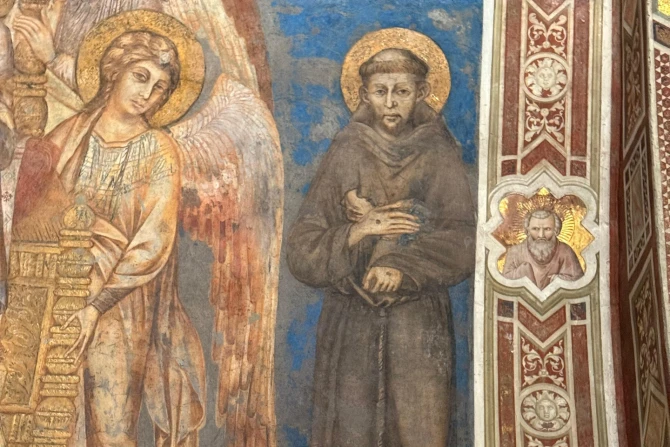
The Catholic Church celebrates the feast of St. Francis of Assisi every year on Oct. 4. Known as the patron saint of animals and ecology, the 13th-century Italian friar is often remembered for his deep humility, his life of prayer, and for founding the Franciscan order.
Here are seven things to know about this beloved saint:
1. Francis was a party-loving rich kid before his conversion.
Before giving his life completely over to the Lord, Francis lived a life of luxury. His father, Pietro di Bernardone, was a wealthy silk merchant in Assisi, and Francis lived a carefree, pleasure-seeking life in his youth. He was known for partying, fine clothes, and his dreams of glory on the battlefield. It wasn’t until he was captured during a war between Assisi and Perugia — and spending nearly a year in prison — that he began to reflect on a different path.
2. Francis voluntarily gave up his wealth.
After hearing God’s call to “rebuild my church,” Francis renounced his family’s wealth in a dramatic and public fashion. In front of the bishop and townspeople, he stripped off all his clothes — literally — and gave everything back to his father. He declared that from that point on, he would have no father but “Our Father who art in heaven.” It was at this moment that he completely rejected worldly goods and embraced a life of poverty.
3. Francis never became a priest.
Many assume that St. Francis was a priest, but he was never ordained beyond the role of deacon. Due to his great reverence for the Eucharist, he felt unworthy to become a priest. Therefore, he remained a friar and lived a life of poverty, charity, and devotion to God.
4. Francis was the first recorded person to receive the stigmata.
In 1224, while on retreat at Mount La Verna, Francis experienced a vision of a seraph bearing the image of Christ crucified. When the image ended, the wounds of Christ appeared on his body — piercings in his hands, feet, and side.
5. Francis wrote one of the first known works of Italian literature.
Francis’ “Canticle of the Sun,” written around 1225, is considered one of the earliest works in the Italian language. At the time, most literary pieces were written in Latin. However, Francis chose to write it in his native language so more people could understand it. “Canticle of the Sun” is a poem in which Francis encourages all of creation to praise the Creator and consists of 23 verses dedicated to different aspects of creation.
6. Francis created the first living Nativity scene.
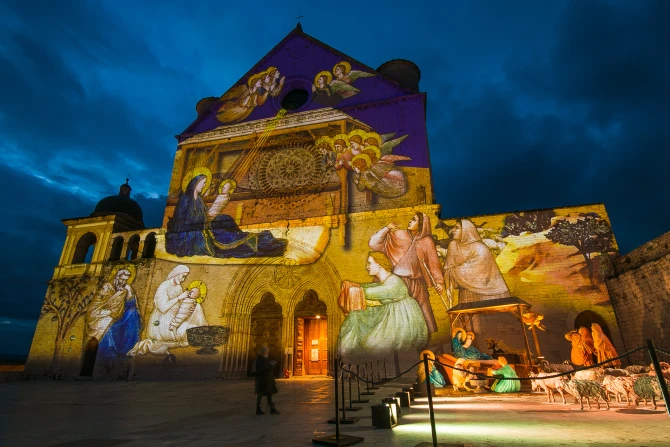
In 1223, Francis staged the first-ever live Nativity scene in Greccio, Italy. He used real people and animals with the hope of helping people connect more with the birth of Christ. To this day, the people of Greccio stage a live, historical reenactment of St. Francis and the first Nativity scene every year at Christmas.
7. Francis’ order continues his legacy over 800 years later.
The Rule of St. Francis was approved in 1223, which marked the beginning of the Franciscan order. The order has three main branches: the First Order (Friars Minor), the Second Order (Poor Clares), and the Third Order (Secular Franciscan Order for laity). Franciscans take vows of poverty, chastity, and obedience. Today, Franciscans are active in over 100 countries and have roughly 650,000 members across its various branches.
This article was originally published by CNA.