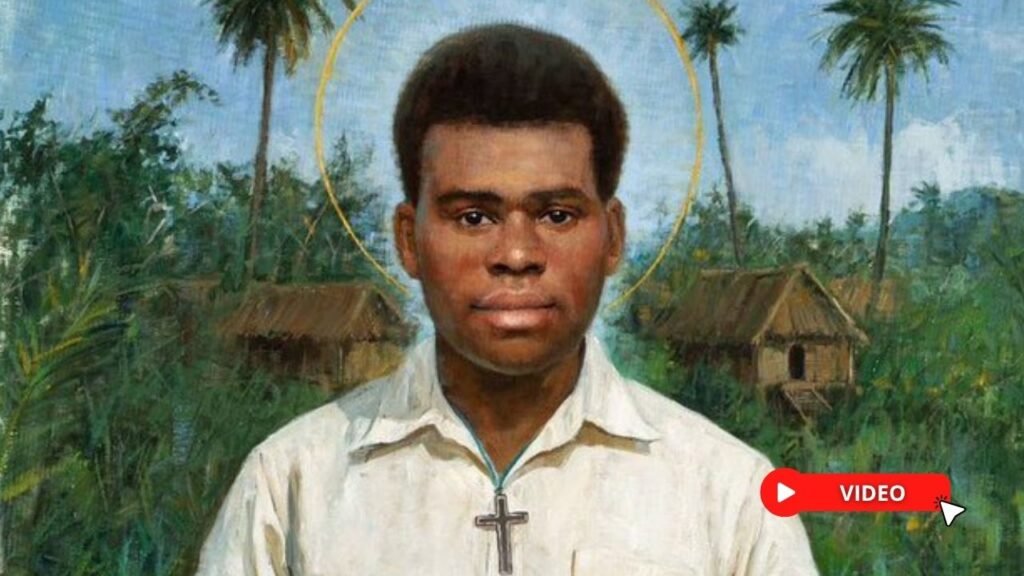
October 19th marked a historic day of joy for the people of Papua New Guinea, as Peter To Rot was canonized by Pope Leo XIV — becoming the nation’s first indigenous saint and a witness to the power of faith, marriage, and martyrdom.
A Saint for the People of Papua New Guinea
Sunday, October 19th is a day of great joy and celebration for the people of Papua New Guinea, as, for the first time in history, an indigenous islander — Peter To Rot — is being canonized by Pope Leo XIV.
Rudolf Pamat, one of only two seminarians from Papua New Guinea currently studying in Rome, is in his third year of Theology at the Pontifical Urban University. Reflecting on this moment, he shares:
“They are more than happy — they are truly delighted. This is the first time we have a local saint.”
For Rudolf, the canonization of Peter To Rot carries profound personal significance.
“I come from the Archdiocese of Rabaul,” he shares, “where Peter To Rot was martyred. The Feast of Blessed Peter To Rot was instituted by Pope John Paul II, that’s on the 7th of July. I came to know more about Blessed Peter To Rot when we celebrated the Feast.”
A Catechist, Husband, and Martyr for the Faith
Born in 1912, Peter To Rot grew up in a devout Christian household and began his religious formation early. Commissioned as a catechist by German missionaries, he was known for his integrity, spiritual strength, and compassion — quickly becoming a leader in his community.
Fr. Boguslaw Turek, Under-Secretary in the Dicastery for the Causes of Saints, notes:
“Peter To Rot is a beautiful figure — a husband, a father, and a catechist. He comes from the very first generation of Christians in Papua New Guinea. His parents were among the first to be baptized.”
Faith Under Persecution
During the Japanese occupation of Papua New Guinea in the 1940s, Christianity was banned. Both foreign missionaries and local Catholics were imprisoned or killed. Amid this, Peter To Rot continued baptizing children, leading prayers, and ministering to the sick and elderly.
In 1945, he publicly denounced polygamy, which the Japanese had encouraged to appease tribal leaders. For his bold defense of Christian marriage, he was arrested and later executed by lethal injection after two months in prison.
Mr. Pamat reflects on this powerful testimony:
“Peter To Rot was murdered for defending the sacrament of marriage. This is a time to renew our commitment to life as couples — to recommit to one another, to the sacrament of marriage, and for all of us to renew our commitment to God in our own vocations — whether as religious, laity, or clergy.”
From Beatification to Canonization: A Nation’s Long Wait
Peter To Rot was beatified by Pope John Paul II during a visit to Port Moresby in 1995. Now, three decades later, his canonization — alongside six other new saints from around the world — has been fulfilled in St. Peter’s Square.
“It’s surely a moment of great joy,” Fr. Turek says. “It’s also a moment of pride, because it shows that the universal Church recognizes and cherishes the treasures found in national churches.”
A Growing Local Church
Faith in Papua New Guinea remains strong. Although Catholicism only arrived 150 years ago with missionaries landing on Yule Island, it has flourished. During Pope Francis’ 2024 apostolic journey to Oceania, EWTN visited the site of the first Mass celebrated in 1885.
“Even today, there are still missionaries — and thanks be to God, they continue to support the Church in Papua New Guinea. But now we also have indigenous priests, brothers, and sisters as well,” says Mr. Pamat.
Today, most priests serving the country’s 9 million people are native vocations. Rudolf Pamat, preparing for priesthood, looks forward to returning home:
“My dream is to be with the people — wherever my bishop sends me.”
With Saint Peter To Rot as a heavenly intercessor, his mission — and that of countless young Catholics — is now blessed with an even greater strength and purpose.
Adapted by Jacob Stein. Produced by Magdalena Wolinska-Riedi; Camera by Sergio di Natoli.