Pope Leo XIV began his second day in Lebanon on Monday with a deeply symbolic pilgrimage to the tomb of Saint Charbel Makhlouf, entrusting the country and the wider Middle East to the intercession of the saint whom many Lebanese, Christians and Muslims alike, invoke as the “heavenly physician.”
The pope traveled roughly 25 miles (40 kilometers) by car from the Apostolic Nunciature in Harissa to the hilltop monastery of St. Maron in Annaya, where thousands of pilgrims come each year seeking healing and consolation. The monastery’s archives record nearly 30,000 miracles attributed to Saint Charbel’s intercession, including many reported by Muslims, a sign, the pope noted, of Charbel’s unique place in Lebanon’s spiritual landscape.
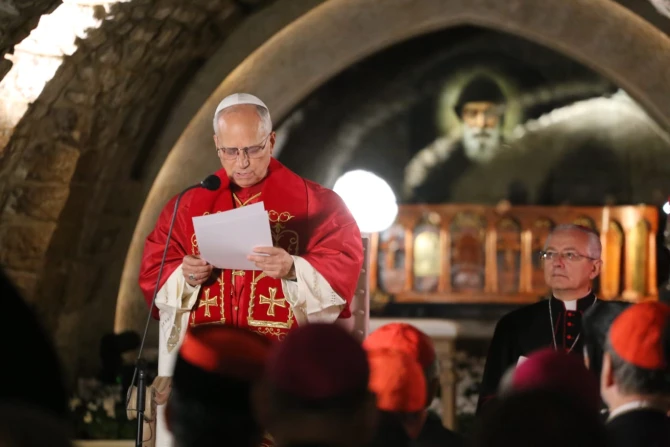
Pope Leo prayed in silence at the saint’s tomb before being welcomed by Abbot Hady Mahfouz, Superior General of the Lebanese Maronite Order. He then offered a reflection on Saint Charbel’s enduring message.
“What does Saint Charbel teach us today?” Pope Leo asked. Despite leaving behind no writings, he said, the hermit of Annaya continues to speak with surprising power. “The Holy Spirit formed him so that he could teach those who live without God how to pray, those immersed in noise how to be silent.” Charbel also teaches “those who live ostentatiously how to be modest, and those who seek riches how to be poor.”
This message, he added, is addressed to all Christians and “reminds us, bishops and ordained ministers, of the evangelical demands of our vocation.”
The pope described the saint’s intercession as “a river of mercy,” recalling in particular the monthly pilgrimage held every 22nd of the month in memory of a miracle granted to a woman named Nouhad El Chami, a devotion that still draws thousands.
Pope Leo prayed for unity within the Church and for peace in Lebanon and the Levant. “There is no peace without conversion of hearts,” he warned. As a sign of entrustment, he offered a lit lamp to the monastery, praying that Lebanon “may always walk in the light of Christ.” He concluded by reciting a prayer in French, asking God, through Saint Charbel’s example, to grant the Lebanese people faith, inner silence, healing of body and soul, and renewed strength in trials.
Born Yousef Antoun Makhlouf in 1828 in the remote village of Bkaakafra, Saint Charbel is one of the most beloved saints of the Maronite Church. Known from childhood for his devotion and simplicity, he entered the Lebanese Maronite Order in 1851, was ordained a priest in 1859, and later embraced a life of strict solitude at the Hermitage of Saints Peter and Paul near Annaya.
For 23 years he lived in silence, fasting, and continuous prayer. After his death on Christmas Eve in 1898, reports of extraordinary signs around his tomb, including the incorrupt state of his body, drew global attention. He was beatified in 1965 and canonized in 1977 by Pope Paul VI. Today he is venerated worldwide as a model of humility and a powerful intercessor for the sick.
Saint Charbel’s tomb lies within the St. Maron Monastery, perched at 1,200 meters above sea level. Founded by the Lebanese Maronite Order, the site grew significantly after Charbel’s beatification to accommodate the rising number of pilgrims. A larger church dedicated to the saint was inaugurated in 1974. The monks continue to welcome visitors and maintain the grounds, sustaining themselves through agricultural work, a balance of labor and prayer inspired by the saint they guard.
Pope Leo’s visit to Annaya, the first by any pontiff, reinforced the central message of his pilgrimage to Lebanon: a call to conversion, hope, and unity rooted in the spiritual heritage of a country longing for peace — and in the intercession of one of its most beloved saints.
Follow all EWTN News coverage of Pope Leo’s First Apostolic Trip here.
This article was originally published by CNA.