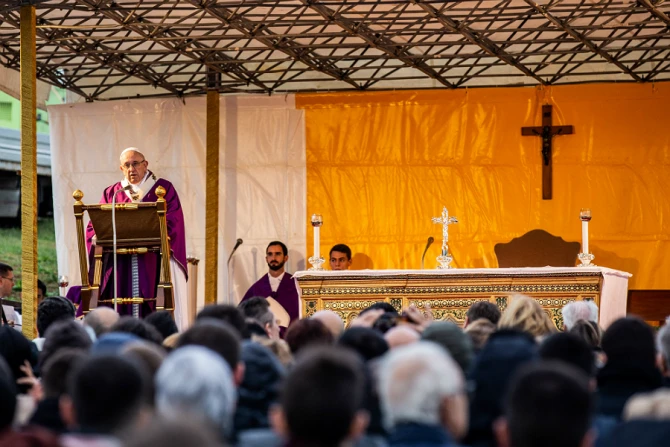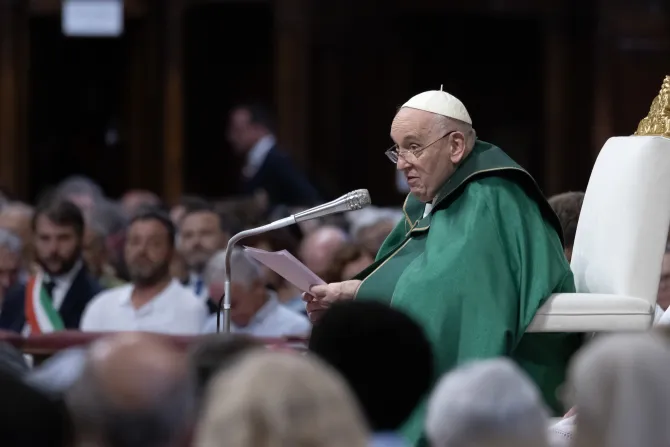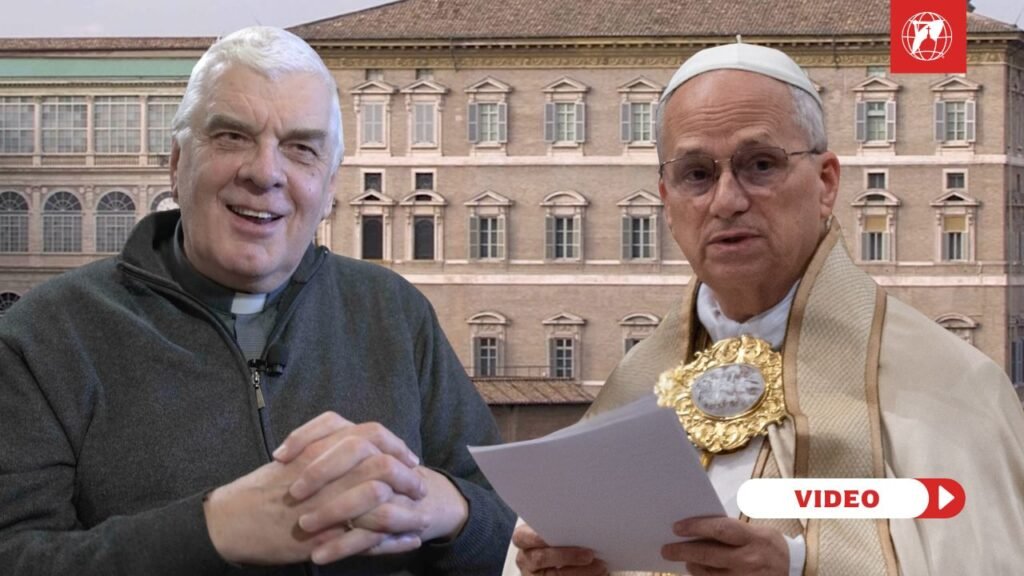
When Lent begins in the Vatican, the rhythm of life within the Apostolic Palace changes. The Holy Father withdraws for the annual Spiritual Exercises, praying alongside cardinals, bishops, and members of the Roman Curia. Among them is a quiet but crucial figure: the Theologian of the Papal Household.
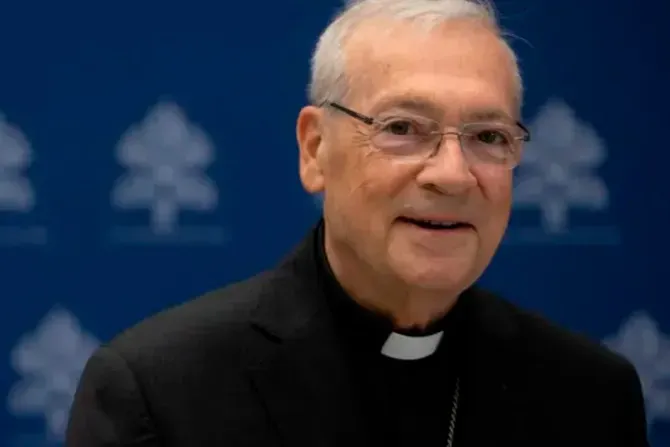
Considered part of the so-called “papal family,” he lives and works at the heart of the Vatican, closely involved in the Pope’s spiritual and intellectual life. Since 2005, that role has been held by Fr. Wojciech Giertych, a 74-year-old Dominican priest who has served the last three popes. One of the few people who reside permanently inside the Apostolic Palace, he now awaits Pope Leo’s move there — ready to welcome him as a neighbor.
In an interview with EWTN Vatican correspondent Magdalena Wolińska-Riedi, Fr. Giertych reflected on his unusual vocation and on the deeper meaning of Lent.
Guarding the Pope’s Words
When asked about his responsibilities within the Papal Household, Fr. Giertych responded with characteristic humility: “Well, that’s a good question. I would like to have an answer. I was never given an answer, strictly speaking,” he said, before explaining the practical reality of his work.
“Basically the procedure in the Holy See is such that the discourses which are prepared for the Pope, basically not by the Pope, but for the Pope— It’s obvious that the Pope has many, many meetings and so many discourses are prepared; And they’re prepared by various people depending on the subject matter—And so before the Holy Father receives the text, the function of the theologian of the Holy Father is to look at them and see if they’re not confusing, if they’re not ambiguous, if something has to be corrected. And this is the prime reason why I live here in the Vatican, because these texts are sometimes prepared in the last moment.”
In other words, his task is to safeguard theological clarity. Before a papal address is delivered to the world, it passes through his careful review — ensuring precision, faithfulness, and coherence.
What Lent Truly Means
Beyond his daily responsibilities, Fr. Giertych sees Lent as a deeply spiritual invitation. Asked what Lent means for a believer, he pointed to Christ’s forty days in the desert.
“It’s a time of maybe a deepened prayer,” he explained, recalling how the liturgy reminds the faithful of “the encounter of Jesus with the evil one, and the three temptations.”
He described those temptations in vivid terms: “to use the power of Jesus and change stones into bread, to use the power of the angels and do something stupid, to jump off the pinnacle of the temple and crust in an absurd way, and then to bow in front and adore the evil one as to possess the entire world.”
Christ rejected them all. In doing so, Fr. Giertych noted, Jesus entered fully into the human condition — even into moments “where the meaning of life seems to be difficult, seems to slip through the fingers.”
“And yet, nevertheless, he continued in his prayer,” the Dominican priest emphasized.
For believers today, Lent becomes “an invitation for a deepened prayer, a deepened focus on God and the putting away of distractions and assuring that God is essential in our lives.”
Human Effort and Divine Grace
Lent often raises a fundamental question: is it primarily about human effort — fasting, sacrifice, discipline — or about God’s grace?
Fr. Giertych insists the two cannot be separated. “We have to distinguish between nature and grace,” he explained, “between our natural thinking and working on the basis of faith, which opens us to grace. But grace doesn’t appear as a rival to our will and to our mind.”
He offered a concrete example. A father who spends ten minutes each day speaking with his teenage child gives a fully human gift. “That gift of the dad is 100% human. It’s his gift,” Fr. Giertych said.
But when that effort is lived in faith — perhaps as a special Lenten commitment — something more occurs. “This time given to the child is 100% human and 100% divine at the same time, because grace is working within us.”
Grace, he added, does not diminish freedom. On the contrary, it strengthens it: “in such a way that we don’t lose the dignity and liberty of our will, but we become even more free, even more generous, even more true.”
Why Confession Matters
Confession stands at the center of Lenten practice. When asked why people seek the sacrament, Fr. Giertych again highlighted both the human and divine dimensions.
“There is the human aspect and the divine aspect, and the divine aspect is working through the human, through the gestures, through the words, through the sacramental signs,” he explained.
While it is possible to encounter God outside the sacraments — “through faith, hope, and charity expressed in prayer” — the sacraments provide something distinctive. He pointed to Christians who maintained deep spiritual lives even when deprived of sacramental access, such as “In Siberia, under communism,” where believers “had no access to the sacraments.”
“Nevertheless,” he concluded, “the sacraments give, they strengthen the supernatural order in us, and they give the certitude that the grace of God has been given.”
Inside the Apostolic Palace, where papal texts are refined and Lent is lived with particular intensity, that conviction remains central: grace works through human words, human gestures, and human lives — quietly shaping the Church from within.
Adapted by Jacob Stein