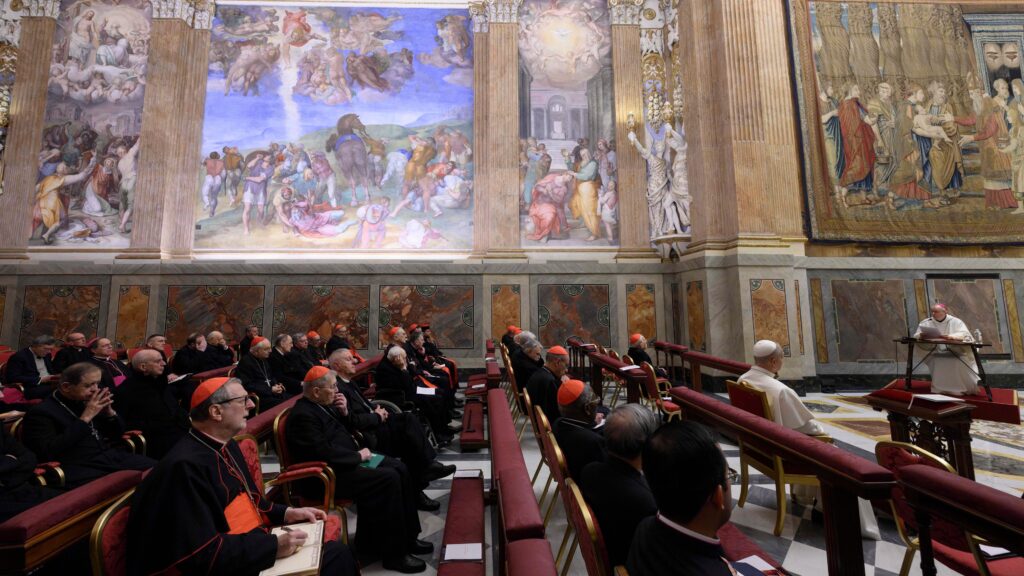
Bishop Erik Varden warned Pope Leo XIV and the Roman Curia that corruption within the Church has caused profound harm.
Falls can humble people when they are “puffed up,” showing God’s power to save, and can become “milestones on a personal journey of salvation, to be recalled gratefully,” Bishop Erik Varden said during this week’s Lenten retreat for Pope Leo XIV and the Roman Curia.
Yet, he warned, “we cannot afford to be gullible.”
“Not every fall ends in exhilaration,” Varden said in the sixth meditation of the retreat, delivered in the Pauline Chapel at the Vatican. “There are falls that reek hellishly, bringing destruction to the guilty and carrying ruin in their wake. That wake is often broad and long, pulling in many innocents.”
Varden pointed to the grave harm caused by wrongdoing within the Church itself.
“Nothing has done the Church more tragic harm, and compromised our witness more, than corruption arisen within our own house,” he said. “The worst crisis of the Church has been brought on, not by secular opposition, but by ecclesiastical corruption. The wounds inflicted will take time to heal. They call out for justice and for tears.”
Facing corruption — “especially when we confront abuse” — Varden said it can be tempting to search for a single “diseased root” and presume there were early warning signs that were ignored.
“Sometimes these trails exist and we are right to blame ourselves for not having spotted them in time,” he said. “We do not, however, find them always.”
At the same time, he noted that real good can often be recognized in the beginnings of communities later linked with scandal — meaning it is not always accurate to assume “structural hypocrisy from the start.”
“A secular mindset will simplify: When it meets calamity, it designates monsters and victims,” he said. “Happily the Church possesses, when she remembers to use them, more delicate and more effective tools.”
Citing St. Bernard of Clairvaux, Varden said that “where people pursue noble endeavors, enemy attacks will be fierce” and that casualties can be especially numerous where spiritual aspirations are strongest.
Progress in the spiritual life, he continued, “requires a configuring of our physical and affective self attuned to contemplative maturing, else there is danger that spiritual exposure will seek physical or affective release; and that such instances of release are rationalized as if they were, somehow, ‘spiritual’ themselves, more elevated than the misdemeanors of ordinary mortals.”
“The spiritual life is not adjunct to the remainder of existence,” Varden said. “It is its soul. We must beware of all dualism, always remembering that the Word became flesh so that our flesh might be imbued with Logos.”
‘Hidden glory’ even now
In the seventh meditation of the retreat, Varden turned to the theme of glory, reflecting on how many disciples “drew back and no longer went about with” Jesus when his teaching became demanding — including “discourses about sacramental realism, the indissolubility of marriage, the necessity of the cross.”
When Christ was crucified, Varden said, the group that had walked with him “was no more,” and only two followers remained at the foot of the cross: Mary and John. Yet, he added, John’s Gospel insists that “this scene of dereliction manifests Christ’s glory.”
Quoting St. Bernard, Varden said: “‘Glorification’ … ‘happens in the presence of God’s face’ when, our earthly voyage done, we shall at last behold what in this life we have firmly hoped for, putting our trust in Jesus’ name.”
“Our hope is in the name of the Lord; the reality hoped for will be revealed face to face,” he said.
Still, Varden emphasized, a “hidden glory” can be perceived even now. He recalled St. Augustine’s teaching that the image of glory is carried in an “obscure form” in this life, to be revealed “explicit and ‘luminous’” in the next — and that while the glory of that image can never be lost, it can be “buried under accumulating layers of darkness.”
“The Church reminds women and men of the glory secretly alive in them,” Varden said. “She shows us that present mediocrity and despair … need not be final; that God’s plan for us is infinitely lovely; and that God, through Christ’s mystical body, will give us grace and strength, if only we ask.”
He added that the Church manifests the radiance of “hidden glory” in the saints and channels it through the sacraments.
“Any Catholic knows what light can break forth in the confessional, in an anointing, at an ordination or a wedding,” Varden said. “Most splendid, and in some ways most veiled, is the glory of the holy Eucharist.”
This story was first published by ACI Stampa, the Italian-language sister service of EWTN News, and has been translated and adapted by EWTN News English.