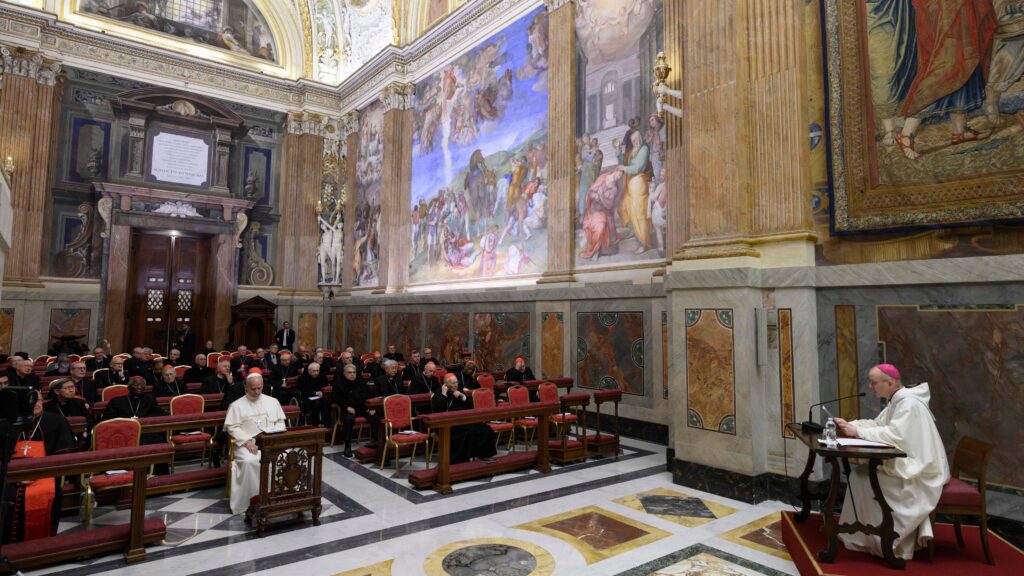
The Cistercian bishop reflected on angels as mediators of God’s providence and on St. Bernard of Clairvaux’s realism rooted in mercy.
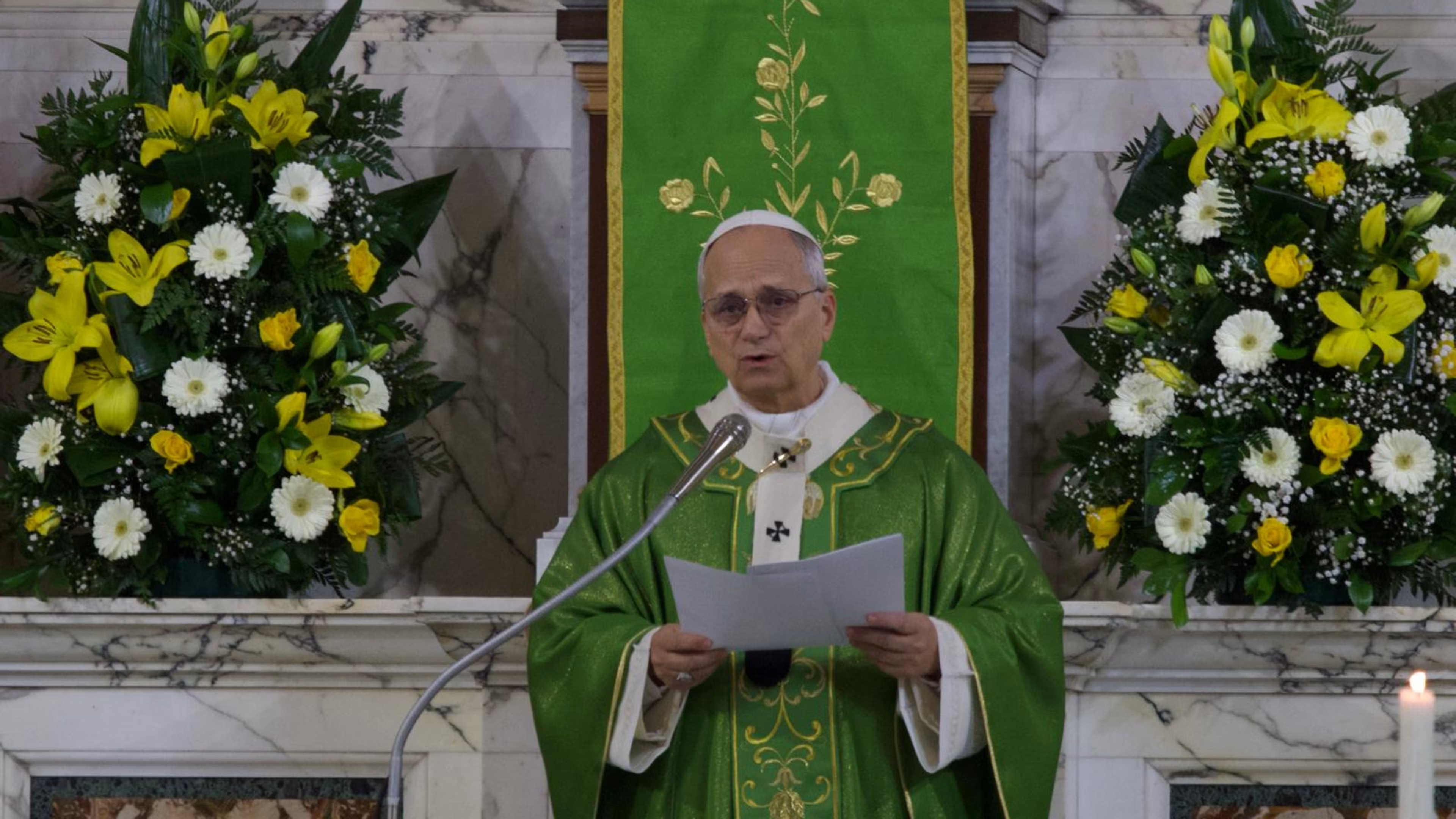
Bishop Erik Varden continued leading the Vatican’s Lenten spiritual exercises on Feb. 26 with meditations on angels, trust in God, and St. Bernard of Clairvaux’s path from lofty ideals to what Varden described as a realism grounded in mercy.
In his eighth meditation of the retreat, Varden recalled Christ’s temptation in the desert, when the devil cited Psalm 90 while urging Jesus to throw himself from the Temple. “The devil,” Varden said, “took him to the holy city and placed him on the pinnacle of the temple,” challenging Christ to prove he is the Son of God by casting himself down, “for it is written: ‘He will command his angels concerning you’ and ‘On their hands they will bear you up, so that you will not dash your foot against a stone.’”
“God alone may invite us to jump from a pinnacle,” Varden said. “His call, however, will be, ‘Jump into my arms,’ not, ‘Throw yourself down.’”
Angels, he added, are not sent to indulge human whims. “Angelic interventions are not always reassuring,” he said. “The angels are not there to humor us in our caprices.”
Pointing to a traditional prayer to the guardian angel, Varden highlighted what he called “hefty verbs” describing the angel’s mission: to “enlighten, keep, govern, and guide.” He described an angel as a “guardian of holiness.”
Varden linked that angelic mission to monastic life, long understood as “angelic,” he said, because of its orientation toward praise and because the monk is called to be “aflame with God’s love” and to bring that love to others.
He also connected the angels to the Church’s liturgy, saying Christ’s “canticle of praise” resounds through “a pulsating chain of mediation” that rises from the earth to heaven, echoed in the prefaces of the Mass, where the Church joins the angels’ worship.
Citing St. Bernard, Varden emphasized angels as mediators of God’s providence — while noting that God can act directly but also “delights” in letting his creatures become “channels of grace” for one another.
He quoted Bernard’s counsel to imitate an angel’s movement between charity and contemplation: “Descend, and show mercy to your neighbour; next, in a second movement, letting the same angel elevate your desires, use all the cupiditas of your soul to rise towards the most high and eternal truth.” Varden said Bernard’s language suggests that human yearnings — including embodied desires — are drawn toward fulfillment in God and must be guided toward him.
Varden said the angels’ “last, most decisive act of charity” will come at the hour of death, when they will bear the faithful “through this world’s veil into eternity.” In that moment, he said, “All pretence will fall … Rhetoric will fail. Only truth will stand and sound, attuned to mercy.”
In his ninth meditation, Varden turned again to Bernard, describing how the Cistercian movement was forged between “the ideal and the concrete,” and how Bernard’s early intransigence was “sweetened over time,” turning “the idealist into a realist.”
Quoting psychoanalyst Jacques Lacan, Varden noted that “‘the real’ is what we butt against,” but said Bernard’s realism was not simply acceptance of facts. “He learnt above all that the deepest reality of all human affairs is a cry for mercy,” Varden said.
He tied that realism to Bernard’s devotion to the holy name of Jesus, quoting Bernard’s words to his monks: “Every food of the mind … is dry if it is not dipped in that oil; it is tasteless if not seasoned by that salt. Write what you will, I shall not relish it unless it tells of Jesus. Talk or argue about what you will, I shall not relish it if you exclude the name of Jesus. Jesus to me is honey in the mouth, music in the ear, a song in the heart.”
Varden concluded by quoting Bernard’s early biography, the Vita Prima: “He was … at freedom with himself,” adding that a man or woman who is truly free is “glorious to behold.”
This story was first published by ACI Stampa, the Italian-language sister service of EWTN News, and has been translated and adapted by EWTN News English.