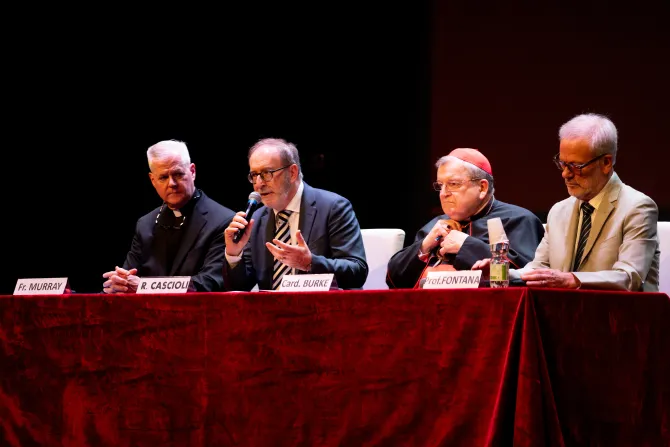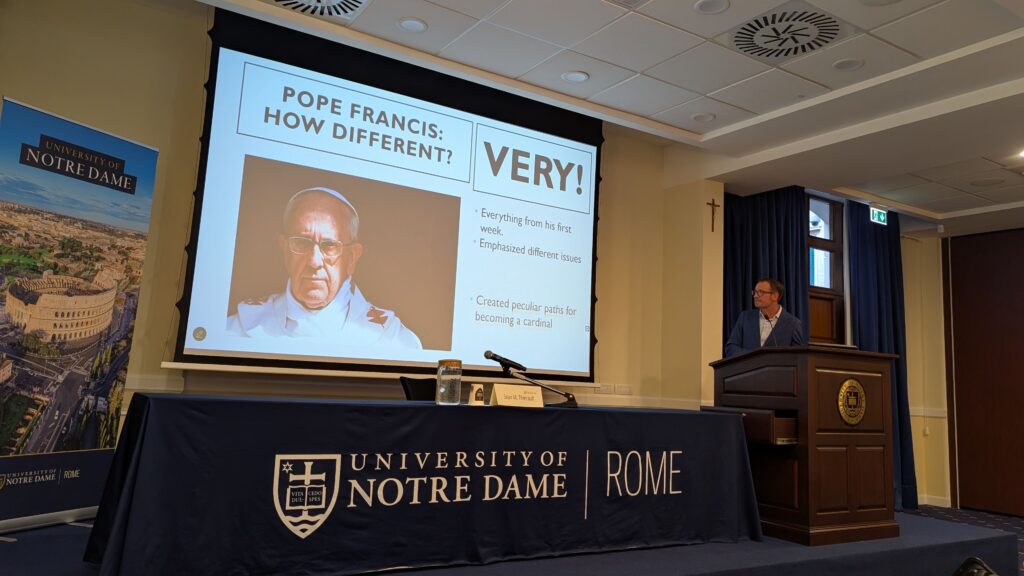
The University of Notre Dame hosted the lecture on their Rome campus on Thursday.
ROME — A political science professor from the U.S. has used data analysis to show how Pope Francis differed from predecessors regarding policy, appointments, and papal trips, while notably omitting discussion of the deceased pontiff’s doctrinal differences.
The University of Notre Dame in Rome hosted the lecture “Francis and His Predecessors: Quantifying Continuity and Change in the Modern Papacy,” by Sean Theriault, on March 19.
Avoiding theological debate?
Theriault, a professor of government at the University of Texas at Austin, told EWTN News that he became interested in studying Pope Francis’ legacy two years ago after discussing the papacy with his students and fellow Catholics.
“I had heard people suggest that Pope Francis was different, and I thought I could bring data to help assess how different he was. In other words, as a social scientist, I could actually supply some facts to the question at hand.”
He noted that his study avoids theological debate entirely, observing that while many theologians emphasize Francis’ doctrinal shifts, his study focuses on quantifiable patterns in the data.
What do the numbers say about Francis?
Examining the data reveals that Pope Francis was vastly different from his predecessors. The first metric used in the study was papal policy.
To quantify policy, Theriault analyzed papal addresses to the diplomatic corps — the so-called “State of the World address” — dating back to St. John XXIII. By parsing the words of each speech, he found that Francis had the lowest statistical correlation to any of his predecessors, focusing more on issues like immigration and refugees than traditional diplomatic concerns.
“I parsed out these speeches going back to the early 1960s by sentence or quasi-sentence, categorizing them,” Theriault said in his lecture. “If we separate international relations, Francis had the lowest correlation among his recent predecessors. For instance, in his 2025 address, though he did discuss the release of Israeli hostages in Gaza, Francis touched on issues like artificial intelligence, respect for migrants, and the elimination of the death penalty.”
Increased diversity in cardinals and saints
The next metric analyzed was personnel, chiefly the makeup of the College of Cardinals and the canonization of new saints.
Theriault noted that while St. Paul VI was the first to diversify the demographics of the cardinals significantly, Francis had accelerated this trend toward a less Eurocentric cardinalate.
“The conclave that elected Paul VI was dominated by Europe (55 out of 80 cardinals), but he spread the reach of the college to other parts of the world. John Paul II continued this, Benedict, a bit less so, but Francis did it by far the most by 55%. He brought in cardinals from places like Laos, Sweden, and Brunei, and passed over traditional sees like Paris and Milan.”
Theriault also pointed out anomalies in Francis’ selection of cardinals from suffragan dioceses — rather than major archdioceses as done before — and his approach to canonization. “When Cardinal Roger Mahony of Los Angeles retired, we all expected the red hat to be given to the new archbishop, José Gómez. Instead, he gave the red hat to Bishop [Robert] McElroy, the bishop of San Diego, a suffragan diocese of Los Angeles.”
He added regarding canonizations: “Francis shortened the average time to canonization to 151 years. He canonized a vastly higher percentage of laypeople (18%) than his predecessors. He paired John XXIII with John Paul II for canonization, effectively blocking the canonization paths for Pius IX and Pius XII.”
Pilgrimages to the margins
Papal travel was the third metric Theriault analyzed. He observed that while previous popes spent their time abroad ministering primarily to Catholic audiences, Francis preferred to spend time with the marginalized.
“John Paul II loved meeting with everyday Catholics during his travels, especially the Polish and Hispanic communities. Benedict XVI focused on meeting with the Church hierarchy. Francis chose rather to visit prisons and homeless centers, focusing on the marginalized rather than exclusively Catholic audiences,” he said.
Looking ahead to Pope Leo XIV
Theriault concluded the lecture by predicting that Pope Leo XIV’s pontificate would reveal far more about Pope Francis’ time as pope than when he was still alive.
“Pope Leo is more of an institutionalist than Pope Francis, and significantly more reserved. In the long run, Pope Francis’ legacy is going to be far more pronounced precisely because he was succeeded by Leo, who is bringing along the whole Church and institutionalizing that vision in a way Francis just did not know how to do,” he said.
This article was originally published by EWTN News English.