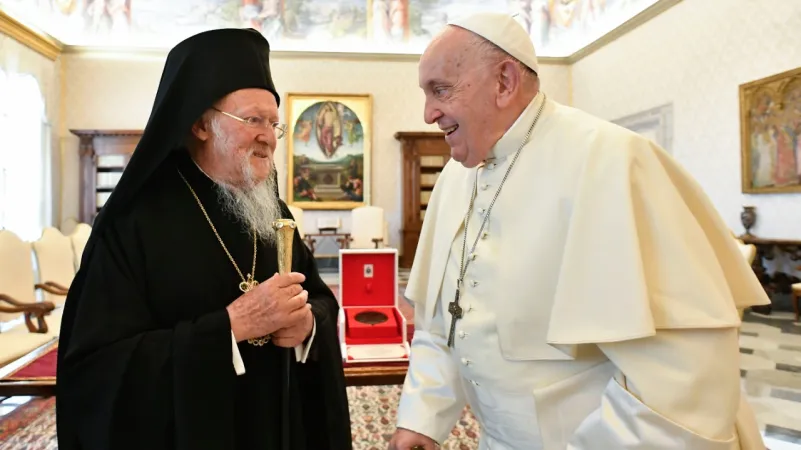
he presence of Patriarch Bartholomew I of Constantinople at the Consistory for the creation of new cardinals is a historic first. Never before had an Ecumenical Patriarch attended a consistory. However, Bartholomew, the first patriarch to also participate in the inauguration ceremony of a Petrine pontificate (he was present at Pope Francis’s on March 19, 2013), was in Rome at the invitation of Pope Francis to take part in the ecumenical prayer vigil Together.
Bartholomew I’s visit to Rome concluded on October 1st with the celebration of a Divine Liturgy at the church of San Teodoro al Palatino. The Patriarch was accompanied by His Eminence Policarpo, Metropolitan of Italy, the Very Reverend Aethios, Archpriest of the Ecumenical Patriarchate, and Archon Stilianos Efstratiadis.
Bartholomew arrived in Rome after an extensive visit to countries in Eastern and Central Europe, including Greece, Finland, and Estonia, as well as the Hungarian Abbey of Pannonhalma, where he delivered an inaugural address at an International Ecumenical Conference for Peace.
The Ecumenical Patriarch emphasized that his presence at the ecumenical vigil is even more significant “at a time when the sister Church of Rome is closely examining the two-thousand-year-old experience of the Eastern Church regarding the relevance of Synodality.”
In his homily at San Teodoro, Bartholomew recalled that “the notion of conciliarity, highly cherished by the Eastern Orthodox Church, known for its synodal character, was the center, especially in its relationship and concept of primacy, of the bilateral theological dialogue between the Roman Catholic Church and the Eastern Orthodox Churches of the East.” He noted that as a result of this dialogue, there has been “a more intense commitment by the sister Church of Rome to seek its synodal path.”
Bartholomew stated that promoting ecumenical and interreligious dialogue, religious tolerance, religious freedom, and a culture of solidarity is an “essential part of our ministry and mission,” especially in this period of “conflict, division, and war.” Therefore, he added, “we encourage and oversee dialogues with all Christian denominations, as well as between Christians and the other two monotheistic religions, Judaism and Islam.”
The Patriarch also highlighted his more than thirty-year commitment to environmental issues, emphasizing the Ecumenical Patriarchate’s dedication to developing these principles and stating that the patriarchate is “not a relic of the past but a beating heart.