“Only through a return to negotiation can the war come to an end,” the pope said at the end of his weekly general audience.
VATICAN CITY — Pope Leo XIV on Wednesday welcomed the announcement of a two-week ceasefire in the Iran war and urged negotiation and prayer to end the war in the Middle East.
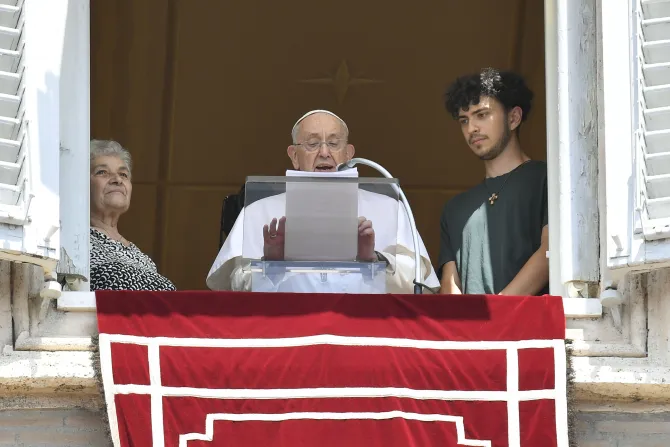
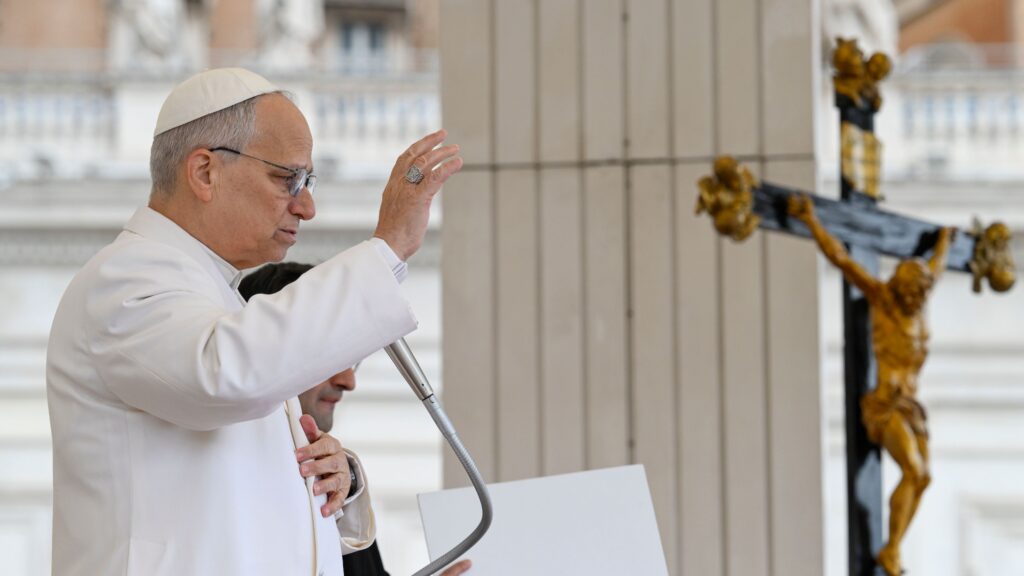
“Following these recent hours of great tension for the Middle East and for the whole world, I welcome with satisfaction and as a sign of living hope the announcement of an immediate two-week truce,” the pope said at the end of his weekly general audience in St. Peter’s Square on April 8.
Commenting in the wake of a ceasefire deal between the United States, Israel, and Iran, Leo said: “Only through a return to negotiation can the war come to an end.”
“I urge that this time of delicate diplomatic work be accompanied by prayer, in the hope that readiness for dialogue may become the means to resolve other situations of conflict in the world. I renew for all the invitation to join me in the prayer vigil for peace that we will celebrate here in St. Peter’s Basilica on Saturday, April 11,” he said.
In comments to the press on the evening of April 7, the pope renewed his forceful appeal for an end to war and urged an embrace of dialogue, distinguishing himself as a singular global voice calling for restraint and moral accountability amid bellicose statements from U.S. leadership.
The first U.S.-born pope called on U.S. citizens to plead with elected officials to work for peace in remarks to the press as he left his residence in Castel Gandolfo, 18 miles south of Rome, and called threats to destroy Iran’s civilization unacceptable.
Leo said “attacks on civilian infrastructure [are] against international law [and] also a sign of the hatred, the division, the destruction that the human being is capable of … We all want to work for peace. People want peace. I would invite citizens of all the countries involved to contact the authorities, political leaders, congressmen, to ask them, tell them to work for peace and to reject war.”
Catechesis: Holiness is more than an ethical commitment
Before his appeal, the pope spoke about the Second Vatican Council constitution Lumen Gentium.
The pontiff emphasized that holiness is not a privilege reserved for an elite or a mere “ethical commitment” but a vocation and a gift that involves all the baptized.
“Holiness, according to the conciliar constitution, is not a privilege for a few but a gift that commits every baptized person to strive for the perfection of charity, that is, the fullness of love toward God and toward one’s neighbor,” the pope said.
“Charity is the heart of the holiness to which all believers are called,” he affirmed, noting that its highest expression, as in the early days of the Church, is martyrdom — that is, the willingness to confess Christ even to the shedding of blood.
“This readiness for witness becomes a reality whenever Christians leave signs of faith and love in society, committing themselves to justice,” the pontiff explained in his catechesis.
Along this path, he added, the sacraments — and in a particular way the Eucharist — are the nourishment that fosters a holy life, assimilating each person to Christ, the model and measure of all holiness.
He stressed that holiness does not have “only a practical nature, as if it could be reduced to an ethical commitment, however great, but concerns the very essence of Christian life, both personal and communal.”
Consecrated life: A prophetic sign
The pontiff also recalled that Lumen Gentium defines holiness as a constitutive characteristic of the Catholic Church, which is conceived as “indefectibly holy.”
However, he clarified that this affirmation does not imply a full and completed perfection but rather a call “to confirm this divine gift during her pilgrimage toward the eternal destination,” walking — citing St. Augustine — “amid the persecutions of the world and the consolations of God.”
In this context, the pope also addressed the reality of sin within the Church, emphasizing that this reality calls everyone to a serious process of personal and communal conversion. “The infinite grace that sanctifies the Church entrusts to us a daily mission: that of our conversion,” he affirmed.
The pope devoted a significant portion of his reflection to consecrated life, which he described as a prophetic sign of the new world already present in the mystery of the Church. In this sense, he noted that the evangelical counsels — poverty, chastity, and obedience — are signs of the kingdom of God and give shape to every experience of consecrated life.
Leo XIV concluded by emphasizing that these virtues are not limits to freedom but gifts that liberate, bestowed by the Holy Spirit. In this way, he said, consecrated persons bear witness to the universal vocation to holiness through a radical following of Christ, recalling that even the experience of suffering, when lived in union with the Lord’s passion, can become a path of holiness and transformation.
Redemptive suffering
Thus, the pontiff explained that there is no human experience that “God does not redeem.”
“Even suffering, lived in union with the passion of the Lord, becomes a path of holiness. The grace that converts and transforms life thus strengthens us in every trial, pointing us not toward a distant ideal but toward the encounter with God, who became man out of love,” he concluded.
This story was updated on April 8, 2026, at 7:57 a.m. ET with the pope’s catechesis. Part of this story was first published by ACI Prensa, the Spanish-language sister service of EWTN News. It has been translated and adapted by EWTN News English.
Victoria Cardiel co-authored this article.