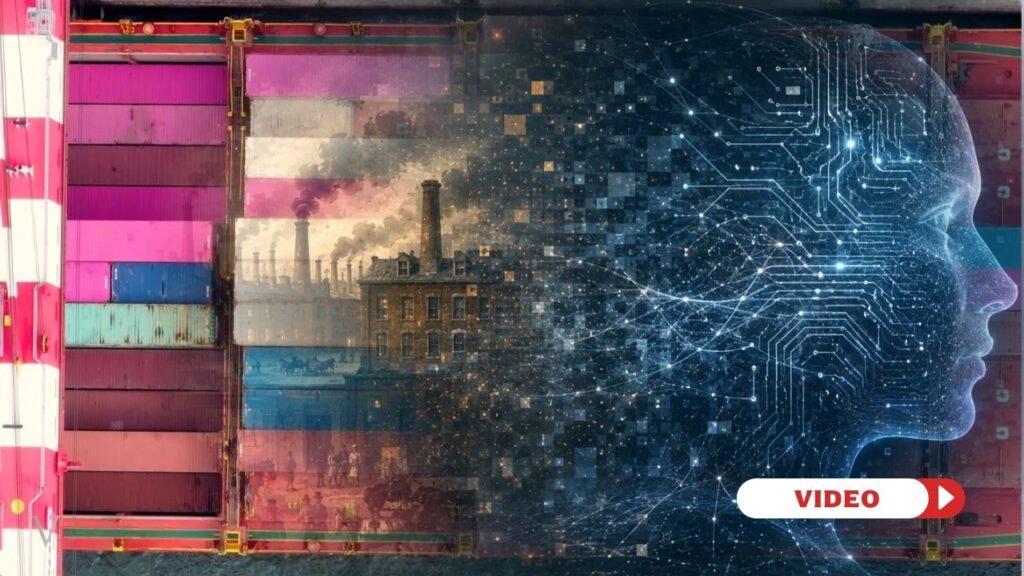
Artificial intelligence is rapidly transforming the global economy, reshaping industries, and raising urgent questions about the future of work. From factory floors to corporate offices, few sectors remain untouched by the technological revolution now underway.
For Pope Leo XIV, however, the conversation cannot be limited to efficiency, productivity, or economic growth. As governments, businesses, and researchers debate the opportunities and risks of artificial intelligence, the Church is insisting that the human person must remain at the center.
With the publication of his first encyclical, Magnifica Humanitas, Pope Leo has made clear that technological progress must always serve humanity, never replace it.
A Technology That Must Serve Humanity
Since the beginning of his pontificate, Pope Leo XIV has repeatedly addressed the opportunities and dangers presented by artificial intelligence. His concern is not with technology itself, but with how it is used and the values that guide its development.
“It must not be forgotten that artificial intelligence functions as a tool for the good of human beings, not to diminish them, not to replace them,” the pope said. “What is emerging is in fact a significant challenge, one that calls for great attention and foresight in order to project, also in the context of new scenarios, healthy, fair and sound lifestyles, especially for the good of younger generations.”
The pope has backed these concerns with concrete action. Just days before publishing Magnifica Humanitas, he approved the creation of an inter-dicasterial Vatican commission on artificial intelligence. The commission has been tasked with studying AI’s development, its expanding role in society, and its potential impact on humanity.
The initiative reflects the Vatican’s growing engagement with one of the defining issues of the twenty-first century. Yet the Church’s contribution extends beyond official documents and commissions.
At a recent conference organized by the Pontifical Gregorian University, economists, theologians, researchers, and technology experts gathered in Rome to discuss how artificial intelligence is reshaping the labor market and what that transformation means for workers around the world.
A Disruption Unlike Any Before
Among the speakers was Matthew Sanders, founder of Magisterium AI, who argued that the scale of change brought by artificial intelligence may exceed any previous technological revolution.
“Never before in history have we had a threat to the blue-collar worker and the white-collar worker simultaneously,” Sanders said. “So this disruption, it’s not the same thing. I think it’s important to state: Industrialization was incredibly disruptive; This is 10 times the disruption, which means we need 10 times the focus, and creativity here.”
While previous technological revolutions often affected specific industries or categories of workers, AI is increasingly capable of performing both manual and cognitive tasks. As a result, questions about employment, workforce adaptation, and economic inequality have become more pressing.
Yet experts caution that predicting the long-term consequences remains difficult.
Noam Yuchtman, Hayek Professor of Political Economy at the London School of Economics, explained that society is still in the early stages of understanding how AI will transform organizations and workplaces.
“As with historical technologies, the process of adopting this technology is in its early stages and will be different as new organizations emerge that adopt the technology, as old organizations readjust their organizational structure and their modes of work in order to use the technology best,” he said.
“And so I think we currently have a sense of how workers and firms are using AI in this infant stage, but we don’t know what that means for adoption and usage in two years or in five years.”
The uncertainty extends beyond employment. Artificial intelligence also raises concerns about its potential misuse by malicious actors, military applications, and the long-term implications of increasingly powerful systems.
For Yuchtman, these challenges underscore the need for leaders who remain focused on human flourishing rather than technological advancement alone.
“I think, at the level of the organization, managers need to have some sense of why they do what they do,” he said, emphasizing that AI should be directed toward solving human problems such as healthcare, climate change, renewable energy, and disease.
Human Dignity at the Center
One of the most notable aspects of the Gregorian conference was the diversity of voices involved. Although hosted by a Catholic institution, the event brought together participants from a wide range of academic, professional, and religious backgrounds.
The goal was not simply to advance a Catholic perspective, but to contribute to a global conversation that affects every society.
George Osborne, Managing Director and Head of OpenAI, acknowledged the unique role the Church can play in that discussion.
“Whatever faith you’re from or whatever religion you’re from or if you have no religion, I think you’d be foolish not to recognize that the catholic church has incredible reach around the world including the wealthier societies and poorest societies on our planet and has a huge moral influence on the world,” he said.
“And I think if that can be put to serve this technology in a way that, as I said in my speech here, makes us more human than less human that’s a good thing.”
For social entrepreneur and Carnegie Mellon University professor Po-Shen Loh, the future is not necessarily one of decline or displacement. Instead, he sees opportunities emerging for innovation, entrepreneurship, and new forms of economic participation.
“Unfortunately, whether we like it or not, this entire world we have is interconnected,” he observed. “Our economy is going to change absolutely fundamentally.”
Yet despite those changes, Loh remains optimistic about the next generation. Through his work with students and young entrepreneurs, he has witnessed a desire not only to succeed, but also to serve others.
“We’re also encouraging them to start businesses,” he said, “because I think that if we can have more businesses being created by people who actually have a mentality that they want to help other people, that can become much, much healthier as a general society.”
This vision aligns closely with Pope Leo XIV’s broader message. The future of work is not merely a question of economics or technology. It is a question of what kind of society humanity wishes to build.
As artificial intelligence continues to transform the global economy, the Church is reminding policymakers, business leaders, and workers alike that efficiency can never become more important than human dignity.
The technologies may be new, but the principle remains unchanged: economic systems exist for the human person, not the other way around. In the age of artificial intelligence, Pope Leo XIV is calling the world to ensure that technological progress makes humanity not less human, but more.
Adapted by Jacob Stein