At Las Raíces reception center in Spain’s Canary Islands, the pope heard testimonies from migrants who risked their lives crossing the Atlantic and urged a more humane response rooted in dignity.
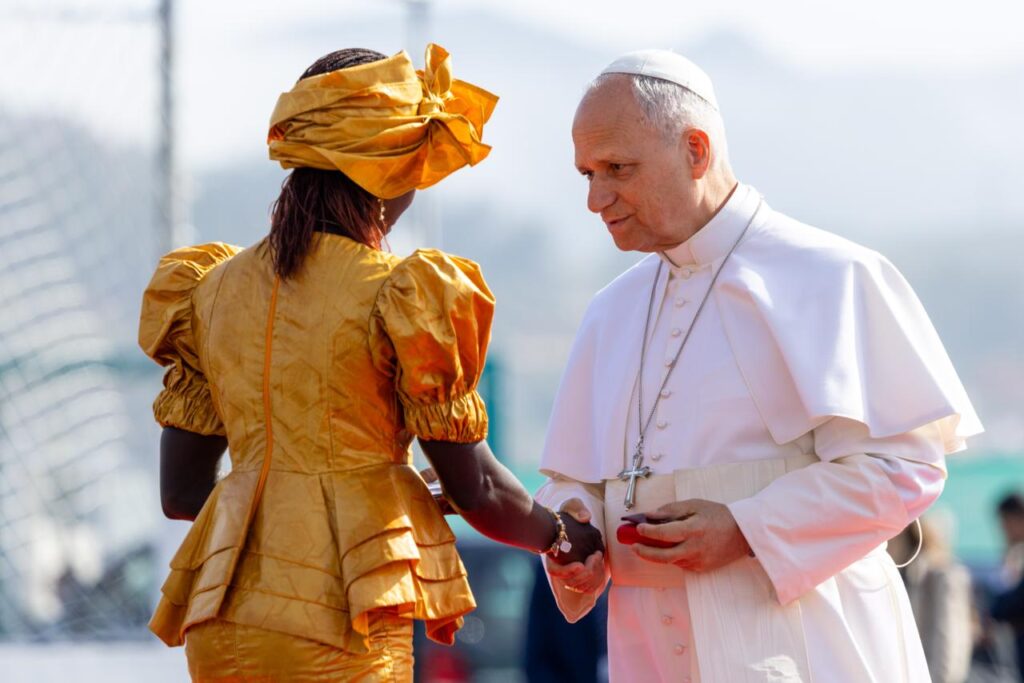
TENERIFE, Canary Islands — “No one leaves their land, their family, and their roots by choice when they can live in peace,” said Bousso Diouf, a woman from Senegal who spoke with the moral authority of someone who risked her life crossing the Atlantic in a wooden boat, knowing the journey could last a week or end adrift at sea.
Diouf was among the migrants who greeted Pope Leo XIV at the Las Raíces reception center in Tenerife, where some 700 sub-Saharan African migrants — all adult men — are currently housed. The center is located in the humid Las Raíces area of Tenerife, a eucalyptus-filled area about 3,300 feet above sea level.
The number is relatively low compared with the hardest years of the “cayuco” crisis, especially at the end of 2024, when the center received between 2,000 and 3,000 migrants amid overcrowding and widely reported tensions.
Most of those currently housed at the center come from Senegal, Gambia, and Mali, and on average spend about three months there before being transferred to mainland Spain.
They arrive exhausted after having spent up to 72 hours in police custody for identification and registration procedures.
“We come from countries where poverty, violence, war, persecution, and lack of opportunity forced us to leave,” Diouf said.
Las Raíces opened in 2021 in response to the 2020 crisis, when more than 23,000 migrants arrived on the coasts of the Canary Islands.
Now those numbers have fallen sharply, and the situation is very different.
“Our work is to offer them an initial welcome that is dignified, humane, and organized at an especially difficult moment, immediately after their arrival by sea,” Navarro Atiénzar, regional director of Accem, the nongovernmental organization that manages the Las Raíces Reception Center for Refugees and Immigrants in Tenerife, told Pope Leo.
The pope arrived in Tenerife early in the morning from Las Palmas and went to the large camp set up inside a former rural military barracks after six marathon days in Spain that had taken him to Barcelona and Madrid.
He listened to those housed there as a father listens when a child opens his heart to recount a trauma.
One young Nigerian man said that crossing the ocean to the Canary Islands means facing hunger, cold, desperation, and often death.
“Many brothers and sisters lost their lives at sea, and others continue to suffer in silence, victims of mafias that take advantage of need and human suffering,” he said.
He also made a plea for humanity: “May we not be seen only as migrants, numbers, or documents but as people with stories, dreams, families, and hope.”
“We do not ask for privileges. We do not ask for compassion. We ask for respect, humanity, and the opportunity to live with dignity,” he said.
Among those present was also Aliu Ceesay, a 16-year-old Gambian who arrived in the Canary Islands just one month ago in an irregular boat after a difficult journey from his home country. Like many other migrant minors, his goal is to find work so he can help support his family.
Amid an experience marked by uncertainty, Aliu has followed Pope Leo XIV with interest online. The teenager said he wanted to see him in person and was struck by the pope’s message.
“I have been following him on the internet and wanted to see him. He is very kind, very good,” Aliu said. He also emphasized the pope’s inclusive spirit: “He does not care if we are black or white, Muslim or Christian. He wants to help us.”
More than 54,000 people have passed through Las Raíces. Behind each one is a story, a difficult journey, and, above all, a hope.
In his address, Pope Leo repeated the message he gave on the first day he set foot in Las Palmas: “God’s love knows no borders, makes no distinctions, is given to all and brings us together in unity.”
“As I look at your faces and listen to your stories, I also think of your hearts — wounded by so many difficulties, yet also comforted by the love you have received from other open, generous, and merciful hearts,” the pope said.
“Christ’s heart suffered and was pierced out of love, and he was also comforted by compassionate people who eased his pain,” he added.
Missionary saints and migrants
The pope dedicated part of his address to missionary saints such as St. Brother Peter of St. Joseph de Betancur and St. José de Anchieta, who set out from the Canary Islands to proclaim the Gospel in the Americas, opening new missionary horizons.
“They too were migrants who ventured into the unknown, carrying faith, hope, and charity as their greatest possessions,” he said.
The pope called for “responsibility” with an eye toward future generations, to whom, he said, “we wish to bequeath the heritage of a civilization of love.”
“Migration will play an important role in this,” he said, because it “can become an opportunity for encounter and mutual enrichment among peoples.”
“Dear brothers and sisters, in a sense, all of us are migrants, for we are all pilgrims on our way to our heavenly homeland,” he said. “Let us help make this journey more humane for everyone by contributing in whatever way we can.”
The pope said the name of the center, Las Raíces — “the roots” — had caught his attention. He recalled that Pope Francis, “who so longed to be with you,” often used the image of roots “to emphasize the importance of remembering our origins, staying united, and trusting in the Lord.”
“May this image of roots also help you to be firmly rooted in the Lord, so that no storm may drive you away from his presence, which strengthens and gives life,” Pope Leo said.
At the end of his address, the pope told those gathered: “Dear friends, I carry you in my heart and will remember you in my prayers. May God bless you, your families, and all who do good to you. And may the Blessed Virgin Mary, consolation of migrants, always accompany and assist you with her maternal protection.”
During the meeting, when the pope announced that he would speak in French and English, many migrants responded with loud applause.
This story was first published by ACI Prensa, the Spanish-language sister service of EWTN News. It has been translated and adapted by EWTN News English.