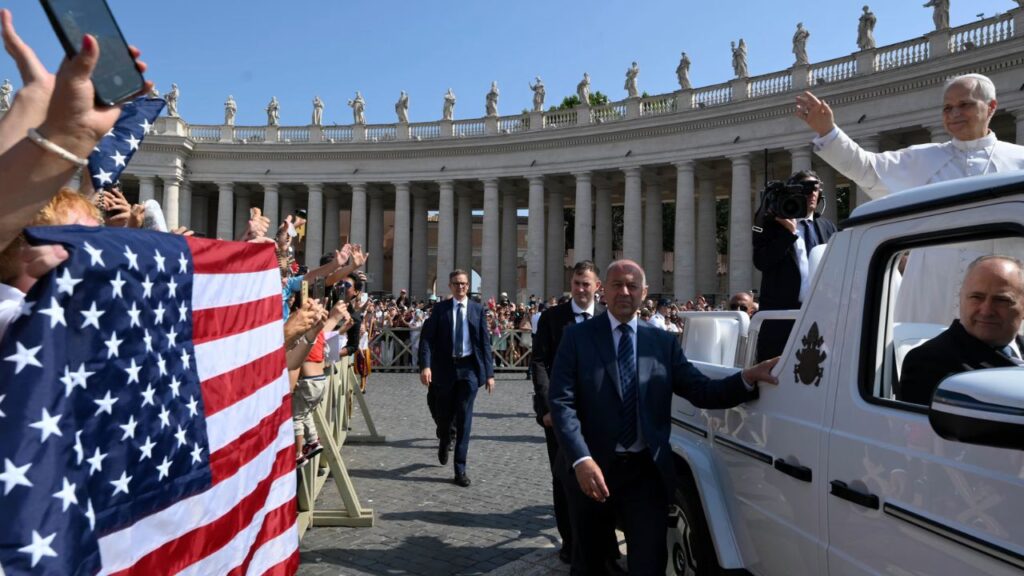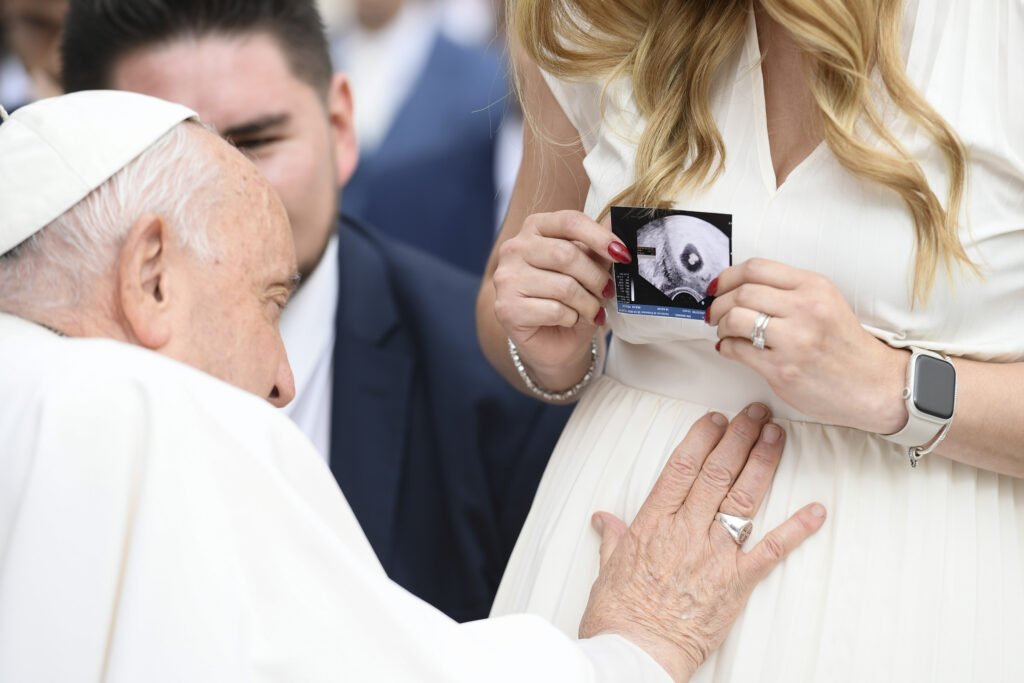
St. Peter’s Square, 9 a.m.. Rome wakes up to a cloudy sky. The Pope arrives in the popemobile for a tour of the Piazza. It is the day of the general audience. Pope Francis, today, resuming the cycle of catechesis on the theme of the Holy Spirit who “leads the people of God to meet Jesus our hope,” focuses his meditation on the theme, “I believe in the Holy Spirit.” The Reading chosen for this catechesis is from the Gospel of John chapter 14.
“In the first three centuries,” the Pope begins, “the Church did not feel the need to give an explicit formulation of her faith in the Holy Spirit. In the Church’s earliest Creed, the so-called Apostolic Symbol, after proclaiming, ‘I believe in God the Father, creator of heaven and earth, and in Jesus Christ, who was born, died, descended into hell, rose again and ascended into heaven,’ it adds, ‘[I believe] in the Holy Spirit,’ without any specification.” He holds, then, to remember that it was “heresy that pushed the Church to specify this faith of his. When this process began-with St. Athanasius in the fourth century-it was precisely her experience of the sanctifying and divinizing action of the Holy Spirit that led the Church to the certainty of the full divinity of Him.”
He cites the Ecumenical Council of Constantinople in 381: it was this council that defined “the divinity of the Holy Spirit in the well-known words that we still repeat today: I believe in the Holy Spirit.” But what does it mean to utter the formula “The Holy Spirit is Lord”? Here is Pope Francis’ answer: it is “like saying that He shares the ‘Lordship’ of God, which belongs to the world of the Creator, not the world of creatures. The strongest statement is that the same glory and adoration is due to Him as to the Father and the Son.” The Pope, then, goes into the historical-telogical aspect: “The conciliar definition was not a point of arrival, but of departure. And in fact, having overcome the historical reasons that had prevented a more explicit affirmation of the divinity of the Holy Spirit, it will be quietly proclaimed in the Church’s worship and its theology.”
The Pontiff’s gaze then turns to our contemporary world. But what does the article of faith we proclaim every Sunday at Mass say to us, believers today? Continues, then, the Holy Father, “It has, in the past, been dealt with mainly in regard to the statement that the Holy Spirit ‘proceeds from the Father.’ The Latin Church soon supplemented this statement by adding, in the Creed of the Mass, that the Holy Spirit ‘also proceeds from the Son.'” He resorts to the etymology of the word, in order to explain himself better: “Since in Latin the expression “and from the Son” is called “Filioque,” the dispute known by this name arose, which was the reason (or pretext) for so many disputes and divisions between the Church of the East and the Church of the West. Because of this, misunderstandings, divisions were created. But, once overcome, “today we can value the most important prerogative for us that is proclaimed in the article of the Creed, namely that the Holy Spirit is ‘life-giving,’ that is, life-giving.”
The pontiff, then, continued his catechesis with some questions, “We ask ourselves: what life does the Holy Spirit give? At the beginning, in creation, the breath of God gives Adam natural life; from a statue of mud, it makes him ‘a living being.’ Now, in the new creation, the Holy Spirit is the One who gives believers new life, the life of Christ, supernatural life, as children of God.” Another question the Pontiff poses to the faithful: “Where, in all this, is the great and consoling news for us? It is that the life given to us by the Holy Spirit is eternal life! Faith frees us from the horror of having to admit that everything ends here, that there is no redemption for the suffering and injustice that reign supreme on earth.”
.
This article was previously published by acistampa.com