MONTECASSINO, Italy — Rising above the Liri Valley, the Abbey of Montecassino has stood for nearly 1,500 years as one of the most important monasteries in Christian history.
Founded by St. Benedict around A.D. 529, it was here that the Father of Western Monasticism established the monastery that would become the birthplace of Benedictine monasticism and where he composed the Rule that would shape religious life throughout Western Europe.
Over the centuries, the abbey has been destroyed repeatedly—by invading armies, earthquakes, and war—yet each time it has been rebuilt, becoming a lasting symbol of resilience and faith.
The birthplace of Benedictine monasticism
When St. Benedict arrived at Montecassino, he found the remains of a pagan temple on the mountaintop. Transforming the site into a place of Christian worship, he established the monastery that would become the spiritual center of the Benedictine Order.
It was also here that he wrote the Rule of St. Benedict, which gradually spread throughout Europe.
Abbot Antonio Luca Fallica, the 193rd Abbot of Montecassino, says the Rule’s decisive influence came during the Carolingian era.
“Especially during the Carolingian period, thanks to the work of Charlemagne and St. Benedict of Aniane, the Rule of Benedict was promoted and gradually became the single rule of Western monasticism.”
From Montecassino, Benedictine monasticism became a unifying force across Charlemagne’s empire and throughout the centuries that followed.
The abbey that refused to disappear
Long before the Second World War, Montecassino had already endured centuries of destruction.
The monastery was devastated by the Lombards in 570, the Saracens in 883, and a major earthquake in 1349. Yet each time, the monks rebuilt.
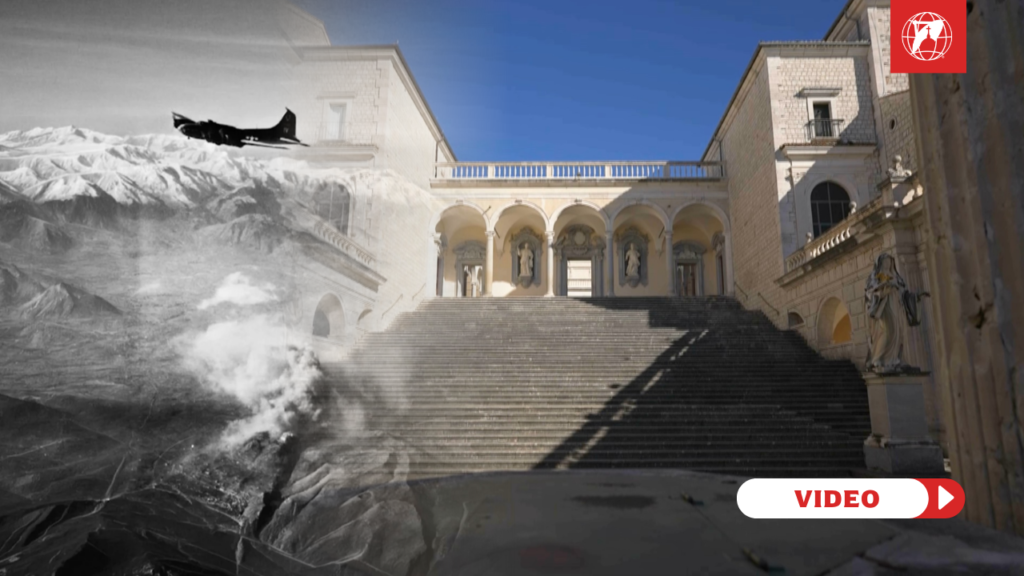
Its greatest trial came on February 15, 1944, during the Battle of Monte Cassino.
Believing the monastery had become a German military position along the Gustav Line, Allied aircraft dropped hundreds of tons of explosives, reducing the abbey to ruins.
Abbot Fallica notes that one part of the monastery survived the bombardment.
“The oldest area, known as St. Benedict’s cell, was spared from destruction, and those who had taken refuge there survived.”
The destruction, however, came at an enormous human and cultural cost.
“Because of the symbolic importance of the abbey, the bombing had an enormous emotional impact… because of what the abbey represented for Europe and beyond.”
A battle that changed the war
The Battle of Monte Cassino became one of the longest and bloodiest campaigns of the Second World War.
Pietro Rogacin, whose father served in the Polish II Corps under General Władysław Anders, explains why the location was so strategically important.
“This was a crucial point along the Gustav Line… The defense of Rome was established here because this was the narrowest point of the Italian peninsula.”
Although the abbey itself was believed to be occupied by German troops, that assumption proved incorrect.
“Because Montecassino was considered an untouchable cultural monument, the Germans also relied on the fact that it would not be attacked.”
He says the bombing ultimately benefited the German defenders.
“[Bombing the monastery] was likely a strategic mistake, as the Germans later used the ruins as a defensive position.”
Victory finally came on May 18, 1944, after the Polish II Corps launched the decisive assault that captured the monastery.
Damiano Parravano of Italy’s Gustav Line Association stresses that the victory came only after months of sacrifice by Allied forces.
“The Poles were certainly able to prevail, but only after those who came before them had paid an extraordinarily high price.”
Remembering those who never returned
Every year on May 18, veterans, families, and pilgrims gather at Montecassino to commemorate those who died in the battle.
Among them is Major Władysław Dąbrowski, one of the last surviving veterans of the Polish II Corps.
At 102 years old, he still returns to the battlefield where so many of his comrades fell.
“I am still deeply moved, especially when I see these graves where my comrades lie.”
Recalling the final assault, he points toward the ground his unit crossed as they advanced toward the monastery.
“Directly in front of us we had the monastery.”
“A root that has been cut returns to bloom”
More than eight decades after its destruction during World War II, Montecassino once again serves as a living monastery.
Its small Benedictine community continues the rhythm of prayer, work, and study established by St. Benedict nearly fifteen centuries ago, while also caring for one of Europe’s great religious and cultural treasures.
For Abbot Fallica, the monastery’s history is captured in its ancient motto.
“After each destruction, monastic life at Montecassino has always been reborn. This is why the abbey’s motto is Succisa virescit — A root that has been cut returns to bloom.”
Today, that motto reflects not only the monastery’s remarkable history but also the enduring legacy of St. Benedict, whose vision has survived every trial and continues to inspire the Church around the world.
Adapted by Jacob Stein