SPILIMBERGO, Italy — In the small town of Spilimbergo in Italy’s northeastern Friuli-Venezia Giulia region, an ancient artistic tradition continues to flourish.
For more than a century, the Mosaic School of Friuli has trained artisans in one of Christianity’s oldest forms of sacred art, preserving techniques that have adorned churches, basilicas, and some of the world’s most iconic monuments for centuries.
Today, it remains the only school in the world dedicated to forming artisan entrepreneurs in the craft of mosaic-making, attracting students from across the globe while maintaining close ties with the Vatican.
Preserving a centuries-old tradition
The Mosaic School of Friuli was founded on Jan. 22, 1922, to safeguard an artistic heritage deeply rooted in the region.
According to Stefano Lovison, president of the Consortium of the Friuli Mosaicists School, the institution was created to provide comprehensive training for young artisans already working in the area’s many mosaic workshops.
“The Mosaic School of Friuli was founded here in Spilimbergo on January 22, 1922,” Lovison explained.
“There was a need for a school that could provide a more complete, professional education.”
Its mission was also to preserve an artistic tradition that risked disappearing as many local mosaicists emigrated abroad.
“The school could preserve and bring together the ancient tradition of mosaic-making that had flourished in this region over the centuries,” Lovison said, noting that many artisans had carried their skills around the world.
Serving the Vatican
Over the decades, mosaics created by the school’s graduates have been installed in churches throughout Italy, the Vatican, and around the world.
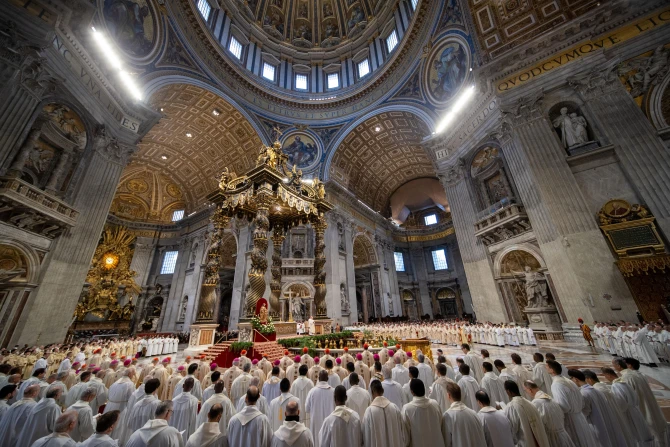
The school maintains a particularly close relationship with the Fabric of Saint Peter, the Vatican institution responsible for the conservation, maintenance, and artistic care of St. Peter’s Basilica.
“We have a very good relationship with them,” Lovison said.
Teachers from the school are regularly invited to the Vatican to provide specialized workshops and training for those responsible for preserving the basilica’s artistic treasures.
“They often request our teachers to come and spend time with them, offering workshops or training sessions lasting a week or even 15 days,” he explained.
Learning an ancient craft
Admission to the school begins not with artistic talent, but with commitment.
“To come and study at the Mosaic School of Friuli, I always say that you need to have strong motivation,” Lovison said.
“That is the main prerequisite we look for.”
There is no entrance examination.
Instead, the school welcomes adults over the age of 18 who have completed secondary education and wish to dedicate themselves to mastering the demanding craft.
Over a three-year program, students study both the history and practical techniques of mosaic-making.
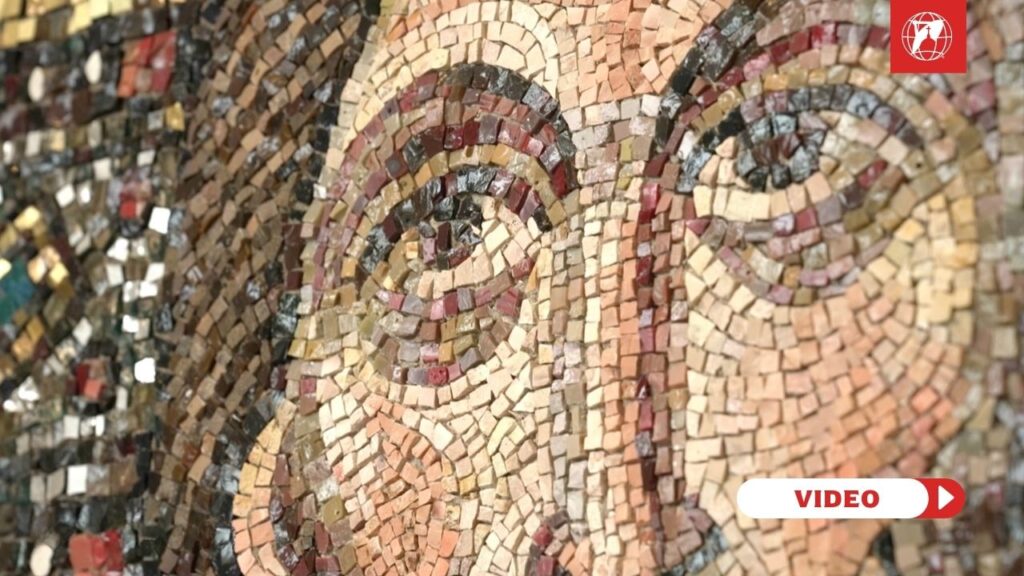
The first year focuses on Roman mosaics, introducing students to the careful placement of tesserae—the small pieces of stone, marble, or glass that form each image—and the artistic traditions that shaped the early Christian world.
Inspired by Aquileia
A major source of inspiration for students is nearby Aquileia, one of the Roman Empire’s most important cities and home to one of Christianity’s most remarkable mosaic floors.
“If we were to go to Aquileia today, what would leave the greatest impression on us?” Lovison asked.
“A basilica — a basilica with a magnificent floor.”
The mosaics there are more than decoration.
“But what does that floor tell us?” he continued.
“It tells a story: the story of Sacred Scripture.”
For this reason, Aquileia remains one of the school’s principal artistic references, alongside Roman mosaics found throughout Europe, Rome, and North Africa.
“They all belong to the same Roman tradition,” Lovison said.
A global legacy
The influence of the Mosaic School of Friuli extends far beyond Italy.
Its artists have contributed to projects across the world, including the Library of Congress in Washington, D.C., the dome of the Church of the Holy Sepulchre in Jerusalem, the Ground Zero subway station in New York, and the monumental mosaics of Rome’s Foro Italico.
Each year, students from numerous countries come to Spilimbergo to learn techniques that have been passed down through generations.
“This year, in the 2025–2026 academic year, we have students from 15 different nationalities,” Lovison said.
Despite its international character, the school remains deeply rooted in its Italian heritage.
“Italian is spoken here,” he explained, “which is also a way of preserving and passing on our traditions.”
Students not only learn the ancient craft but often choose to remain in Friuli after graduation, where many of the world’s largest mosaic commissions continue to be created.
More than a century after its founding, the Mosaic School of Friuli continues to ensure that one of Christianity’s oldest artistic traditions remains alive—one tessera at a time.
Adapted by Jacob Stein. Special thanks & Credits to The Friuli Mosaicists School of Spilimbergo.