The pope urged Catholics to rediscover prayer “in its true form” and embrace the Liturgy of the Hours as a daily school of Christian prayer.
Pope Leo XIV lamented Wednesday that prayer is no longer being passed on in many Christian families and urged the faithful to rediscover it as a fundamental dimension of human life.
“In our time, in contexts dominated by an efficiency-driven and consumerist mindset, prayer may seem pointless and trivial,” the pope said during his Aug. 5 general audience.
“In a world where science and technology claim to provide all the answers, praying may appear to be a form of escapism,” he continued.
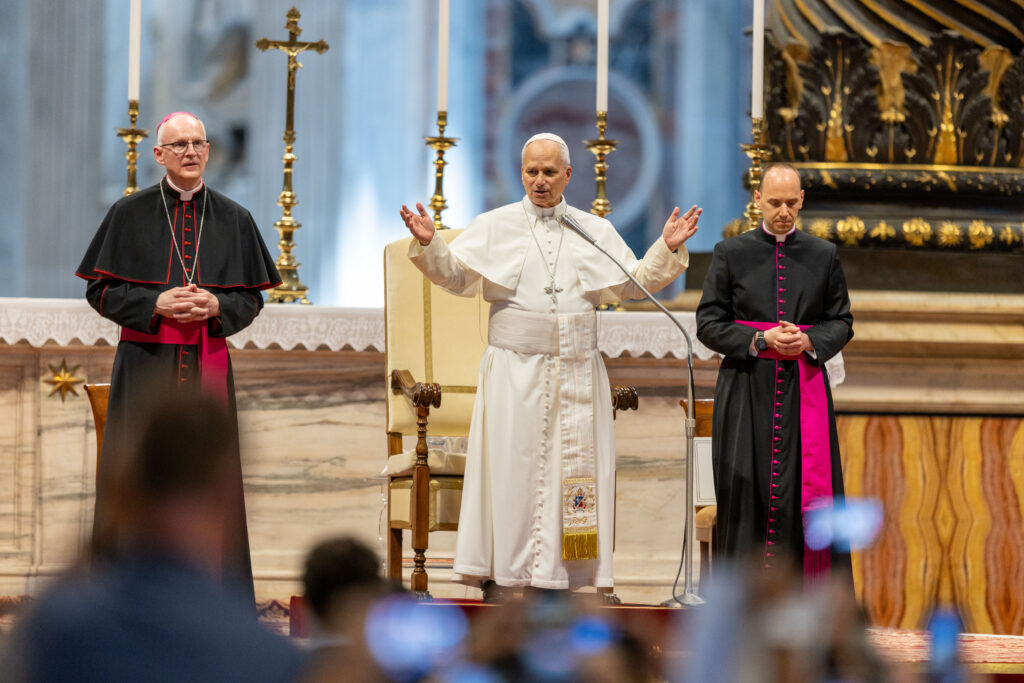
Leo resumed his weekly public audience after suspending most of his official schedule during the traditional July summer break. Because of Rome’s high summer temperatures, the audience was held inside St. Peter’s Basilica.
Continuing his catechetical series on the Second Vatican Council, the pope focused on the ecclesial dimension of liturgical prayer as presented in the conciliar constitution Sacrosanctum Concilium.
He warned that prayer is increasingly misunderstood, including within Christian homes.
“Furthermore, even in many Christian families, the tradition of prayer is no longer passed on, whilst many people risk confusing it with just another technique, of a psychological nature aimed at personal well-being,” he said.
“Prayer, however, as a fundamental dimension of our humanity, is worth rediscovering in its true form.”
Leo said Sacrosanctum Concilium took this need seriously. He recalled the words of St. Paul VI when the constitution became the first document promulgated by the Second Vatican Council on Dec. 4, 1963.
“God comes first; prayer is our primary duty; the liturgy is the primary source of the divine life communicated to us, the primary school of our spiritual life,” Paul VI said at the time.
Leo explained that the word “prayer” in the constitution refers to the liturgy as a whole. This understanding, he said, proved decisive in guiding the liturgical reform and placing the active participation of the faithful at its center.
“The liturgy is presented first and foremost as the place of encounter, of God’s initiative in drawing near to humanity in his Son, ‘the Word made flesh, anointed by the Holy Spirit,’” the pope said.
The faithful respond “through Christ, with Christ and in Christ, in the unity of the Holy Spirit,” he continued, through “the very prayer which Christ himself, together with his body, addresses to the Father.”
The importance of the Liturgy of the Hours
Leo recalled Paul VI’s desire that the Liturgy of the Hours — the Church’s daily public prayer, which is inseparable from the Eucharist — would permeate, enliven, and guide all Christian prayer.
“For this desire to be fulfilled, the Liturgy of the Hours needs to be more fully embraced and lived out in the daily lives of the baptized and of the communities,” Leo said.
The pope described the Eucharist and the Liturgy of the Hours as “the breath of the life of the Church,” through which the Holy Spirit circulates throughout the body of Christ.
He said the Liturgy of the Hours sanctifies the different moments of ordinary life.
“Bound to the Eucharist, whose light it prolongs, the Liturgy of the Hours sanctifies the time of our daily lives: In the morning, we begin the day with faith and gratitude; at midday, we ask for the strength to remain faithful amidst our labors; in the evening, once our work is done, vespers accompany the moment of sunset; at night, we fall asleep entrusting ourselves to God’s peace,” he said.
“Each hour is an act of hope: During our earthly pilgrimage, we keep watch, awaiting with the whole Church the glorious return of the Lord.”
The Liturgy of the Hours can also serve as a practical school for those learning how to pray, the pope said, particularly people preparing to enter the Catholic Church.
“To the many people who wish to learn to pray, especially catechumens, it can offer the path and the school of Christian prayer,” he said.
This story was first published by ACI Prensa, the Spanish-language sister service of EWTN News. It has been translated and adapted by EWTN News English.