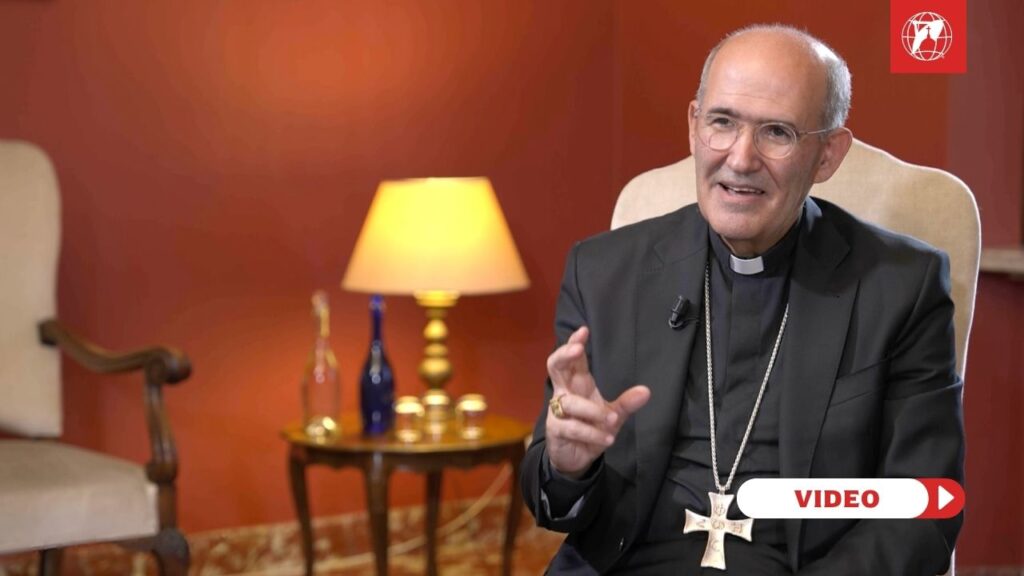
Why does the Catholic Church need contemporary art? Speaking with EWTN Vatican at the Venice Biennale, Cardinal José Tolentino de Mendonça reflected on the Church’s dialogue with artists, the inspiration of St. Hildegard of Bingen and the power of beauty to “heal the wounds of the heart.”
Your Eminence, thank you so much for your availability. What does it mean for the Holy See itself to take part in an event as global, historic, and international as the Biennale?
I think the Biennale is a great antenna, a kind of seismograph, a great observatory that lets us understand the movements of the contemporary human heart, its searches, its great questions, what is being felt and seen in so many parts of the world, and how an international Biennale with more than 100 countries present can be an opportunity to listen to the world. For the Church, it is very important to be present in this exercise, one of listening but also of speaking out. The Church has a great responsibility, and for that reason it cannot be absent from a place that is such a great showcase of international art as Venice is at this moment.
When we talk about the Biennale, we’re obviously talking about art, about contemporary art. In your view, what can the Church learn from contemporary artists?
Pope Paul VI, who was the founder of the collection of modern and contemporary art at the Vatican Museums, said of artists when he inaugurated it: the Church needs you to translate the mystery. So the Church is the custodian of the deposit of faith, of the kerygma, but in order to translate the mystery of God into a language, visual, musical, emotional, conceptual that can today reach the tension and the searching of the women and men of our time, artists are certainly allies, because they have the new words, the new images that make the mystery tangible and near.
Speaking of the Holy See’s two pavilions, I’d like to focus for a moment on the one located near the Santa Lucia train station, which is inside the mystic Garden. It is based on a contrast namely, music and sound, but at the same time silence.
For this Biennale, the Holy See chose to bring back the spiritual and aesthetic teaching of a medieval woman who is a Doctor of the Church. Pope Benedict named her a Doctor of the Church, Saint Hildegard of Bingen. And Saint Hildegard is truly a master of the human heart, because she initiates us into silence, into welcoming silence. We offer this experience, which is first and foremost an experience of contemplating silence.
Regarding people’s reactions, experiencing the space in the garden, one of the things that struck me was the way tourists, visitors and pilgrims talked about this place — namely, that we never would have imagined the Holy See could create and offer something like this, multisensory and above all particularly original. I think this may be one of the responses you were perhaps hoping, or waiting, to hear?
I have to say that sometimes poverty helps us be creative, because the Holy See, unlike so many other countries, does not have a permanent pavilion. We don’t have a pavilion at the Biennale, and since we don’t have one, we become pilgrims in the city of Venice. That’s why, for example, in 2024 we had our pavilion in the women’s prison on the island of Giudecca. It was an incredible experience of humanity. Pope Francis went to visit. It was truly a striking, prophetic moment. And this year we asked ourselves: where will we go on pilgrimage? And we found that garden, which holds a very well-kept secret in Venice, because it’s right next to Santa Lucia station. But how many of us knew about it? This fact tells us just how much of a secret that garden was. And that’s exactly why — to help make something beautiful known. Beauty heals the wounds of the heart. We truly believe that beauty is an icon of God and can heal the heart and the wounds each of us carries inside.