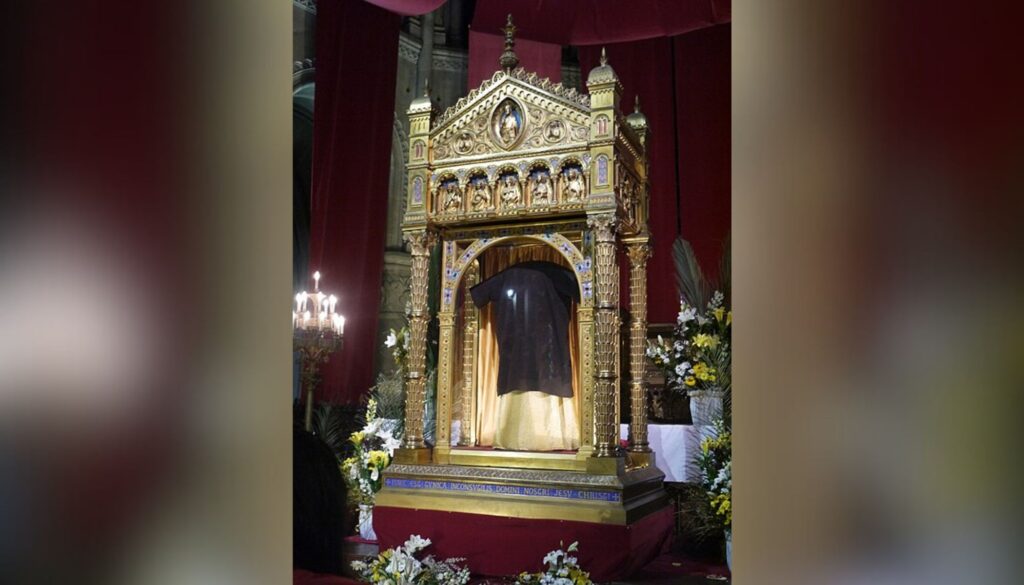
The Holy Tunic will travel almost four miles from Argenteuil, France, to the pope’s youth vigil at the Stade de France in Saint-Denis.
For the first time, a pope will witness an exposition of the Holy Tunic, the garment worn by Christ during his passion, which is preserved in the Basilica of Saint-Denis in Argenteuil, France.
The special relic is put on display during regular expositions every 50 years, as well as on extraordinary occasions — the most recent being in 2023 — but it has never before been brought before a pope.
Pope Leo XIV will be able to view it on Sept. 25, when it is displayed at the conclusion of the youth vigil at a soccer stadium in a suburb north of Paris, part of the packed schedule for his trip to France.
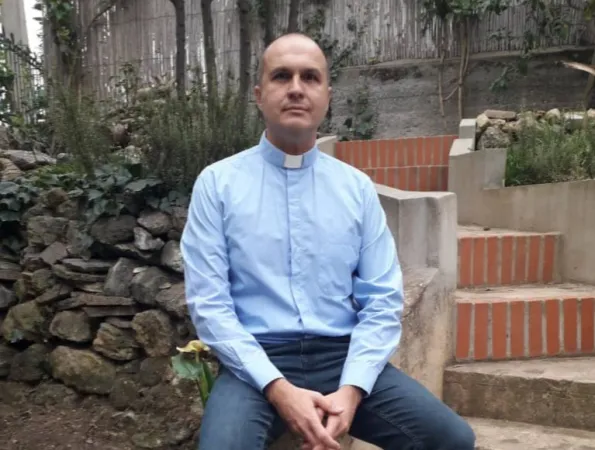
More than 80,000 French young people have registered for the prayer vigil at the Stade de France, and according to Father Guy-Emmanuel Cariot, former rector of the basilica of Argenteuil, Leo is the first pope to see the tunic since the time of St. Peter.
That may be an exaggeration, but it is true that there has never before been an extraordinary exposition of the relic during a papal journey and in the presence of a pontiff. That will happen during this trip, in part because only 3.7 miles separate the basilica of Argenteuil from the Stade de France.
The tunic will travel those nearly four miles under extremely tight security measures, made even stricter by memories of the theft of the tunic in 1983, when the relic disappeared for a couple of months. For that reason, the route the tunic will take is being kept confidential. It is known, however, that there will be surveillance both on the ground and from above to ensure that the transfer takes place discreetly and under optimal security conditions.
The tunic has been kept in Argenteuil for more than 1,200 years and is one of several relics of Christ’s passion preserved in France. The Crown of Thorns is kept at Notre-Dame Cathedral in Paris, while the Holy Headcloth of Jesus is preserved in Cahors.
As for the Holy Tunic itself, it was mentioned in Gregory of Tours’ sixth-century work “Liber in Gloria Martyrum Beatorum” (“The Glory of the Martyrs and the Blessed”). The book notes that Jesus’ seamless tunic was kept in Galata, in a church dedicated to the holy archangels, about 120 miles from Constantinople. The seventh-century “Chronicle of Fredegar,” however, locates the tunic in Zafad, not far from Jerusalem.
The tunic later came into the possession of the Byzantine Empress Irene, who gave it to Charlemagne in the year 800 on the occasion of his coronation as the first emperor of the Holy Roman Empire. Charlemagne in turn donated it to the monastery of Argenteuil, whose abbess was his daughter Theodrada. The “Charta Hugonis” of 1156 notes that the tunic had long been kept in the basilica of Argenteuil.
Over the centuries, the tunic was hidden to protect it from the Normans and later from the Huguenots. During the French Revolution, in order to save it from anticlerical persecution, Father Ozot, pastor of Argenteuil, had it cut into pieces and hidden. It was eventually reassembled, although some portions were lost.
Other pieces of the tunic are preserved elsewhere. One example is the so-called “Tunic of Trier” in Germany, which has appeared in historical records since 1072 and is believed to be one of the relics brought back from the Holy Land by St. Helena. However, scholars have been unable to determine its origin and age because of its poor state of preservation and the extensive repairs it has undergone over the centuries.
This story was first published by ACI Stampa, the Italian-language sister service of EWTN News. It has been translated and adapted by EWTN News English.