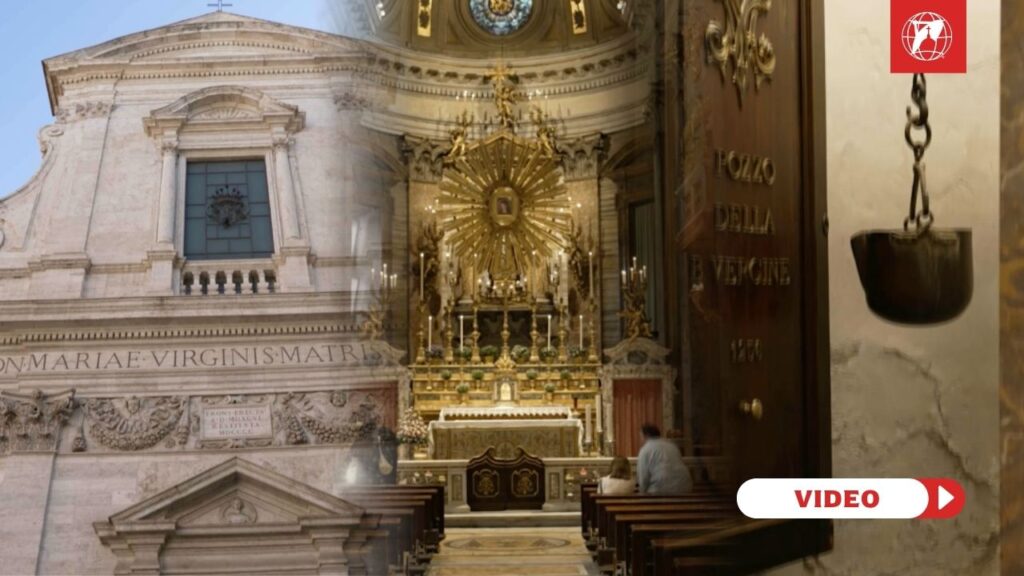
ROME — Just a few steps from the crowds surrounding the Trevi Fountain lies one of Rome’s lesser-known Marian treasures — a church where pilgrims have come for centuries to drink from a well associated with a remarkable miracle.
The Church of Santa Maria in Via is home to the venerated image of Our Lady of the Well and a devotion dating back to 1256.
Today, Romans sometimes call the church the “Little Lourdes of Rome.”
But unlike Lourdes, where the Virgin Mary appeared to St. Bernadette Soubirous in 1858, the story of Santa Maria in Via begins with a stone image, a well and water that inexplicably began to rise.
The miracle of 1256
According to tradition, the site once contained a stable belonging to Cardinal Pietro Capocci.
“One night, probably because of a somewhat distracted servant, the image you see fell into the well,” Father Moreno Versolato, rector of Santa Maria in Via, told EWTN.
The image was made of stone and should have sunk. Instead, it floated.
“The miracle consists precisely in the fact that, although it was made of stone, a heavy material, it did not sink,” Versolato explained.
As water continued to rise from the well, attempts were made to retrieve the image, but no one succeeded.
Only when Cardinal Capocci himself took hold of it could the image be removed. According to the tradition, the water then stopped flowing.
The event gave rise to a devotion that has endured for nearly eight centuries.
A chapel was commissioned around the site by Cardinal Capocci and Pope Alexander IV, who personally led a procession to enthrone the image for public veneration.
Romans have been coming ever since.
The “Little Lourdes of Rome”
The connection between water, Mary and stories of healing eventually led Romans to give Santa Maria in Via an affectionate nickname.
“The Romans call this church the ‘Little Lourdes,’ and I understand why,” Versolato said.
But the rector cautions against treating the two shrines as identical.
“A great miracle took place at Lourdes, where the Virgin Mary appeared to a young girl. Here, the miracle is different: it is a miracle connected with water.”
For Versolato, that water points toward something deeper than the extraordinary events of 1256.
“Water is essential. Water speaks to us of profound realities,” he said.
For Christians, he explained, water immediately evokes Baptism and the new life it gives. It also recalls the blood and water that flowed from the side of Christ on the Cross.
“All of these great mysteries should invite us to pause, to stop and reflect,” he said.
Pilgrims from around the world
That invitation continues to draw pilgrims centuries later.
From morning until evening, seven days a week, people enter the church to pray before Our Lady of the Well and drink from the water associated with the ancient miracle.
Some come from across Rome. Others travel thousands of miles.
“We have testimonies from all over the world,” Versolato said.
He recalled a recent group from Australia that celebrated Mass at the church, as well as pilgrims from Colombia.
The Jubilee Year brought particularly large numbers of visitors, he said, but the pilgrimages have continued.
Many pilgrims do not drink the water only for themselves. Some fill bottles to bring to sick relatives and friends or to people unable to make the journey to Rome.
And over the years, the church has received many stories of prayers answered.
“People come here to give thanks,” Versolato said.
Some return after the birth of a child they had waited years to welcome. Others give thanks following successful medical procedures, including operations on their eyes.
These testimonies form part of a centuries-old tradition surrounding the shrine, where pilgrims entrust their intentions to the intercession of the Blessed Virgin Mary.
“The greatest miracle of all”
For the rector of Santa Maria in Via, however, physical healing is not the most important grace associated with the shrine.
Again and again, he encounters people whose visit to the church has led them back to their Catholic faith.
“Very often, people tell us that they have rediscovered their faith after entering this church, stopping to pray, and asking Our Lady for a grace,” Versolato said.
Some begin practicing their faith again and return to life within the Church community.
For Versolato, that transformation surpasses even the stories of physical healing associated with the well.
“They have found their faith again and resumed their journey of faith within the Church community,” he said. “This is the greatest miracle of all.”
Nearly 770 years after the events of 1256, the devotion continues in the heart of Rome.
Tourists stream past on their way to the Trevi Fountain, often unaware that only a short walk away, pilgrims are descending into a small chapel, drinking from an ancient well and continuing a Roman tradition that has endured for centuries.
Adapted by Jacob Stein. Produced by Bénédicte Cedergren; Camera by Alberto Basile; Video Edited by Giada D’Ottavi.