Cardinal Domenico Bartolucci was known as the musician of the Popes, the musician of the Saints. A priest, distinguished composer, and musician, Cardinal Bartolucci served as Music Director of the Pontifical Sistine Chapel for over 40 years. He is the author of an extraordinary body of work, published in over 40 volumes, and knew many Popes. The Bartolucci Foundation, based in Rome, keeps alive the artistic and spiritual genius of the great Maestro and Cardinal, who passed away in 2013. Veronica Giacometti, EWTN Vatican journalist, met with Alessandro Biciocchi, Secretary General of the Foundation.
Dr. Biciocchi, the Bartolucci Foundation is committed to keeping Cardinal Domenico Bartolucci’s artistic legacy alive. Could you tell us a little about the life and work of this great composer, and how the Foundation carries his legacy forward today?
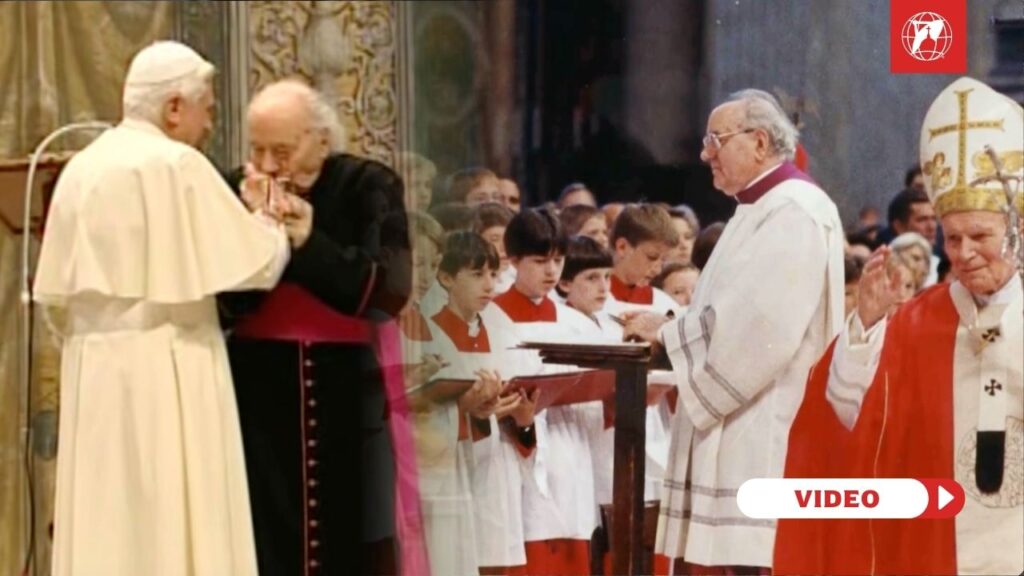
Well, trying to condense Domenico Bartolucci into a single interview is quite a challenge. I first met him when I was a boy chorister in the Sistine Chapel, during my final years of elementary school and then in middle school, when I was a member of the choir. Of course, it is his work as a musician for which he is best known internationally. Originally from Florence, he served as maestro of several of Rome’s most important basilicas. His superiors recognized his remarkable musical talent while he was studying in the seminary and sent him to Rome to further his education in sacred music. In a short time, he became choirmaster at the Basilica of Saint John Lateran, then at Saint Mary Major. In 1952, while still very young, Pope Pius XII appointed him assistant director of the Sistine Chapel Choir alongside Lorenzo Perosi. After Perosi’s death, Bartolucci became director of the Sistine Chapel Choir himself. At just 39 years old, he was appointed Perpetual Director of the Sistine Chapel Choir, a role from which he dedicated his life to the service of sacred music.
Cardinal Bartolucci dedicated more than forty years of his life to the Pontifical Sistine Chapel Choir. Why was he so committed to passing on the Roman polyphonic tradition to new generations?
You see, sacred music lives on through inheritance. Sacred music has its origins in Gregorian chant and polyphony, these two great pillars that the Church still recognizes as the primary sources to draw upon for liturgical celebration. And so, clearly, the past is not optional; the past is our roots, and Bartolucci was particularly attentive to this, perhaps more than others.
In 2004, [the foundation] founded its choir. How does the choir continue to carry this sacred music tradition beyond Italy’s boarders?
Yes, the choir was founded at a time when the Maestro had retired from his work as a musician and as Director of the Sistine Chapel Choir. But since he was still in the fullness of his years, he did not want, so to speak, to leave behind what had been his life’s work. So we reconstituted this choir, which is a professional ensemble made up of musicians, many of whom come from Rome’s principal musical institutions, including those of the Vatican. With it, we devote ourselves to the same repertoire that the Maestro wanted to see disseminated. Today, we have chosen not only to perform the polyphonic music of the Roman Renaissance tradition, but also to give significant space to Bartolucci’s own compositions. Since the Foundation is dedicated to him, we believe that his repertoire should be made accessible not only in Italy, but internationally as well.
Your foundation’s mission is to evangelize through music. In what way can music bring the faithful closer to God?
I believe this is part of the Church’s teaching. The Church has always sought to draw upon the benefits of every art in the work of evangelization, and music is certainly one of them. It is no coincidence that the liturgy has always been accompanied by song. Likewise, Bartolucci himself insisted that music should be given ample space within the liturgy. He used to say that if Michelangelo had been given only a postage stamp on which to paint the Last Judgment, we would have only a tiny fragment to contemplate and admire. Instead, he was given vast surfaces and immense spaces on which to create. In the same way, Bartolucci argued that music should be given that same breadth and prominence within the celebration of the liturgy.
Produced by Bénédicte Cedergren; Camera by Alberto Basile, Fabio Gonnella; Video Edited by Giada D’Ottavi.