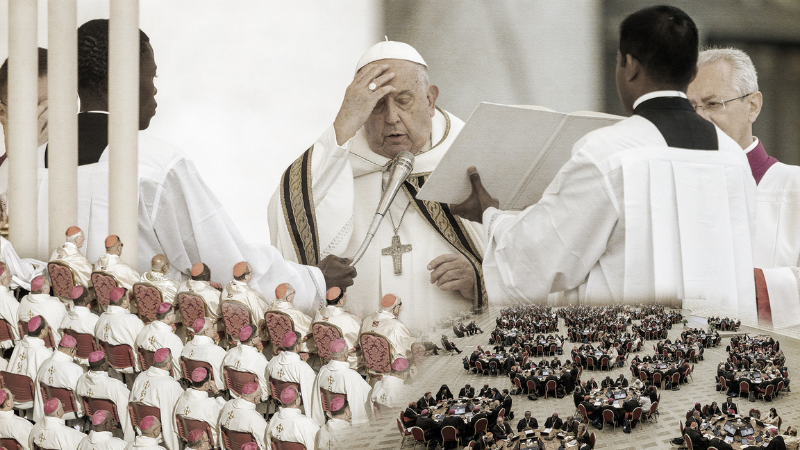
In the aftermath of the second part of the Synod on Synodality, Andreas Thonhauser, EWTN Vatican Bureau Chief, sat down with Cardinal Mario Grech, Secretary General of the Synod of Bishops, to discuss the Synod’s key outcomes and its impact on the Church’s mission.
Andreas Thonhauser, EWTN Vatican Bureau Chief:
Your Eminence, what are your takeaways of the Synod on Synodality?
Cardinal Mario Grech, Secretary General of the Synod of Bishops:
I feel a sense of deep gratitude, appreciation, and hope. The aim of this Synod is very similar to the mission of your station—you are committed to sharing the Eternal Word and the aim of this assembly was and is mission. Evangelization. But to fulfill this mission, we need to be more Church. And this Synod was in view of mission evangelization, a reflection on who is the Church, who are we as a Church. And I think that the people of God, all the baptized, must realize that they have received the Holy Spirit that empowers them to be prophetic in the world today. Otherwise, we will miss a great opportunity.
Andreas Thonhauser, EWTN Vatican Bureau Chief:
In a nutshell, how would you describe the Church post-Synod?
Cardinal Mario Grech, Secretary General of the Synod of Bishops:
This Synod helps us to understand ourselves and to recognize our identity founded on baptism—that the Church is the people, holy people of God. And when I say we are the holy people of God, there are three important dimensions: the communio fidelium, communion of the faithful, the communio ecclesiale, all the particular Churches together, and the communion episcoporum, because the Bishop is the principle that guarantees unity and truth in the Church. If these three dimensions work together, then yes, I think we made a significant step forward, considering the teachings of Lumen Gentium from Vatican II.
Andreas Thonhauser, EWTN Vatican Bureau Chief:
So, would you say also that the goals that were set by your office and I would imagine also by Pope Francis and others for the Synod, that those were achieved and what were the biggest achievements?
Cardinal Mario Grech, Secretary General of the Synod of Bishops:
We had one simple goal. I mean the trust of the Synod was, “how to become more synodal church.” Communion, participation and mission. But then there were no other agendas. So, throughout the process we learned to walk together.
Andreas Thonhauser, EWTN Vatican Bureau Chief:
Were you surprised that Pope Francis did not give his own exhortation after the Synod, but accepted the final document, the summaries, into Church teaching as Church teaching?
Cardinal Mario Grech, Secretary General of the Synod of Bishops:
In a way, yes, I was surprised because this is the first in the history of the Synod of Bishops that the Holy Father at the end says, listen, I sign this document. I make my own this document. But at the same time, I saw it coming. The Holy Father believes in this. Believes in the sensus fidelium. And what he did when he decided to approve to make his own this document proves that he believes in the authority of the Synodal Assembly.
Andreas Thonhauser, EWTN Vatican Bureau Chief:
Your Eminence. Thank you very much.
Cardinal Mario Grech, Secretary General of the Synod of Bishops:
Thank you.
Adapted by Jacob Stein